Recently, this blog reported the not very widely known or reported fact that the contribution of wind decreased last year by 6% despite building 20% more wind farms. This was because the capacity factor (actual output / maximum output) dropped to 27% in 2016. Or another way of saying this is that there was less wind blowing last year.
At the same time, the PSO Levy, which pays wind farms the difference between the subsidized price and wholesale price, increased last year by 20% (some of that going to peat). This is a bit of a paradox - wind farm installations increased by 20% but total wind output dropped by 6%, yet the subsidy for wind increased by 20%.
If a farmer cut his herd or crop by 6%, would he receive more subsidies ?
The answer is that the Energy Regulator estimates the PSO Levy a year in advance. For 2016, the wholesale price dropped much more than was estimated and so the PSO Levy had to increase to compensate for this large drop in market prices (called the R-factor).
Another paradox is that the PSO is also paid to higher emitting peat generation at the same time as wind generation. So some, if not all, the CO2 savings from wind have been cancelled out by the use of peat generation instead of gas. PSO payments to peat are due to be phased out by 2019.
Showing posts with label subsidies. Show all posts
Showing posts with label subsidies. Show all posts
Sunday, 10 December 2017

Friday, 10 November 2017
The New Renewable Electricity Support Scheme
The consultation for the forthcoming Renewable Electricity Support Scheme (RESS) ends today. Here is my submission :
A Floating Feed in Premium (FIP) which reduces over time to nil as the generators borrowings are paid down should be the primary financial support mechanism for the main RESS. This makes a lot of sense with regard to Irish wind energy which is now a mature technology, where there are no fuel costs and where Irish wind farms have access to the best wind resources in Europe.
I believe that LCOE is not a good measure for comparing different sources of generation. As is well known, the system effects of uncontrollable variable renewables are not adequately addressed by LCOE, since adding uncontrollable variable renewables to a system increases overall costs (new grid and operating procedures, suboptimal operation of the conventional fleet and new fast acting plant required as back up), all of which tends to reduce system productivity thus increasing costs. LCOE doesn’t capture this, so a Total System Cost analysis is required to discover what the probable effect would be on the consumer. This does not appear to have been carried out.
I therefore do not agree with the statement that “the least-cost RES-e mix would consist of mostly onshore wind”.
Indeed, the system costs will rise exponentially with the higher levels of wind proposed in RESS as conventional plant will be forced to run at far below their optimal efficiency*.
This means that the viability gaps of various renewable technologies are not comparable as stated in the RESS report. Some technologies incur less system costs (like biomass which can use the existing grid), some incur more.
In an analysis carried out by Irish Energy Blog, it was found that even without including the additional grid investment required for wind and other system costs, we have to spend € 1.00 on wind energy to replace 40 cents worth of fossil fuels. This does not represent value for money to the consumer nor is it a cost effective way of reducing fossil fuel imports. I would support instead investing in energy efficiency and in particular Passive Housing as a more cost effective way of reducing emissions.
Best wind location in Europe
“Ireland has one of the best onshore wind locations in Europe. Purely from a technical perspective, ignoring all other considerations, the unrestricted technical potential for onshore wind would be more than sufficient to meet Ireland’s energy needs”.
I fail to understand why, if the above statement is true, Irish onshore wind requires a high support scheme. Surely if Ireland has one of the best onshore wind locations in Europe, then a lower support scheme would be required than other European countries as the resource is greater.
In Germany, onshore wind receives € 4.66cent – 8.38cent per kWh (according to duration of payment) (§ 46 EEG 2017) minus €0.40 cent per kWh (§ 53 no. 2 EEG 2017) compared with € 6.72 cent per kWh (5.1 and 5.2 REFIT 2) in Ireland. The support scheme in Germany reduces over time which makes sense as the wind farms loans are paid down over the same period. A similar “reducing” scheme should now be adopted by Ireland given that Irish onshore wind is a mature technology and has access to the best wind resources in Europe. This would provide best value for money to the consumer. The support scheme should eventually reduce to nil after a fixed period of say 10 years.
This would ensure that our society is not locked into high energy costs for many years to come.
*Increased costs of combined cycle gas turbines (CCGT) running inefficiently to provide back up for when the wind does not blow were estimated to rise by €175 million per annum according to a 2014 Single Electricity Market report.
*Increased costs of combined cycle gas turbines (CCGT) running inefficiently to provide back up for when the wind does not blow were estimated to rise by €175 million per annum according to a 2014 Single Electricity Market report.
Monday, 27 February 2017
Why does Wind Energy still require a subsidy ?
In 2015, wind generation accounted for 22.8% of the electricity generated and was the second largest source of electricity generation after natural gas - SEAI.
The SEAI have reported that wind was the second largest source of electricity generation and ahead of coal power for the first time in 2015.
This means it is now providing a considerable amount of power in a given year. Neither gas or coal power receive a subsidy. Instead they receive the market price.
Coal produced the same amount of power in 2014 as wind did in 2015 (22%) but without a subsidy.
Tuesday, 9 August 2016
Rise in PSO Levy Angers Irish Industry
It appears that reality is beginning to bite at The Irish Times in view of the many large industries (some of the biggest employers in the country) complaining about the rise in PSO Levy to fund more wind farms.
Full Article Here.
In a submission to the CER before it arrived at its final decision, tech giant Microsoft, which employs 1,200 people in the Republic, said this penalises large energy users who are holding energy capacity in reserve to meet anticipated growth.
The multinational also points out that the rate at which the PSO has increased over the last five years represents a “rate shock” for large energy users and “puts the Ireland energy market at a disadvantage”. In a similar vein, Irish food and ingredients giant, Kerry, which employs 4,000 people here, warns that the charge will damage its competitiveness.Irish Energy Blog has been warning about this for years now, but the warnings have fallen on deaf ears. The Irish Times have been calling for more renewable energy for a long time now and have allowed the wind industry to spread their propaganda far and wide. To be fair, they were not the only ones.
The only journalist that is going to come out well of this is Colm McCarthy. Of course, there will be no accountability for what will happen in the next few years. An exodus of large companies coupled with a hit from any prolonged Brexit negotiations will see us well back in recession and rising unemployment once again. At a time of record low oil and gas prices.
Will we ever learn....
Wednesday, 24 February 2016
Does Ireland have Low Cost Renewables ?
A recent report by the Council of European Energy Regulators (CEER) has been rolled out lately by the Department of Energy as evidence that their policy of more and more wind energy is a low cost one. According to the report, Ireland has a renewable support of € 2.03 compared to the EU average of € 13.68. Sounds pretty good, right ?
Well, once again, the data refers to the year 2012, just like the SEAI report that is also rolled out by wind energy proponents. Somewhere around 600-700MW of wind has been added since then. The report also looks at 2013 but curiously there is no data for Ireland for this year.
So why is 2012 chosen and not any of the subsequent years ? Well, the wholesale price of electricity was high in this year. Why is this relevant ? The higher the wholesale price, the lower the renewable subsidy required and vice versa. The level of support was calculated by subtracting the REFIT (or subsidized) price from the wholesale price for 2012 :
In the case of FITs [Feed-in-Tariffs], the level of support was estimated by subtracting the average wholesale electricityprice from the overall tariff and therefore is not the same as the full FIT granted to producers.
CEER used a wholesale price of € 63.20 for 2012 (click on graph to show wholesale price) :

But if we look at a recent day, the wholesale price is now between € 20 and € 40 :

The Energy Regulator (CER) calculates the annual cost of renewable supports each year, taking into account the wholesale prices and the installed capacity of renewable generators. This is then used to calculate the PSO Levy to be applied to energy bills. Back in 2012, the PSO Levy was still in it's infancy with a total cost relating to renewable energy (mainly wind) of just € 37 million.
But by 2016, the CER had calculated total renewable supports (again mainly wind) of € 181 million, almost five times the cost for 2012. The CER cite lower wholesale prices, lower capacity payments and more renewables, mostly wind, as the drivers in the increase.
Demand is now around 26,500 GWh so if we work out renewables support per unit of electricity consumed we now get € 6.83 for 2016, over three times the cost for 2012 that CEER have calculated.
Evidently, this is only the direct cost of renewables like wind. There are other, mostly hidden, system costs that are subsidized by consumers. The CEER report acknowledged this point in relation to the grid costs in Ireland :
In addition, in Ireland, the generator pays 100% of the construction of the Least Cost Connection physical connection to the transmission system i.e. the shallow connection works. Any deep reinforcements required to facilitate the connections are not charged to the generator.
We can throw in another € 4 billion plus for that.
When Ireland goes offshore, the experience in other EU countries tells us that it will require a higher subsidy that onshore wind, so the cost of renewables will rise further again. In 2012, many other EU countries had offshore wind whereas Ireland did not.
It is also interesting to note that certain EU countries like Poland, Belgium and Sweden never introduced tariffs or subsidies for renewables, instead opting for Green Certificates. Are we really comparing like with like here ?
Lastly, have a look at pages 57-67 of the CEER report. Spain, Portugal, Greece and Ireland all opted for exclusively feed in tariffs supports. Italy used a mix of supports including FITs. Then if we add the total cost we get Spain € 6 billion, Portugal € 700 million, Greece € 1.1 billion and Italy € 9.5 billion. The PIIGS countries spent over € 17 billion on renewables supports in 2012, at a time when their banks and economies were going down the drain. Most of these countries are still in financial distress.
Were the likes of Sweden, Romania, Poland and Belgium craftier when they opted for Green Certificates rather than fixed subsidies like Ireland and Greece ? I can't really say for sure, but I have a hunch that they were.
References :
CEER Status Review of Renewable and Energy Efficiency Support Schemes in Europe in 2012 and 2013 (January 2015)
PSO Levy Paper for year ending 30th September 2012 - see page 19, cost of REFIT and AER schemes.
PSO Levy Paper for year ending 30th September 2016 - see page 4.
Friday, 13 November 2015
ESB call on energy regulator to cap subsidies to wind
Electric Ireland welcomes the proposed reduction in the overall PSO levy for 2015/16 period of c. 9% compared to the current period and notes the positive impact this will have on all electricity customers. However the proposed PSO levy of €304.8m will continue to be a significant burden for all electricity customers and adds considerably to the overall price of electricity.
Electric Ireland also notes that over 50% of the proposed PSO levy (€173.9m) relates to Renewables and suggests that every effort be made in future years to cap, and ideally reduce, this amount. The wind market in Ireland is at this point a mature and well established market and we believe it does not warrant any further subsidy beyond current commitments. The hardpressed energy customer cannot sustain further subsidisation through the PSO and we would urge policy makers to ensure no additional subsidies are created beyond existing PSO commitments.
It is difficult to see how the Government can justify increases to subsidies to wind generators, although Energy Minister Alex White seems committed to fulfilling every wish of the wind industry.
Sunday, 8 November 2015
The Modern Economics of Electricity Generation - UK, A Case Study
Hundreds of millions of pounds worth of subsidies will be handed to highly polluting diesel-fuelled electricity generators, under plans to preventpower shortages over the next few years.Companies have registered to provide 4,000 megawatts of standby power under a government auction scheme designed to help the UK cope with the intermittent nature of wind and solar energy - The Times, November 2015.
In an article written by Irish Energy Blog last June, it was stated that: (The economics of electricity generation)
So now, we enter into a new era of electricity generation economics where subsidies are required to maintain all generators, not just the renewables.
This is precisely what is now happening in the UK. Due to the fact that they have invested heavily in non dispatchable renewable generation, they are facing a shortage in dispatchable generation - that is, generation available on demand. The quickest solution to this problem is to use diesel generators. But these diesel generators will be running intermittently and would not be economically viable. So the UK National Grid will pay subsidies to diesel generator owners to maintain their capacity available on standby.
A similar situation is happening in Ireland where DSUs (demand side units) get paid capacity payments. There is now 160MW of these diesel generators in Ireland.
Friday, 16 October 2015
Irish Academy of Engineering call for wind farms to pay for associated grid and system costs
The Academy of Engineering recommends that the new renewable support scheme for wind
generation should :
- Reset REFIT reference prices for new developments, undertaken post 2015, to the levels originally set for 2004, to reflect the fall in materials and financing costs
- Remove CPI indexation from those technologies which are essentially fixed cost, in the case of new developments
- Remove the Balancing Price paid to suppliers of renewable generation, as there is now no justification for such a payment, particularly following the completion of the EastWest Interconnector
- Remove access to system marginal prices, when those are higher than REFIT provisions, in the case of both existing and new developments, as payments in this case are both unjustified and are likely to increase significantly, as wind penetration increases. It is inappropriate that wind generators benefit from the system problems caused by increasing wind farm penetration.
- Require that new renewable electricity developments contribute to the full cost of associated network reinforcements, in proportion to the share of additional capacity required for their development. This will help concentrate development in areas with existing network capacity and thus minimise the requirement for highly controversial new overhead lines.
- Given that Ireland has substantially more onshore wind generation potential than can ever be exploited there is in Ireland’s case no justification for introducing a separate and higher pricing regime for offshore wind. Thus the Academy supports the present position of not differentiating between onshore and offshore wind.
Monday, 29 June 2015
The economics of electricity generation
The general definition of economic sustainability is the ability of an economy to support a defined level of economic production indefinitely - Thwink.org
Able to be maintained at a certain rate or level e.g. "sustainable economic growth" - Definition of Sustainability, Oxford English Dictionary
Traditionally, when you wanted to build a new gas plant, you obtained a bank loan on the basis that the output and hence income of the plant could be determined in advance and was at a price linked to the wholesale cost of gas. There would be a certain amount of downtime for maintenance but your plant would be running for most of the year. This meant that the bank was satisfied that you could meet your repayments.
Total generation capacity in the country was linked to demand for electricity in the economy with some spare capacity for reserve. This meant that the cost of your electricity bill was pretty much directly linked to the amount of electricity you consumed with a few added extras to keep the system running and of course, profitable.
During the last decade, with the advent of intermittent renewables, most notably wind generation, both of the above sound economic principles began to be unwound.
Wind generation requires a subsidy because the output of wind is uncertain and therefore banks would be wary of funding such intermittent generation. The wind might blow, then again it might not. If your 20MW wind farm is only generating at half output i.e. 10MW, the subsidy you receive in effect brings your output up to 16MW (10MW multiplied by € 80 / €50 ). In otherwards you would only have received 10MW * €50 = € 500 MWh but instead you will receive 10MW * 80 =
€ 800MWh. Now the bank will be much happier.
€ 800MWh. Now the bank will be much happier.
If we now go back to our gas plant that has received bank funding, its output is starting to become more uncertain as intermittent wind is pushed onto the grid. Therefore, its income which was once fairly regular becomes staggered and less certain. Now, the banks will become worried, how certain are the loan repayments ?
So once we introduce alot of intermittent generation such as wind and solar into the system, all forms of generation, which were once dispatchable and reliable, become intermittent. This means that some form of subsidy needs to be introduced for the gas plant either in the form of a REFIT style subsidy on the market price or a capacity payment to ensure the plant remains financially viable throughout periods of high wind and solar penetration. So now, we enter into a new era of electricity generation economics where subsidies are required to maintain all generators, not just the renewables. We reach a stage where the gap between supply and demand is so large that there is simply not enough peanuts to go around for everybody and so subsidies are required for all. This differs from the heavily subsidized farming industry because demand for farming products is always equal to or above supply.
This situation that we then have is the exact opposite of the free competitive electricity market we were promised by the Fianna Fail government, when in 2006 they broke up ESB's monopoly on the market and set up Eirgrid to run the national grid. The fact is that when ESB controlled the electricity market, electricity was much cheaper (and no, I don't work for them).
The housing bubble evolved in exactly the same manner - there was a huge over-supply of houses, developers required subsidies in the form of tax reliefs and cheap credit (we now know that all that cheap credit was in effect a taxpayer funded government subsidy) and there simply was not and never could have been enough demand to maintain that level of supply indefinitely.
So the question is how long will it take for the levels of over investment in the electricity market to begin to become unsustainable and the bubble bursts ? It will most likely happen when the level of electricity bills becomes so high that more and more consumers fail to pay the bills on time or at all. Disconnections will rise. Quite a large proportion of the hikes in energy bills are loaded on industry. When most of them decide to jump ship to more competitive countries, as in the case of Cadburys, we are deep trouble, not just because of the resultant job losses, but because there will be a significant hole in the funding of the electricity bubble. When holes begin to develop at the bottom of a pyramid, the whole pyramid eventually collapses.
When this happens, subsidies to generators will be slashed, loan repayments will no longer be met, and the banks will be facing another hole in their balance sheets. In effect, this means that today, the electricity generation assets on the balance sheets of banks are significantly overvalued. Their current valuation is only as good as the ability of the electricity consumer to continue funding indefinitely the ever wider gap between electricity supply and demand (and the supporting grid infrastructure required to support it).
It may turn out that because electricity is a necessity good, the bubble will continue for longer than the housing bubble. This then means that people will have less discretionary spending in direct proportion to the increasingly higher electricity bills. So there will be a period where the electricity bubble will impact other sectors in the economy, themselves already impacted by the higher bills (e.g. a designer clothes shop will be impacted twofold with less customers and higher bills).
There are alot of industries dependent on discretionary spending in Ireland and along with the water charges (water is another necessity good), the hikes in energy bills will put a squeeze on them. Cold weather will also increase the demand for coal and oil - necessity goods which are now heavily taxed. With government policy, and the majority of investment, focused almost solely on electricity generation and windmills, people have little choice when it comes to heating their homes e.g. the investments into retrofitting and energy efficiency are tiny compared to wind energy.
In this scenario, different sectors in the economy will start to feel the squeeze and we will see another recession. This will be the beginning of the bottom sections of the pyramid collapsing. On top of this will be the disappearance of large industry - another section at the bottom of the pyramid gone. The electricity bubble will have collapsed but, like the housing bubble, will have brought down alot of other industries with it.
But whatever the sequence of events - one thing economists know for certain is that an economic bubble will eventually collapse.
So once we introduce alot of intermittent generation such as wind and solar into the system, all forms of generation, which were once dispatchable and reliable, become intermittent. This means that some form of subsidy needs to be introduced for the gas plant either in the form of a REFIT style subsidy on the market price or a capacity payment to ensure the plant remains financially viable throughout periods of high wind and solar penetration. So now, we enter into a new era of electricity generation economics where subsidies are required to maintain all generators, not just the renewables. We reach a stage where the gap between supply and demand is so large that there is simply not enough peanuts to go around for everybody and so subsidies are required for all. This differs from the heavily subsidized farming industry because demand for farming products is always equal to or above supply.
This situation that we then have is the exact opposite of the free competitive electricity market we were promised by the Fianna Fail government, when in 2006 they broke up ESB's monopoly on the market and set up Eirgrid to run the national grid. The fact is that when ESB controlled the electricity market, electricity was much cheaper (and no, I don't work for them).
The housing bubble evolved in exactly the same manner - there was a huge over-supply of houses, developers required subsidies in the form of tax reliefs and cheap credit (we now know that all that cheap credit was in effect a taxpayer funded government subsidy) and there simply was not and never could have been enough demand to maintain that level of supply indefinitely.
So the question is how long will it take for the levels of over investment in the electricity market to begin to become unsustainable and the bubble bursts ? It will most likely happen when the level of electricity bills becomes so high that more and more consumers fail to pay the bills on time or at all. Disconnections will rise. Quite a large proportion of the hikes in energy bills are loaded on industry. When most of them decide to jump ship to more competitive countries, as in the case of Cadburys, we are deep trouble, not just because of the resultant job losses, but because there will be a significant hole in the funding of the electricity bubble. When holes begin to develop at the bottom of a pyramid, the whole pyramid eventually collapses.
When this happens, subsidies to generators will be slashed, loan repayments will no longer be met, and the banks will be facing another hole in their balance sheets. In effect, this means that today, the electricity generation assets on the balance sheets of banks are significantly overvalued. Their current valuation is only as good as the ability of the electricity consumer to continue funding indefinitely the ever wider gap between electricity supply and demand (and the supporting grid infrastructure required to support it).
It may turn out that because electricity is a necessity good, the bubble will continue for longer than the housing bubble. This then means that people will have less discretionary spending in direct proportion to the increasingly higher electricity bills. So there will be a period where the electricity bubble will impact other sectors in the economy, themselves already impacted by the higher bills (e.g. a designer clothes shop will be impacted twofold with less customers and higher bills).
There are alot of industries dependent on discretionary spending in Ireland and along with the water charges (water is another necessity good), the hikes in energy bills will put a squeeze on them. Cold weather will also increase the demand for coal and oil - necessity goods which are now heavily taxed. With government policy, and the majority of investment, focused almost solely on electricity generation and windmills, people have little choice when it comes to heating their homes e.g. the investments into retrofitting and energy efficiency are tiny compared to wind energy.
In this scenario, different sectors in the economy will start to feel the squeeze and we will see another recession. This will be the beginning of the bottom sections of the pyramid collapsing. On top of this will be the disappearance of large industry - another section at the bottom of the pyramid gone. The electricity bubble will have collapsed but, like the housing bubble, will have brought down alot of other industries with it.
But whatever the sequence of events - one thing economists know for certain is that an economic bubble will eventually collapse.
Saturday, 18 April 2015
Whats In Your Electricity Bill : Part 6 Conclusions
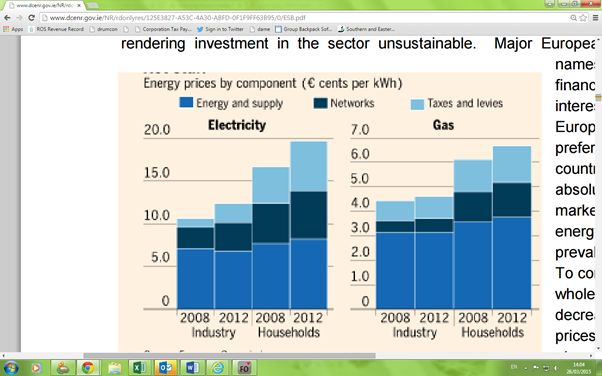 |
| Diagram 1: Energy Prices by component (Source ESB and Eurostat) |
The above diagram shows in very simple terms the factors which are driving up our bills. Energy and Supply is basically the cost of generating the electricity including wholesale costs of fuel, operation costs etc. As ESB noted, only 40% of the electricity price is subject to the competitive market; the balance is set by policy measures and regulated prices. So Energy and Supply makes up 40% and if the costs come down in the wholesale market as they have recently done then this cost comes down. The problem then lies with the 60% - Networks and Taxes and Levies. The main driver in these costs is government policy.
One of the things to note is that when wholesale costs come down, the cost of energy and supply comes down but levies goes up. This is explained in this blogpost :
http://irishenergyblog.blogspot.ie/2015/01/pso-levy-set-to-soar-this-year.html
So next time you hear about rising electricity prices been blamed on the wholesale cost of gas going up, you will know that this is only 40% of your bill, and so does not fully explain what is going on. Taxes and Levies must be increased to pay for additional wind capacity and network costs must also be increased as explained below. But the situation is even worse when wholesale costs come down, as just like in a weighing scales, taxes and levies must then increase further to make up the larger gap between the market price and subsidy price for peat and wind etc.
.png)
Network Costs
While there was always an issue in Ireland with dispersed houses and buildings, thus requiring a larger network than other countries, we can see from Diagram 1 that something else has impacted on this cost since 2008. Between 2008 and 2012 we added about 700MW of wind, driving network costs up to bring this wind energy from remote regions to where it is needed. Two new gas plants were also built in Cork but these were built nearby existing power plants which meant that minimal transmission infrastructure was required.
We can refer to Eurostat to see what has happened network costs since 2012 (click to zoom in):
 |
| Network Costs for domestic customers |
 | |
For households, the cost has gone up from € 0.0669 in 2012 to € 0.0697 in 2014. For industry,
the cost has gone up from € 0.0446 in 2012 to € 0.0455 in 2014. For industry, they have had a 47% increase since 2008. |
Taxes and Levies
For industrial consumers, taxes and levies have more than doubled since 2012. Hence, why we have industries complaining that they are been unfairly levied. For households, levies have gone up by 35% since 2012. Levies comprise the ever increasing PSO Levy which was discussed in Part 5.
 |
| Taxes and Levies for households |
 |
| Taxes and Levies for industrial customers with consumption between 2,000MWh and 20,000MWh |
 | |
|
Taxes have remained static i.e. VAT at 13.5%
Other Costs
Other costs include supplier profit and admin costs to run the electricity market. Of course, the suppliers do make good profits and engineers and staff are paid higher than most of their European counterparts. But anyone that has followed this blog, should know that it is a mistake to blame the high electricity bills coming through your door entirely on capitalism. It is socialist interventionist policies that fixes the price above a certain level.
Admin costs would have also gone up in recent years due to the increased complexity in the market with increased wind and interconnection. What has happened is that the market has now become imperfect. If everyone had perfect foresight, the system would run smoothly i.e. be "perfect". But because nobody can have this level of foresight and can only know what will happen after the fact (i.e. when the wind rushes in unexpectedly or doesn't blow at all), the system runs imperfectly and as Eirgrid point out "less optimal".
To be fair to one supplier, they are not too happy about this situation. After all, one of the benefits of wind energy and interconnection that we were sold by our politicians was that it would reduce energy costs :
Concern was raised by a respondent in which they expressed their disappointment ‘that despite growing levels of wind and recently introduced TSO incentives to reduce dispatch balancing costs, the overall charges are increasing. This increase and the fact that the supplier have no control over these increases does not bode well for consumer perception of increasing energy bills.’
And the CER Response:
The RAs expect the TSOs to continue to seek mitigation measures to reduce constraint costs for the betterment of electricity consumers.
In other words, we will keep trying to keep the costs down. Just don't expect it to happen anytime soon.....
Lower fuel costs does not mean lower bills
The year 2008 saw record prices for fossil fuels (see page 8 of this document).
The SMP is the market price paid to generators and is influenced by international gas prices. So we can see from the below that the SMP was highest in 2008 and in 2013 was lower reflecting the fact that gas prices never recovered fully since 2008. So we would expect that our electricity bills would be lower in 2013 than 2008.


But in 2013, electricity prices were higher at € 22.95 :

So despite lower fuel prices, electricity prices were higher. It was other factors apart from fuel - network costs and taxes and levies - that drove the price of electricity up.
Tuesday, 7 April 2015
Five Reasons why we have reached saturation point with wind energy
To any impartial analyst, Ireland has reached saturation point with wind energy and it should now be time to put a pause on new wind development and consider our options. No damage was ever done down through history by pausing before deciding what to do next. Think of how many billions of euros we could have saved if this was done in 2006.
- Dumping of wind power and the 50% limit on wind - recent evidence shows that during periods of high winds we have to dump more and more of available wind energy to maintain a safe secure supply of electricity. On the 30th March, at least 26% of available wind energy was dumped.
- Over capacity - We now have generation capacity equivalent to double our peak demand and three times that of our average electricity demand needs. Let's use up this excess capacity before we start building any more. No new generating units (including wind) need to be built unless they are replacing retired units.
- Baseload plant minimum load requirements - there is a requirement for 5 large generating units to be running at all times for "dynamic stability". These comprise combined cycle gas turbine plants and Moneypoint coal plant. This means they can never be completely switched off. Increasing wind penetration further will exacerbate the inefficiencies inherent in running these plant on low loads, thereby negating any additional savings due to adding more wind.
- Electricity bills are one of the highest in Europe - government policy has locked society into high electricity prices with the preference towards subsidized forms of generation meaning savings from falls in wholesale prices can never filter down to consumer's bills. Another factor is that an over supply of generation capacity results in units requiring subsidies and capacity payments to recover their high fixed costs as payments for energy generation become insufficient and staggered due to low demand and more intermittent wind on the system. There are also extra costs due to new infrastructure required to carry the wind power.
- Impacts on other sectors - The tourism and equine industries are two of the largest industries in Ireland supporting many direct and indirect jobs. Chances are if you live outside any of the main cities, your job is dependent in someway on either of these industries. Planting wind farms and associated pylons near scenic and horse breeding locations will have a negative impact on these important industries. The Irish Hotels Federation recently warned that the location of energy infrastructure should not diminish the natural beauty of the landscape because this is an important element of the Irish tourism product. Already, this impact is being felt with one castle owner recently saying "The tourists can't believe it. They said we're mad. They said we're ruining our heritage. They say it's disgusting to go around Ireland now"
Saturday, 28 March 2015
What is ESB's position on the current energy policy ?
ESB is Ireland's largest and oldest energy company. The company built Ireland's first hydro plant at Ardnacrusha in 1929, a great engineering feat at the time. They now operate 10 hydro plants around the country and play an important role in fish stock conservation. They at one time controlled and operated the National Grid which is now run by Eirgrid. However, ESB Networks still play a role in maintaining the grid and transmission infrastructure.
They own 10 thermal (or conventional) power stations from Moneypoint Coal Power station in Limerick to Poolbeg CCGT gas fired power station on Dublin Bay. They currently operate 10 wind farms in the Republic of Ireland (about 10% of the total wind power capacity in Ireland), 4 in Northern Ireland, 2 in England and 1 in Wales. Until this year, they had not installed a wind farm in the Republic since 2010 (in Co.Limerick), preferring Northern Ireland and the UK. They are, however, currently installing a 20MW wind farm overlooking the banks of the River Blackwater in Co.Waterford, an area rich in natural beauty and heritage :
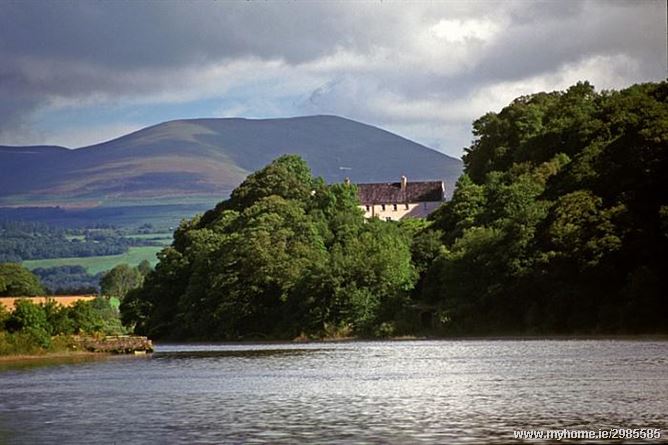
The base of these turbines (Nordex N90s at 2.5MW each) consists of 1,000 tonnes of concrete and 40 tonnes of steel.
They are also involved with Bord Na Mona in building a large wind farm at Oweninny, Co.Mayo which is still going through the planning process.
So back to the main question. What is ESB's position on our energy policy ? Well they obviously want a return on their investments on wind here. Their wind power company made operating losses of €1.6 million in 2012 and € 33,000 in 2013. One would expect that their thermal plant operations have also taken a hit in the past few years with the increasingly intermittent running of plant behind the wind. It is because ESB have such a diverse power generation portfolio that the company often has a more independent position on energy issues than other companies who have a sole focus on renewable generation. We also get more of a macro look at energy issues, rather than the single issue rent seeking views of a wind company.
In the Green Paper submission last year, they outline some of the problems of the current renewables based energy policy :
Technology-Specific Supports: The establishment of RES specific technology targets by the EU rather than low carbon outcomes has the unintended effect of the EU and National Governments attempting to pick technology winners when there is significant uncertainty as to how innovation will unfold. For example, the long-term cost trajectory for Wind vs Solar energy is currently far from clear. In addition, support for specific forms of generation especially those that have zero marginal cost has the inadvertent effect of undermining the investment economics for other forms of generation that remain necessary to provide back up to these intermittent renewables.
Carbon-Leakage: The thrust of the greenhouse gas target is production-based rather than consumption-based and as a result creates the prospect of carbon intensive industries relocating to carbon friendly jurisdictions, reducing carbon production in the EU but merely shifting it to other locations.
So lack of investment in back up plant and outsourcing of heavy industry to outside the EU are two issues ESB have with current policy - both issues addressed on this blog. They are also concerned about government policy and regulation interference in the market driving down wholesale prices but driving retail prices up and where only 40% of the electricity price is subject to the competitive market (issues also addressed in this blog) meaning that the price of electricity is kept artificially high by government policy:
For the industry, the subsidisation of renewable energy generation has had serious impacts at an EU level. The increase in subsidised generation in wholesale markets has led to the undermining of wholesale market prices to non-commercial levels, reducing returns and rendering investment in the sector unsustainable. Major European utilities with household names have been brought into financial crisis. Utilities are less interested in investing in the European energy sector, instead preferring the emerging BRIC countries. This is driving the absolute need for capacity markets to complement the energy-only market that was prevalent in continental Europe. To compound matters, in spite of wholesale electricity prices decreasing, retail electricity prices in Europe have increased at exactly the moment when the large scale production of shale gas in the US has reduced energy prices there, worsening Europe’s global competitiveness. The need to incentivise the choices needed for the policy priorities not addressed by the market, has caused levies and taxes to increase to the point where only 40% of the electricity price is subject to the competitive market; the balance is set by policy measures and regulated prices (Eurelectric, 2014).
The fact that wind energy is non dispatchable due to its intermittency is also highlighted as a problem which results in boosting power generation capacity rather than replacing old capacity :
It is a reality that the technology choices that Ireland and Europe need to make to arrive at a sustainable and secure energy system at a reasonable cost are not yet clear. For example, a sustainable form of generation that can be switched on and off as needed and is not reliant on the weather or sunlight is required.
They also have doubts about the future of EU policy :
At the same time, total renewable subsidies have reached unprecedented levels...and in the face of Europe’s declining competitiveness, a doubt must hang over the immediate future of the sustainability policy in the EU.
Much of ESB's paper focuses on renewable subsidies and their impact. Wind energy is described as more "capital intensive" than a CCGT plant, meaning that the ability to re-coup costs is more unpredictable and over a longer period. So policy makers will be more inclined to bring in policies that set fixed electricity prices to support wind energy with detrimental effects for the consumer :
In such a world, the cost of capital and the risk premium that funders will demand to invest in such projects will be a more critical driver of the price that customers will pay. These will be ultimately driven by the industry’s perception of the stability and coherence of energy policy and regulation. In addition, making the wrong policy decisions with such capital intensive projects would lock society into decades of high costs for its energy – costs that customers have to bear.
It is this warning about locking society into high energy costs for many decades that is the most crucial part of ESBs paper. Many in the "green" movement are unconcerned or oblivious to this and instead carry the belief that setting long term high fixed prices for electricity generation will somehow lower energy bills. ESB's position on subsidies and supports for wind energy is very clear - after 2020, they should be removed.
ESB has been a strong supporter of Renewable Energy Sources and will continue to be so into the future. We fully support Government’s target of 40% RES by 2020 and the EU regulations that underpin it as we believe that both provided a really strong kick start to the RES sector and the wind sector in particular. However we believe that further RES targets beyond 2020 and accompanying support schemes should be discontinued for mature technologies such as Wind and Solar. Instead we believe that continuing decarbonisation of the electricity sector should be driven by a strengthened EU –ETS. Our reasoning behind this is as follows -
By 2020 the RES industry will have operated on the back of subsidies for some 20 years and there comes a point when such subsidies should be discontinued both in the interest of producers and of consumers.
ESB have played an important role throughout Ireland's history - from installing the first power plant to rural electrification. They have helped to make Ireland a better place to live in the 20th Century. In the early 21st Century, they have followed the money and invested in wind power but are best placed to see the overall effects of energy policy and the best route for Ireland to now take. Our policy makers would do well to heed their advice - but will they listen ?
Wednesday, 24 December 2014
Growing calls to scrap wind subsidies
Wind energy is the only source of energy in Ireland that receives a market price subsidy for electricity generation. This is known as REFIT (Renewable Energy Feed In Tariff) and is subject to EU State Aid clearance. The only fossil fuel related EU State Aid in Ireland was for the Northern Irish gas pipeline, a vital piece of infrastructure that links up Britain's gas reserves to Ireland. The current REFIT is due to expire in 2017 and it does not makes sense, considering our relatively high electricity prices and the fact that wind energy is now a mature technology, to renew it. In April 2014, the European Commission adopted new rules on State Aid given to renewables :
The European Commission has adopted new rules on public support for projects in the field of environmental protection and energy. The guidelines will support Member States in reaching their 2020 climate targets, while addressing the market distortions that may result from subsidies granted to renewable energy sources. To this end, the guidelines promote a gradual move to market-based support for renewable energy.
It remains to be seen how the Irish government deal with these new rules as some flexibility in their adoption has been granted.
There are many distorting claims made by lobbyists such as wind is free, but the fact is that wind energy currently receives a fixed market price plus a 15% kicker thanks to REFIT. Another claim made is that fossil fuels also receive subsidies. Again, this is a distortion - no fossil fuel generation receives a fixed subsidy on the market price in Ireland. All sources do however receive tax breaks, which is a form of subsidy.
A recent NERA report comparing the taxation and subsidy regimes applying to oil, gas, coal,
wind, and solar power in the EU28 and Norway during the period 2007-2011 has found
that EU28 (+Norway) governments receive far greater revenues from oil, gas and coal than these
energy sources receive in the form of direct subsidies or other transfers. Oil is by far the largest
contributor to government revenues. In contrast, wind and solar power are net recipients of
support.
There are now growing calls from many independent organisations and companies around the country to abolish REFIT once it expires in 2017. The only groups now proposing the continuation of the scheme are those who stand to profit from it. Below is a list of organisations now advocating its abolition with the relevant quote from their submissions on energy policy made in July 2014.
Boliden Tara Mines
Of particular importance to us as large energy users would be clear definition of the ongoing
requirement for support schemes such as the Capacity Remuneration Mechanism for
electricity generators, the Public Service Obligation levy and Renewable Energy Feed-In
Tariff (REFIT). These support measures, which were seen as necessary in the context of
energy policy direction in 2007 and have largely achieved their objectives in the intervening
period, should be subject to review in the context of the dramatically changed energy
environment and the disproportionate burden which they impose on large energy users.
Bord Gais
Also, although REFIT and priority dispatch have worked well to drive the initial investments required, they are not sustainable support structures in the long-term as we seek to diversify our low-carbon resources and to integrate our market(s) with the wider European market(s). As discussed earlier, a single carbon price (perhaps through a carbon floor price in the absence of a robust carbon price) with equal access to markets for all technology on a cost competitiveness basis may better support diversity in Ireland’s sustainability solutions.
ESB
We fully support Government’s target of 40% RES by 2020 and the EU regulations
that underpin it as we believe that both provided a really strong kick start to the RES sector and
the wind sector in particular. However we believe that further RES targets beyond 2020 and
accompanying support schemes should be discontinued for mature technologies such as Wind
and Solar. Instead we believe that continuing decarbonisation of the electricity sector should
be driven by a strengthened EU –ETS. Our reasoning behind this is as follows:
- By 2020 the RES industry will have operated on the back of subsidies for some 20 years
and there comes a point when such subsidies should be discontinued both in the interest
of producers and of consumers.
Forfas / Enterprise Ireland / IDA
An increasing share of Ireland’s generation capacity is subsidised. This is not sustainable. It is critically important for the effective functioning of the all island electricity market that renewable generation capacity is subject to market forces to the greatest extent possible. As a mature technology, price supports for new onshore wind projects should be discontinued when REFIT 2 ends in2017. Enterprise opportunities in emerging energy technologies should be funded through funding mechanisms for R&D, if deemed competitive, rather than by energy customers;
Indaver Ireland
In developing any future support mechanisms, the recent European Commission State Aid Guidelines must clearly be taken into account. These require that supports move increasingly towards providing only a market premium, and being made available through competitive bidding.
Irish Hotel Federation (IHF)
IHF recommends that the PSO system be abolished in terms of the current revenue
collection mechanism. Where such support is needed, the cost should be borne by
the Exchequer because the supposed benefits are available to the entire society.
As noted above in the context of prices, the PSO system and other systems of supporting
alternative sources of energy need a fundamental review to ensure the most effective
approach is being adopted. The IHF considers that whatever subsidies and supports are
temporarily justified to support renewable energy sources, should be financed by the
exchequer rather than user levies. The IHF again refers to the need to ensure that alternative
sources such as wind farms do not diminish the scenery aspect of the Irish tourism product.
Wind farm and wave energy development should take account of possible impacts on
tourism.
Lagan Cement
The policy behind the aggressive development of wind energy needs to be framed on
a commercial cost competitive basis. It should be envisaged that wind energy can be
built and operated without any government/ end user subsidy.
National Competitiveness Council (NCC)
From Irish Times Article, 3rd December 2014 - The Government should wean the renewable energy sector off State supports, says the National Competitiveness Council (NCC), and it warned against promoting over-investment in new electricity generation capacity.
National Competitiveness Council (NCC)
In a report to be published on Wednesday, Ireland’s Competitiveness Challenge 2014, the State’s competitiveness watchdog says price subsidies for onshore windfarms should be scrapped in 2017 as it is a “mature technology”.
“It is critically important... that renewable generation capacity is subject to market forces to the greatest extent possible,” it said.
The NCC, whose members include the heads of Google and Paypal in Ireland as well as several other employer and trade union representatives, said the focus of the electricity market should be on delivering new electricity for the cheapest possible cost.
The following are those advocating a reduction or a review of REFIT rather than its discontinuation :
Rusal Auginish (Combined Heat and Power)
The Green Paper references Ireland's Strategy for Renewable Energy. Renewable energy is
important for delivering a low carbon economy and it has already received substantial support e.g.
REFIT. We would urge caution about the govemment putting all its eggs in one basket so to speak
and a mix of energy sources should be considered, in particular LNG and further indigenous gas. We
do agree with continued support for "Renewables" but not for the mature technologies which should
compete in the market based on the value they deliver i.e. carbon savings. A possible approach couldbe that any additional costs incurred by non-renewable generators as a result of non-reliable,
intermittent, non-synchronous generation should be borne by the renewable generators directly (hencewhy they are subsidised). Otherwise, the failure to adopt this approach is effectively a Govemmentcharge / tax on the energy consumer i.e. a further cost to the energy consumer to support renewable generation.
Page 59 of the Green Paper discusses a new support scheme for renewables from 2016
and the paper notes that onshore wind is now becoming a mature technology and hence less support isrequired. Aughinish supports a reduction in support for mature renewables.
SLR Consulting
The REFIT price is an appropriate support mechanism that gives an element
of revenue certainty to the developers of renewable projects. However, it should be
adjusted for new projects in the future to take account of the reduced cost of
renewable technologies.
Competition Authority
Renewable generation of electricity through wind turbines provides sustainable energy from an indigenous source, but it is not without costs. While renewable energy can provide cheap wholesale energy prices, it can raise the cost of conventional generation, which will always need to be available for days when wind doesn’t blow. The approach to subsidising renewable energy could be fine-tuned to prevent over investment in wind projects which may not be necessary. For example, the length of the guaranteed price of 15 years under REFIT seems very long as technology can change a lot in that time and the long period can increase costs. The cost implications of individual policy decisions should be recognised in the formulation of future energy policy.
[Note: I have contacted TCA to clarify their position and would urge others to do the same. When/if I receive a reply it will be posted on here]
Association of Irish Energy Agencies (AIEA)
A clear long term transparent carbon tax inflation methodology should be utilised that reflects the UK’s REFIT system that decreases REFIT as targets are achieved.
Renewable generation of electricity through wind turbines provides sustainable energy from an indigenous source, but it is not without costs. While renewable energy can provide cheap wholesale energy prices, it can raise the cost of conventional generation, which will always need to be available for days when wind doesn’t blow. The approach to subsidising renewable energy could be fine-tuned to prevent over investment in wind projects which may not be necessary. For example, the length of the guaranteed price of 15 years under REFIT seems very long as technology can change a lot in that time and the long period can increase costs. The cost implications of individual policy decisions should be recognised in the formulation of future energy policy.
[Note: I have contacted TCA to clarify their position and would urge others to do the same. When/if I receive a reply it will be posted on here]
Association of Irish Energy Agencies (AIEA)
A clear long term transparent carbon tax inflation methodology should be utilised that reflects the UK’s REFIT system that decreases REFIT as targets are achieved.
Kore Energy (energy procurement services)
Of particular importance to large energy users would be clear definition of the ongoing requirement for support schemes such as the Capacity Remuneration Mechanism for electricity generators, the
Public Service Obligation levy and Renewable Energy Feed‐In Tariff (REFIT). These support
measures, which were seen as necessary in the context of energy policy direction in 2007 and
have largely achieved their objectives in the intervening period, should be subject to review in
the context of the dramatically changed energy environment and the disproportionate burden
which they impose on large energy users.
Apart from the usual lobby groups and state boards, Bord Na Mona, Carlow Kilkenny Energy Agency, Cork Institute of Technology (some form of subsidy), Coillte, Cork City Energy Agency, Energia, Energy Cork, Matheson, RES and SSE Airtricity want the lucrative subsidy to continue. There are others who want it expanded to small community owned wind farms and other sources of renewables.
Let's hope the Irish government push the red button this time before things go out of control.........
Friday, 14 November 2014
The Green Bubble - are we heading for another crash ?
London financier warns of impending Green Bubble
In an earlier blog, I showed that there are clear signs of an energy bubble in Ireland. In the above video, Per Wimmer speaks about an international green bubble. With banks leveraging up to 80% of the green industry, are our banks once again over-exposed to an over subsidized sector ?
We have around 2,000MW of wind energy in Ireland and it costs around €1 million to install a MW of wind. So that works out at a total capital cost of €2 billion. My own investigation into company accounts in Ireland shows that the 80% leveraging figure applies in Ireland too. This means Irish and EU banks are exposed to €1.6 billion in loans to the wind industry in Ireland**. The means to repay these loans is entirely dependent on REFIT, PSO and the other subsidies for wind energy which the consumer pays through electricity bills that are among the highest in Europe.
There are so many similarities between the green bubble and the credit bubble that it's almost scary - Per WimmerInvestors in property were able to avail of a myriad of tax reliefs throughout the housing boom and once again investors in wind energy can also receive tax relief in the form of EII (Employment and Investment Initiative). The housing boom was characterized by disproportionately high property prices and the green boom is likewise characterized by our disproportionate high electricity prices. There was a strong reluctance from commentators and the media to report independently and fairly on the housing boom. We can also see a very similar Group Think mentality with regards to wind energy.
Another interesting similarity is the lack of regulation. We have an energy regulator who is powerless to prevent the high electricity prices and green subsidies / levies, unlike in the UK where he can at least hold energy companies to account. And whilst the lobby groups main complaint during the boom was "too much financial regulation", in an Irish Wind Farmers Association / AIB document titled 2020 Energy Finance, it is stated that "to unlock more [wind energy] funding we need to remove regulatory barriers".
The only attraction for banks is the guaranteed income from wind energy in the form of subsidies, but how long realistically can households and industry keep funding this ? As Per Wimmer points out, this is hardly sustainable green energy. In the latest PSO Levy Decision Paper, the regulator pointed out that cheap gas prices resulted in a lower wholesale price. But what will happen when the price of gas rises in tandem with the rise in wind energy subsidies in the next few years ?
Are we going to see another financial collapse or will we keep feeding the beast ?
Subscribe to:
Posts (Atom)