Showing posts with label Government debt. Show all posts

Thursday, 26 July 2018

If We Really Care about Sustainability Then Lets Look at our Debt

by Owen Martin

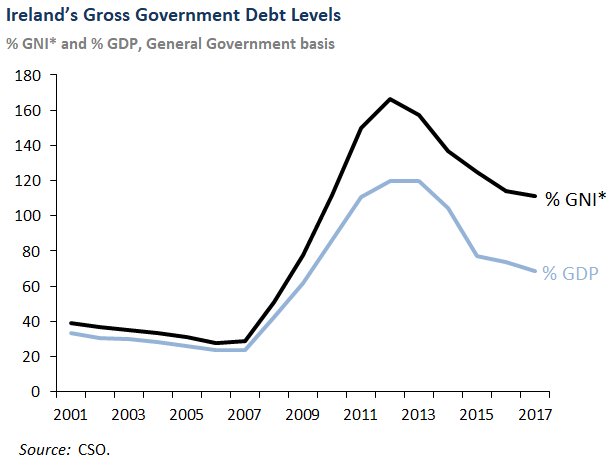
The chart shows the latest data for Gross Irish General Government Debt over the period 2001 to 2017, with the 2017 outturn showing a level of 111.1 per cent for debt-to-GNI*.


Ireland's debt burden is understated by standard GDP comparisons. Using adjusted Gross National Income (GNI*), which adjusts GDP for the impact of foreign multinationals who book their large non Irish profits here, our debt burden remains high at 111% for 2017. Our government still runs up deficits each year adding to this debt. Government spending is still out of control. 

Ireland's unemployment rate in 2012 was 16%, it is now at 6%, a fall of 62%. Yet, social welfare payments (excluding pensions) have only fallen by €2 billion, from € 14.5bn to € 12.5bn, a fall of just 14%.  How can this be justified?

Our EU contribution has doubled since 2012 to €2.6bn. Our already bloated health sector, one of the most well funded in Europe, has had an increase of €1 billion in it's budget. The funding for housing has more than doubled to €3.3 billion. Superannuation and retired allowances have increased by €50m to €570m. Foreign Aid spending has increased by €40 million to €500m.  Spending on public broadcasting has also increased, now reaching € 255 million.

This level of debt and spending is clearly unsustainable and allows us basically to consume resources beyond our means - the very definition of unsustainability. Yet many politicians from all sides want to increase spending and debt further, whether it's hikes in public sector pay or bringing in more migrants who require public housing and medical services.  

This should be target number one on the list for groups like the Citizen's Assembly. But of course it doesn't even feature in climate change discussions as climate policy is just another justification for more spending, more taxation and more debt. 


1) https://whereyourmoneygoes.gov.ie/en/
 

2) Unemployment rate was 5.8% in may 2018. population increased by about 4% since 2011, according to CSO.


Wednesday, 10 January 2018

The Climate-Energy Problem : A Response


Engineers Ireland yesterday published a fairly in-depth article that caught my attention. There are some points I do agree with, for example, on the conservation of oil and the contribution of fossil fuels and Industrial Revolution to people's lives. I have done a short rebuttal of some of the other points made --


It goes without saying that the second stage of the Industrial Revolution is irreversible and must be sustained by new energy sources because the vast majority of people now reside in cities and earn their living in economic sectors which did not exist before 1900. These people cannot now return to their great grandparents’ employment in agriculture which has been mechanised.


1) Developed world people are not reproducing at rates like before when  huge families were the norm. Only poorer regions like Bangladesh and India have sustainable birth rates (higher than average IQ populations tend to have lower birth rates - see Japan and Hong Kong for example). If people in these poorer regions are using 35 times less oil per person than in the developed world (as stated later in article), then they can return much easier to an agricultural society as before. The Industrial Revolution in the developed world is therefore sustainable if there were low levels of immigration.


The problem is that this transition is unsustainable without the enormous mechanical energy output of more than a billion newly-invented oil, coal and gas-fuelled machines which have caused atmospheric carbon dioxide to reach 400 parts per million.
2) Co2 levels of 400 parts per million are low historically speaking and has helped greening of the planet.

An oil-burning heater does not increase anybody’s productivity. It has an HPM of zero hence heating oil is wasted oil, yet over 30% of global oil production is used for heating. Moreover the 700 litres of diesel emits almost 2 tonnes of carbon dioxide, yet biomass is an alternative which is both carbon-neutral and cheaper than oil.


3) For biomass to be sustainable you would have to cut down trees with a handsaw and transport it with a horse or wheelbarrow so you're back to pre-Industrial Revolution times.

It could and should initiate reforestation, dedesertification and carbon capture.


4) Renewables are often built on forested land displacing green spaces which should be left as forest areas (see Coillte) . Extra CO2 in atmosphere is leading to de-desertification in regions like the Sahara.

During the recent financial crisis in the US, the pragmatic Ben Bernanke pronounced, “Quantitive Easing is wrong in theory but it works in practise, and the Fed will drop money from helicopters if required.”

If something is wrong in theory but works in practise then query the theory. In the situation Bernanke found himself conventional economic theory had become obsolete and by dropping money from helicopters he averted an unnecessary decline in demand in the US economy which is now consumer-driven since the cost of production is so low.

Today an increase in the money in circulation causes an increase in demand which causes an increase in the quantity of products coming down existing, paid-for, automated mass-production lines (and from China, Korea etc.) This benefits manufacturers, distributors, retailers, and consumers.

In fact the exact opposite is true and the following chapter makes the irrefutable case that the free-market has within itself the seeds of its own destruction. 


5) Printing of the money supply, welfare state, government debt, mass immigration are all unsustainable.  Want to reduce CO2 ? Then you need to tackle all of these. These factors are not the fault of the free market - they are the caused by Government policy.

Why should any highly profitable oil company be serious about developing an alternative-to-oil which is less profitable than oil?


6) Oil has a high Energy Return on Investment (EROI). That is, the energy emitted through consumption is many times that of energy required to extract it. The same is not true for alternatives at the moment. It is interesting that as wind energy has increased in Ireland, offsite diesel generation has also done so. There are now nearly 400MW of demand side units.

It is interesting that all talk of Peak Oil has stopped or is not taken seriously anymore.

At any rate, why should it be up to Oil companies to develop a serious alternative ? Were motor cars developed by the horse industry ?

By Owen Martin
Sunday, 12 February 2017

Price of Electricity and Renewables Revisited

Previous work by Willis Eschenbach and Euan Mearns showed the relationship between Electricity costs and per capita installed renewable capacity. A new European Commission report shows the increases in electricity prices since 2010. I put this on a graph alongside the increase in share of electricity from renewable sources [Figure 1].


Figure 1 : Increase in electricity prices 2010-2015 plotted alongside increase in share 
of renewables in electricity generation 2010-2014

So the UK went from renewables providing 7% of electricity generation in 2010 to 17% in 2014 resulting in almost a 50% increase in prices over the same period. Ireland is in the top five increases in electricity prices over this period. Denmark seems to be an outlier (although they started off from very high prices) but most countries who invested heavily in renewables saw a sharp rise in electricity prices. 

Something that struck me was the proliferation of PIIGS countries at the top of the graph. So I labelled the top government indebted countries on the same graph [Figure 2] :


Figure 2: Top 7 member states with highest Government debt as % of GDP 


Greece, Italy and Portugal are the top 3 indebted countries in the EU (Debt of general government, as a percentage of GDP). Most of the countries investing heavily in renewables are also running up the biggest fiscal deficits. They have put environmental sustainability above economic sustainability. However, surely the two are linked ? If capitalism is the driver of climate change then living beyond your means must be twice as bad.


References
_________________


1)  Monitoring progress towards the Energy Union objectives – key indicators - see Page 62
https://ec.europa.eu/priorities/sites/beta-political/files/swd-energy-union-key-indicators_en.pdf

2)  Share of electricity from renewable sources in gross electricity consumption (%) - unfortunately this only goes up to 2014, whereas the prices in 1) goes up to 2015, so if a more recent report comes out I will update this blog. Still, Figure 1 is indicative of the electricity price/ RES-E trend.

3)  Risk Assessment of the EU Banking System - See Figure 1