Showing posts with label Debt problem. Show all posts

Sunday, 22 September 2019

The Motor Industry is Unsustainable because of Debt


Gross new lending for car purchase was €2.1 billion over the past twelve months, the largest amount of new lending recorded since the series began. Non-PCP hire purchase agreements were the main driver of the increase in new lending
- The Central Bank of Ireland, August 2019


The number of motor cars could be reduced, if the Government really wanted to do it, by capping car loans for petrol and diesel vehicles. 

Instead, they prefer the more trendy and coffers-friendly solution of carbon taxes. 


Thursday, 26 July 2018

If We Really Care about Sustainability Then Lets Look at our Debt

by Owen Martin

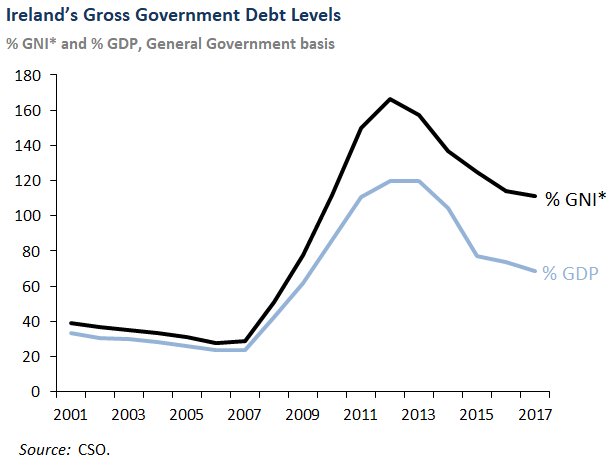
The chart shows the latest data for Gross Irish General Government Debt over the period 2001 to 2017, with the 2017 outturn showing a level of 111.1 per cent for debt-to-GNI*.


Ireland's debt burden is understated by standard GDP comparisons. Using adjusted Gross National Income (GNI*), which adjusts GDP for the impact of foreign multinationals who book their large non Irish profits here, our debt burden remains high at 111% for 2017. Our government still runs up deficits each year adding to this debt. Government spending is still out of control. 

Ireland's unemployment rate in 2012 was 16%, it is now at 6%, a fall of 62%. Yet, social welfare payments (excluding pensions) have only fallen by €2 billion, from € 14.5bn to € 12.5bn, a fall of just 14%.  How can this be justified?

Our EU contribution has doubled since 2012 to €2.6bn. Our already bloated health sector, one of the most well funded in Europe, has had an increase of €1 billion in it's budget. The funding for housing has more than doubled to €3.3 billion. Superannuation and retired allowances have increased by €50m to €570m. Foreign Aid spending has increased by €40 million to €500m.  Spending on public broadcasting has also increased, now reaching € 255 million.

This level of debt and spending is clearly unsustainable and allows us basically to consume resources beyond our means - the very definition of unsustainability. Yet many politicians from all sides want to increase spending and debt further, whether it's hikes in public sector pay or bringing in more migrants who require public housing and medical services.  

This should be target number one on the list for groups like the Citizen's Assembly. But of course it doesn't even feature in climate change discussions as climate policy is just another justification for more spending, more taxation and more debt. 


1) https://whereyourmoneygoes.gov.ie/en/
 

2) Unemployment rate was 5.8% in may 2018. population increased by about 4% since 2011, according to CSO.


Friday, 24 February 2017

Ireland's Debt Problem

An economic policy based on rising debt and low corporate tax rates is not and never was sound policy - by Owen Martin

While the Irish media make a fuss over who will be the next leader of Ireland's biggest political party (Fine Gael), everybody ignores the real elephant in the room. According to the European Banking Authority, Ireland has the largest combined private and government debt as a percentage of GDP in the EU and two thirds higher than that of the US. 


 I'm not sure how this graph is not sending shockwaves through the Trump obsessed Irish media and political establishment - From EBA 


While Greece, Italy and Portugal have higher Government debt, Ireland's private sector debt to GDP dwarfs those countries. Which means that for the size of Ireland's economy, it's private sector has taken on alot of debt.

But not only businesses and industry. We have the 5th highest household debt as percentage of net disposable income in EU with about twice as much debt as income per household. This may explain how we rank so high in numbers of new cars across the EU.   People are taking out car loans that perhaps they can't really afford. It shows that we as a nation are still addicted to debt.


Denmark, Netherlands, Iceland and Norway all have higher household debt than Ireland but these countries are doing much better when it comes to Government debt as percentage of GDP. Ireland ranks 5th in terms of Government debt to GDP. So while Greece and Italy have higher levels of government debt, they have about half of the household and private sector debt. Denmark's high level of household debt doesn't seem as bad considering they have half of Ireland's Government debt to GDP. 


Norway have the wealthiest government in Europe. In fact, they are far ahead of second place Luxembourg and Finland. Norway has slightly more household debt than Ireland. But that kinda makes sense - they are a wealthy country. Ireland has the 5th poorest Government in Europe (Italy and Greece lie at the bottom). Our government has dismal revenue, in part thanks to our low corporation tax rates. Yet we carry roughly the same household debt as Norway and have an even higher private sector debt to GDP.  This is called "living beyond our means".  Yes, Ireland could do with the € 13 billion in tax revenue owed from Apple. Laughably, the Irish government is appealing this decision


Irish Govt has the worst revenue in Europe yet reject a €13 billion EU tax ruling made in Ireland's favour

Of course if all that debt was used wisely, perhaps we could become richer. We are reliant on Norway's gas which arrives to us through UK pipelines. The Irish government have banned fracking so this dependence will continue for the foreseeable future. Imagine if some of that debt was being used to extract our own gas reserves.


Ireland spends the most on health after Iceland in Europe, yet we still have a permanently dysfunctional health system

Ireland has the third highest electricity prices in Europe.

The Irish government takes pride in divesting from fossil fuels and pushing through massive renewables and electricity infrastructure programmes that cost billions and without any proper assessment in the name of climate change.  We pride ourselves on having a massive welfare program and our representatives want to take in more refugees (without any proper assessment). Green/Left politicians cry out as to why we don't do more to tackle climate change, take on more debt (One cannot go the EIB looking for €5 million or €10 million; one needs to go looking for €2 billion. It is there.) and take in more refugees. Ireland is trying to save the world on a sinking ship but our politicians and media don't even realize we are on one.  Have we learned anything from the crash in 2008 ?


POSITIVES


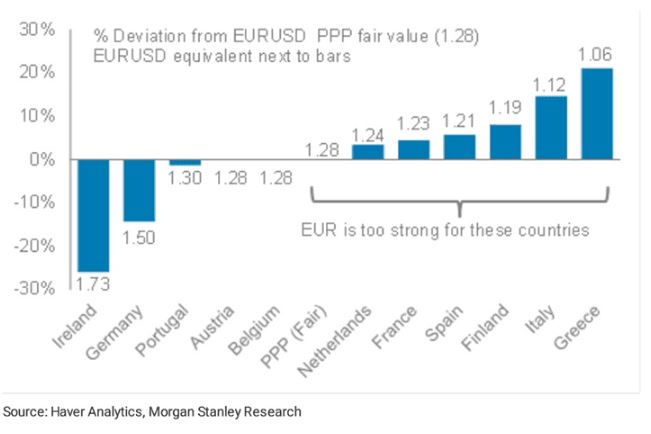
On the positive side, exports are still strong and benefit from the stronger dollar as against the euro. If we went back to our own currency, it would be a strong one as the above graph shows. Presumably thanks to our exports. However, the weaker sterling is not good for exports to Britain. There is a chance that Ireland may actually benefit from Brexit if companies there relocate to Ireland. 


https://data.oecd.org/gga/general-government-deficit.htm#indicator-chart


Ireland has managed to get out of it's budget deficit abyss and back to something fairly normal. If Multinationals move out we could see some real problems, but we would no longer see the massive distortions to our GDP anymore. Perhaps that could be a good thing in the long run. Living on a false economy (now known as Leprechaun economics) is what got us into trouble last time.

I can't see how Ireland's economic fundamentals are much different to that of the Celtic Tiger era.   If anything, things have got worse.