Showing posts with label SNSP. Show all posts

Wednesday, 4 July 2018

Overcoming Grid Constraints Fails to Solve Inherent Problems with Wind Energy

In 2014, the maximum level of wind energy allowed into the grid was 50%. In 2017, this was increased to 60% and by November of last year trials were run at 65%.  So some of the obstacles to higher levels of wind energy such as grid constraints have been partly overcome, which theoretically speaking should result in higher wind outputs from individual turbines (the capacity factor). 

In 2014, the capacity factor for wind was 27%. In both 2016 and 2017, the capacity factor remained at 27% despite the higher wind penetrations allowed. 

An analysis of wind speeds shows that wind speeds were fairly similar for those years, with 2015 being somewhat higher.  I took a sample of six weather stations from around Ireland, the average wind speeds I obtained neatly fitted with the capacity factors for wind. 


Year2014201520162017
Average wind speed (knots)9.610.49.39.7
Capacity Factor Wind27%32%27%27%
Max wind penetration (SNSP)50%55% Trial from Oct55% Perm from Mar60% Perm from Mar - 65% trial Nov 

As can be seen from the last part of the table above, we went from allowing 50% wind into the grid to 60% and by the end of last year 65%. As wind had more access to the grid, we should have seen a higher capacity factor for wind.

This seems to suggest that we have already reached saturation point for wind energy. I would be interested to hear what people think. I have already written about market cannibalisation and diseconomies of scale. Here is strong evidence that supports that argument. Most of the best sites for onshore wind have been used up. The turbine layout at some sites is too dense and newer larger wind turbine models have failed to deliver any significant additional output. And after all, the wind resource itself is limited, particularly in Midland regions. 

Sources

Eirgrid Constraint Report 2017

http://www.eirgridgroup.com/site-files/library/EirGrid/Annual-Renewable-Constraint-and-Curtailment-Report-2017-V1.pdf

Wind speeds from Met Eireann website (in knots)

https://www.met.ie/climate/available-data/historical-data


2014
2015
2016
2017
Cavan
6.3
6.8
5.9
6.3
Kerry
9.5
10.3
9.1
9.3
Donegal
14.4
15.3
14.3
15.1
Cork
12.2
13.1
11.8
12
Tipperary
8.3
8.8
7.9
8.2
Carlow
7.3
8.2
7
7.3
All stations record wind speeds at 10m above ground level.

Note that total wind output did increase in 2017 by about 18% by adding an extra 530mw of wind capacity, an increase of about 20% on the previous years installed wind capacity. The capacity factor measures the actual output in relation to potential output if the entire wind turbine fleet had been operating at full output for the entire year. So theoretically if wind speeds increase so should the capacity factor. Or if wind speeds stay the same and the maximum level of wind permitted into the grid increases, then capacity factor should also increase.

Monday, 12 March 2018

Interconnector Fault Causes Problems for Wind Farms During Beast from the East


As the "Beast from the East" hit Ireland on the 28th February, things were looking good for wind farmers. The east winds were predictable and constant, unlike the variable westerlies that hit Ireland most of the time. Wind energy became baseload power for the first time on the Irish grid. On the 1st March, the capacity factor for wind was 80%, a power output normally reserved for coal or gas generation. However, a problem occurred on the morning of the 28th. The interconnector to the UK (East West interconnector) tripped out. This meant that surplus wind generation could no longer be exported to the UK. High amounts of wind generation would have to switched off or "curtailed".


Wind generation and forecasted wind during Beast from the East. Note how accurate the forecast was
with one notable exception (see later)

East West interconnector fault on 28th February


A further problem happened on the 2nd March as the storm reached it's peak. Power cuts became a frequent event. Power cuts are inevitable of course during storms and periods of extremely high winds, which is very unfortunate for wind farmers as demand for their product, electricity, is reduced just when their supply is at it's highest. In fact, over the four or five days of the "Beast", demand was relatively normal. This is in stark contrast to the Big Freeze event of 2010 where demand reached over 5,000MW (and wind generation was abnormally low). During the Beast, demand reached a high of about 4,600MW on the 28th February. The periods of highest winds (1st - 3rd march) saw demand reach only 4,200MW.


Demand all time peak 2010 Vs Demand during Beast from the East 2018

Power cuts on the 2nd March

 On 1st March, wind energy was generating about 59% of the total electricity production, one of the highest penetrations ever. However, by the next day, as power cuts became widespread, wind energy was been curtailed by as much as 45%. Nearly 1,200MW of wind was been shut down at 4am. 

The period from 1st to 2nd March was when the storm was at it's most intense in Ireland. 
Wind curtailment can therefore be calculated as the difference between forecast wind and actual wind. 
Forecast wind generation was actually equal to demand at times.
The frequency of electricity, normally static at 50Hz, became erratic during the storm as the grid
operator struggled to manage high wind penetrations. This is from the 2nd March.

Had the interconnector been in operation, 500MW of this surplus wind could have been exported.  Demand, in fact, dropped by 10% on the 2nd March compared with the day before, presumably due to the power cuts. 

These are problems that will only intensify as more wind capacity is added and more and more generators are looking to get a piece of the demand "pie". Interconnectors, like storage, seem like an easy solution in theory, but in practice things are often different. 


Monday, 25 December 2017

Technical Problems with High Levels of Wind on Christmas Eve

New Report Describes Total Decarbonisation Dream as Wishful Thinking


On Christmas Eve, wind was providing just over 60% of electricity demand. This is new territory for the Irish grid (or indeed any grid). Eirgrid began trials of allowing a maximum of 65% for wind energy (wind penetration) in November. Wind generation was also exceeding the wind forecast. 

Jolly good I hear you say. However, it can be troublesome balancing this level of wind as other plant are forced to run below their optimum efficiency. The additional unforeseen wind also creates more problems as scheduled plant are constrained off.  Variances in the frequency are a good indicator of just how much trouble these high wind conditions can cause. A stable frequency is required for a stable grid and a certain amount of conventional plant is required to maintain the frequency within a tiny range. 


As the wind level rises, the frequency falls below 50Hz. At around 15:40, some of the wind energy is shut off and the frequency returns again to 50 Hz.


These technical problems have been highlighted in a new report on the German electricity grid (Hidden Consequences of Intermittent Electricity Production).


Another important difficulty caused by intermittency is the increased vulnerability of the electricity grid to instabilities. This is particularly visible in countries that are not so well interconnected like Ireland. An example of a threatening oscillation occurring at a 400MW power generator (24/4/2014 between 21:40:40 and 21:41:00) is shown in Fig. 3 (adapted from M.Zarifakis et al.,  “Models for the transient stability of conventional power generations stations connected to low inertia systems”, Eur. Phys. J. Plus 132, No.6, 289 (2017), op. cit.).

Grid stability is now a major issue around Europe :
Further, if one keeps the current Alternative Current grid technology, a certain minimum amount (~ 20-25%) of “rotating mass” has to be present to guarantee stability.  If this cannot be sufficiently provided using biomass, and if fossil and nuclear based power stations are not allowed, problems will arise. Instabilities caused by large contributions of intermittent power e.g. from wind or solar PV pose a major threat to the stability of the electrical network of a country and to the safe operation of conventional generator systems, as exemplified in Ireland. If no economical solution can be found for such difficulties, conventional backup power based on fossil fuels or nuclear power will necessarily have to remain part of the electricity system.
Their conclusion is in agreement with the work carried out on this blog :

A last point is the economic feasibility of such a system. Germany, with currently an installed capacity of about 90GW in solar PV and wind, has one of the largest renewable systems installed in the world. The cost (including feed-in tariffs, subsidies, extra costs because of court cases due to unfulfilled promises etc…) is estimated between 250 and 300 billion Euros, integrated over the last 10 years. The CO2 reduction on world scale realized by this system is less than 1‰. As discussed above, a 100% iRES without backup or storage systems makes not much economical sense and will lead to a doubling or tripling of the total costs, compared to the conventional system in use now. It is to be expected that not many countries are able to pay for such a costly and inefficient system. The question can thus be raised if the current EU plans for the electricity sector are bound to fail? 

Finally, the electricity sector is only a minor part of the problem. If one wants to completely decarbonise our economy then one should also include other private and economic sectors. Given already the challenge of a 100% renewable electricity system and the complexity of replacing the present primary energy supply based mainly on chemical energy by renewables, this total decarbonisation looks to be wishful thinking, at least at the present stage of technology. Would it not be more useful to invest in research and development of conventional and new energy systems rather than blindly investing in an existing “green” technology which seems bound to miss its goal? The other question is whether decarbonisation should be our primary concern. Is this really the best investment for a better future for mankind, as discussed in B.Lomborg, “Cool It”?A critical assessment of the EU plans is also voiced in countries outside the EU, in particular the United States under the presidency of Obama. Does transforming the present primary electricity supply (based presently mainly on fossil and nuclear sources) into a 100 % intermittent Renewable Energy System, as imposed by the EU, need to be the challenge and moral quest of the 21stcentury? This will for sure affect our society and standard of living if current EU plans are not corrected for the problems that are emerging from the grand renewable experiment in Germany of the recent years.


The full report can be found here : 
http://revue-arguments.com/articles/index.php?id=76

Thursday, 16 June 2016

Rising Costs of Stabilizing Irish Grid

Synchronous Condenser in Australia (Wikipedia)

As levels of wind energy increase, fossil fuel generators and other devices are been called on to provide stability services to the Irish grid to help prevent blackouts. Its a simple engineering fact that as wind energy increases, the grid loses inertia and the frequency of electricity sent to your home becomes more difficult to control. The frequency of the Irish grid is set at approximately 50 Hertz, give or take about 1 Hertz, and all our appliances will not run outside this small range. 

Large power stations have trip switches that deactivate generators when the frequency moves outside this range so if the grid loses inertia for even a few seconds, there will be a cascade effect as generators drop out. A widescale blackout is the likely result. The rotational speed of wind farms is changing all the time and at different regions and it's because of this that they can't provide inertia to the grid. Gas and coal power stations are classed as synchronous generators because they provide stability to the grid, while wind farms and the East West interconnector are deemed non synchronous generators (SNSP). 

At the moment non synchronous generators are limited to 50-55% penetration in the grid. It is envisaged that this will have to rise to 75% in order to achieve the 20-20 targets. A consequence of this will be less synchronous generators online during high wind periods and increased risk of blackouts. So synchronous generators need to be paid more to maintain stability through what are called ancillary services.     


The diagram below shows that these ancillary or grid stability payments increased from € 24.5 million to € 26 million in the year to April 2016. 


POR means Primary Operating Reserves and SOR Secondary Operating Reserves. POR can step in up to 5 seconds and SOR up to 15 seconds to replace a generator that suddenly drops out. Tertiary Reserves (TOR1 and TOR2) take longer to start but can be maintained for longer time. These reserves are set by the single largest generator that happens to be online at the time, usually the East West Interconnector. However, demand for fast reserves, which are inefficient and high emitters, is increasing with higher levels of wind as wind fluctuations dominate the grid

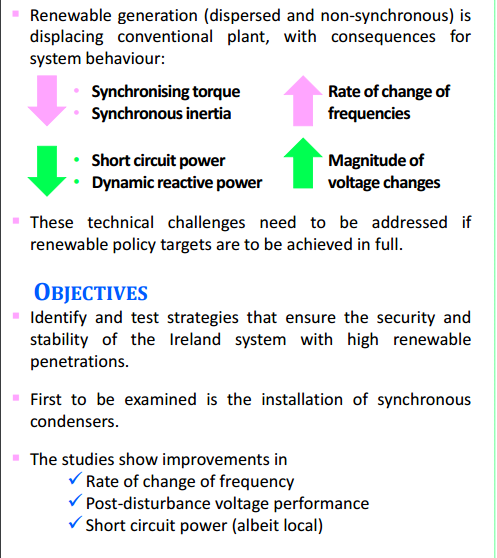
The largest increase was for Reactive Power services. These are mostly provided by synchronous condensers which are able to provide stability in times of large voltage changes due to stochastic wind energy. Engineers at UCD provide a good overview of these devices here.  


Like battery storage units, synchronous condensers are net consumers of electricity but are essential for keeping the lights on with high levels of non-synchronous wind energy.  Adding units that consume more energy over their lifetime that they can generate is a consequence of the wind program and should have been included in a cost benefit analysis, which as we know, was never done.