Showing posts with label frequency of electricity. Show all posts

Sunday, 29 April 2018

Battery Storage Project Doesn't Live Up to Hype

A new 200MW battery storage project in Co. Offaly has been hyped up in the media as a project that will "boost use of renewable energy and reduce dependence on fossil fuel-fired power plants."

From the Independent :


BESS (Battery Energy Storage Solutions) involves the storage of power from the grid which is then resupplied on demand. It will allow renewable energy generated at night to be stored, which would otherwise have to be curtailed due to a lack of demand.
The power can then be released back into the grid, avoiding the use of conventional oil or gas-fired power stations to generate electricity.
The 200MW proposed by Lumcloon could provide power for the equivalent of 170,000 homes.

In reality, the storage facility will not generate any electricity. It will not provide power for any home nor will it reduce dependence on fossil fuel power stations. In fact, it will increase dependence on fossil fuels during periods of low wind. 

According to the planning application, the main purpose of the storage unit is to provide a quick injection of power to restore balance to the grid when there is a fall in system frequency. A fall in system frequency could occur when there is too much wind generation in the system and not enough conventional. According to the Lumcloon Energy website, the facility will need to respond within 5 seconds.

The storage unit is an appliance, like a washing machine, in that it will be a consumer of electricity. It could be called on at any time to inject power, so it will need to be fully charged at all times. So while it will be able to charge at night when there is surplus wind energy, it will also need to charge during periods of low wind thereby increasing dependence on fossil fuel. Therefore, it will be useful during periods of high wind, but a drain on the grid when there is no wind.  

Ireland's only pumped storage facility, Turlough Hill, is also a net consumer of electricity. It has a fixed regime, where it stores electricity at night when it is cheap to do so and exports electricity during the day when prices are higher. Lumcloon is similar but different. Turlough Hill trades in the single market like any other generator. Lumcloon, on the other hand will be paid for providing "system services".

These services must be provided to the grid when requested by the grid operator at short notice , unlike electricity which is bid into the market in a competitive pricing system in advance. They are high quality sophisticated high voltage and frequency services.

A grid run on low levels of renewable energy and supplied mostly by conventional generation plant [i.e coal , gas, hydro, nuclear etc] , does not need to provide such services as they are embedded in the product conventional generators provide.

The storage unit will not sell electricity back to the system ( and receive a price for this product the same as an hydro or wind plant would ) , instead it will receive special remuneration set by the regulator and this remuneration is an additional cost to the system and will have to be recovered from the consumer. 

So the net result from this project will be additional costs to the consumer and it will have little impact (or even none) on the reduction of fossil fuels. A long way from the hype in the media.

Tuesday, 3 April 2018

Storms Linked to Power Station Trips

Eirgrid published this list of power station trips from the past few months:


I couldnt help but notice that most of these dates coincided with storms or very windy conditions:

5th october - Cyclone Xavier
12th october - Hurricane Ophelia
16th october - Hurricane Ophelia
21st october - Storm Brian
27th November - gale force winds
24th December - record wind penetration on the grid
3rd January - Storm Eleanor
17th January - Storm Fionn

It appears that as very high amounts of wind generation is allowed into the grid, the frequency can drop to a dangerously low level.


One of our key tasks is to maintain balance between electricity supply and electricity demand. Electrical frequency is the measure of balance between supply and demand. When supply and demand are balanced, the electrical frequency is at 50 Hz. We must maintain this balance on the system all day, every day. The normal operational frequency range is 49.8 Hz to 50.2 Hz [Eirgrid].

You can see from the above diagram that the frequency has dropped below 49.8Hz on a few occasions over this period.  As a result, the power station tripped and went offline. This then results in the frequency falling even further. At this stage, cutting demand is one of the few options open to the grid operator. This may explain some of the blackouts on these days.

Monday, 25 December 2017

Technical Problems with High Levels of Wind on Christmas Eve

New Report Describes Total Decarbonisation Dream as Wishful Thinking


On Christmas Eve, wind was providing just over 60% of electricity demand. This is new territory for the Irish grid (or indeed any grid). Eirgrid began trials of allowing a maximum of 65% for wind energy (wind penetration) in November. Wind generation was also exceeding the wind forecast. 

Jolly good I hear you say. However, it can be troublesome balancing this level of wind as other plant are forced to run below their optimum efficiency. The additional unforeseen wind also creates more problems as scheduled plant are constrained off.  Variances in the frequency are a good indicator of just how much trouble these high wind conditions can cause. A stable frequency is required for a stable grid and a certain amount of conventional plant is required to maintain the frequency within a tiny range. 


As the wind level rises, the frequency falls below 50Hz. At around 15:40, some of the wind energy is shut off and the frequency returns again to 50 Hz.


These technical problems have been highlighted in a new report on the German electricity grid (Hidden Consequences of Intermittent Electricity Production).


Another important difficulty caused by intermittency is the increased vulnerability of the electricity grid to instabilities. This is particularly visible in countries that are not so well interconnected like Ireland. An example of a threatening oscillation occurring at a 400MW power generator (24/4/2014 between 21:40:40 and 21:41:00) is shown in Fig. 3 (adapted from M.Zarifakis et al.,  “Models for the transient stability of conventional power generations stations connected to low inertia systems”, Eur. Phys. J. Plus 132, No.6, 289 (2017), op. cit.).

Grid stability is now a major issue around Europe :
Further, if one keeps the current Alternative Current grid technology, a certain minimum amount (~ 20-25%) of “rotating mass” has to be present to guarantee stability.  If this cannot be sufficiently provided using biomass, and if fossil and nuclear based power stations are not allowed, problems will arise. Instabilities caused by large contributions of intermittent power e.g. from wind or solar PV pose a major threat to the stability of the electrical network of a country and to the safe operation of conventional generator systems, as exemplified in Ireland. If no economical solution can be found for such difficulties, conventional backup power based on fossil fuels or nuclear power will necessarily have to remain part of the electricity system.
Their conclusion is in agreement with the work carried out on this blog :

A last point is the economic feasibility of such a system. Germany, with currently an installed capacity of about 90GW in solar PV and wind, has one of the largest renewable systems installed in the world. The cost (including feed-in tariffs, subsidies, extra costs because of court cases due to unfulfilled promises etc…) is estimated between 250 and 300 billion Euros, integrated over the last 10 years. The CO2 reduction on world scale realized by this system is less than 1‰. As discussed above, a 100% iRES without backup or storage systems makes not much economical sense and will lead to a doubling or tripling of the total costs, compared to the conventional system in use now. It is to be expected that not many countries are able to pay for such a costly and inefficient system. The question can thus be raised if the current EU plans for the electricity sector are bound to fail? 

Finally, the electricity sector is only a minor part of the problem. If one wants to completely decarbonise our economy then one should also include other private and economic sectors. Given already the challenge of a 100% renewable electricity system and the complexity of replacing the present primary energy supply based mainly on chemical energy by renewables, this total decarbonisation looks to be wishful thinking, at least at the present stage of technology. Would it not be more useful to invest in research and development of conventional and new energy systems rather than blindly investing in an existing “green” technology which seems bound to miss its goal? The other question is whether decarbonisation should be our primary concern. Is this really the best investment for a better future for mankind, as discussed in B.Lomborg, “Cool It”?A critical assessment of the EU plans is also voiced in countries outside the EU, in particular the United States under the presidency of Obama. Does transforming the present primary electricity supply (based presently mainly on fossil and nuclear sources) into a 100 % intermittent Renewable Energy System, as imposed by the EU, need to be the challenge and moral quest of the 21stcentury? This will for sure affect our society and standard of living if current EU plans are not corrected for the problems that are emerging from the grand renewable experiment in Germany of the recent years.


The full report can be found here : 
http://revue-arguments.com/articles/index.php?id=76

Monday, 12 September 2016

Over 40% of Wind Energy Shutdown Last Night

by OWEN MARTIN

Last night, over 40% of wind energy produced was shutdown or curtailed during a spell of gale force winds across the island of Ireland. This episode clearly shows the limitations of relying too much on an intermittent source of energy like wind. Billions of euros worth of turbine installations become worthless at both low wind and at high wind.   

Figure 1


The reason for the shutdown of so many wind turbines can be clearly seen in the System Frequency charts before and after the wind shutdown. 

As the gales gathered in strength on Sunday evening, maintaining the frequency of the grid became more difficult :


Figure 2


The zig zag patterns in the Figure 2 show how frequency fluctuated between 49.9 and 50.1 Hz. The dips represent periods of too much wind when system inertia drops (due to lack of conventional generation such as coal or gas). Should frequency drop below 49.7 Hz then a blackout may occur, so Eirgrid rectified this by shutting down some of the wind and allowing more conventional generation into the system. The frequency then rises again to 50Hz. Gas turbines are forced to ramp up and down more often to maintain system stability during such periods thus pushing emissions up and negating some of the benefits of  having all the wind in the first place. 


Figure 3

Figure 3 shows what happened when over 40% of the wind output was shutdown and there was more manageable levels of wind, in this case about 1,500MW. The frequency is very stable and there is little risk of blackouts. This has been normality in the grid for many years. Compare it with Figure 2. This is the future. It will certainly test engineering skills to it's limits. Gas turbines will have to function under greater strain than before. It will cost a lot of money. There can no longer be a guarantee that the electric kettle will boil when you want it to. 

The other option Eirgrid have to maintain a stable frequency in these situations is to cut demand - which is in effect a blackout under another name. The future is renewable. The future is green. I'm at a loss to figure out how this is "progress".

Thursday, 16 June 2016

Rising Costs of Stabilizing Irish Grid

Synchronous Condenser in Australia (Wikipedia)

As levels of wind energy increase, fossil fuel generators and other devices are been called on to provide stability services to the Irish grid to help prevent blackouts. Its a simple engineering fact that as wind energy increases, the grid loses inertia and the frequency of electricity sent to your home becomes more difficult to control. The frequency of the Irish grid is set at approximately 50 Hertz, give or take about 1 Hertz, and all our appliances will not run outside this small range. 

Large power stations have trip switches that deactivate generators when the frequency moves outside this range so if the grid loses inertia for even a few seconds, there will be a cascade effect as generators drop out. A widescale blackout is the likely result. The rotational speed of wind farms is changing all the time and at different regions and it's because of this that they can't provide inertia to the grid. Gas and coal power stations are classed as synchronous generators because they provide stability to the grid, while wind farms and the East West interconnector are deemed non synchronous generators (SNSP). 

At the moment non synchronous generators are limited to 50-55% penetration in the grid. It is envisaged that this will have to rise to 75% in order to achieve the 20-20 targets. A consequence of this will be less synchronous generators online during high wind periods and increased risk of blackouts. So synchronous generators need to be paid more to maintain stability through what are called ancillary services.     


The diagram below shows that these ancillary or grid stability payments increased from € 24.5 million to € 26 million in the year to April 2016. 


POR means Primary Operating Reserves and SOR Secondary Operating Reserves. POR can step in up to 5 seconds and SOR up to 15 seconds to replace a generator that suddenly drops out. Tertiary Reserves (TOR1 and TOR2) take longer to start but can be maintained for longer time. These reserves are set by the single largest generator that happens to be online at the time, usually the East West Interconnector. However, demand for fast reserves, which are inefficient and high emitters, is increasing with higher levels of wind as wind fluctuations dominate the grid

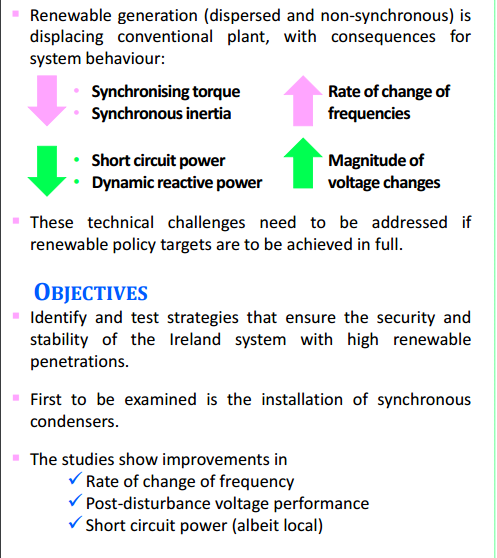
The largest increase was for Reactive Power services. These are mostly provided by synchronous condensers which are able to provide stability in times of large voltage changes due to stochastic wind energy. Engineers at UCD provide a good overview of these devices here.  


Like battery storage units, synchronous condensers are net consumers of electricity but are essential for keeping the lights on with high levels of non-synchronous wind energy.  Adding units that consume more energy over their lifetime that they can generate is a consequence of the wind program and should have been included in a cost benefit analysis, which as we know, was never done.