From the Independent :
BESS (Battery Energy Storage Solutions) involves the storage of power from the grid which is then resupplied on demand. It will allow renewable energy generated at night to be stored, which would otherwise have to be curtailed due to a lack of demand.
The power can then be released back into the grid, avoiding the use of conventional oil or gas-fired power stations to generate electricity.
The 200MW proposed by Lumcloon could provide power for the equivalent of 170,000 homes.
In reality, the storage facility will not generate any electricity. It will not provide power for any home nor will it reduce dependence on fossil fuel power stations. In fact, it will increase dependence on fossil fuels during periods of low wind.
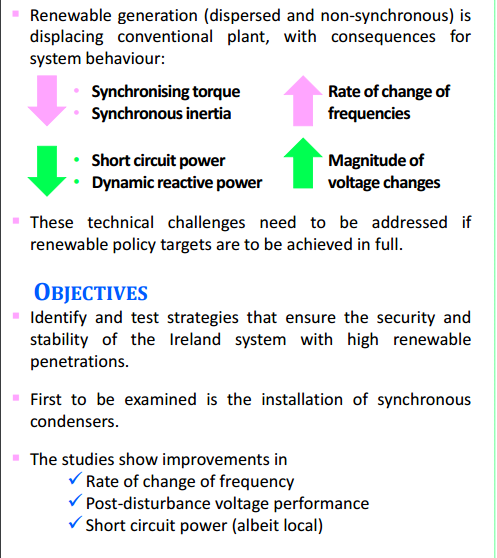
According to the planning application, the main purpose of the storage unit is to provide a quick injection of power to restore balance to the grid when there is a fall in system frequency. A fall in system frequency could occur when there is too much wind generation in the system and not enough conventional. According to the Lumcloon Energy website, the facility will need to respond within 5 seconds.
The storage unit is an appliance, like a washing machine, in that it will be a consumer of electricity. It could be called on at any time to inject power, so it will need to be fully charged at all times. So while it will be able to charge at night when there is surplus wind energy, it will also need to charge during periods of low wind thereby increasing dependence on fossil fuel. Therefore, it will be useful during periods of high wind, but a drain on the grid when there is no wind.
According to the planning application, the main purpose of the storage unit is to provide a quick injection of power to restore balance to the grid when there is a fall in system frequency. A fall in system frequency could occur when there is too much wind generation in the system and not enough conventional. According to the Lumcloon Energy website, the facility will need to respond within 5 seconds.
The storage unit is an appliance, like a washing machine, in that it will be a consumer of electricity. It could be called on at any time to inject power, so it will need to be fully charged at all times. So while it will be able to charge at night when there is surplus wind energy, it will also need to charge during periods of low wind thereby increasing dependence on fossil fuel. Therefore, it will be useful during periods of high wind, but a drain on the grid when there is no wind.
Ireland's only pumped storage facility, Turlough Hill, is also a net consumer of electricity. It has a fixed regime, where it stores electricity at night when it is cheap to do so and exports electricity during the day when prices are higher. Lumcloon is similar but different. Turlough Hill trades in the single market like any other generator. Lumcloon, on the other hand will be paid for providing "system services".
These services must be provided to the grid when requested by the grid operator at short notice , unlike electricity which is bid into the market in a competitive pricing system in advance. They are high quality sophisticated high voltage and frequency services.
A grid run on low levels of renewable energy and supplied mostly by conventional generation plant [i.e coal , gas, hydro, nuclear etc] , does not need to provide such services as they are embedded in the product conventional generators provide.
The storage unit will not sell electricity back to the system ( and receive a price for this product the same as an hydro or wind plant would ) , instead it will receive special remuneration set by the regulator and this remuneration is an additional cost to the system and will have to be recovered from the consumer.
So the net result from this project will be additional costs to the consumer and it will have little impact (or even none) on the reduction of fossil fuels. A long way from the hype in the media.