One and one equals two, six less four equals two, four by three equals twelve - can you do the maths ?
"To think that two and two are four, and neither five nor three, the heart of man hath long been sore, and long tis like to be" - A.E. Housman
Critics of Ireland's current energy policy have now been told by Mr Curtin of the Institute of International and European Affairs in Dublin that they can't count in an Irish Times article :
So lets see who has the deficiency in mathematics.
The reason is not wind but rather the cost of importing gas.
The problem is that more than half of Ireland’s electricity is generated from gas – the fourth highest share in the EU – leaving us more exposed than other countries to gas price increases. When gas prices increase, electricity prices here increase more, and Ireland’s competitiveness declines.
Wind replaces more expensive generation options, reducing their operational and fuel costs. The final net impact on consumer bills is minimal.
The Academy of Engineering point out the fuel price differentials in their July 2014 report :
SEAI’s recently published analysis of the” Benefits of RenewableElectricity in 2012” indicates that in the Republic of Ireland the 4.09 TWh of wind generation is estimated to have saved €177 million in fossil fuel imports i.e. €43.2 per MWh and reduced CO2 emissions by 0.37 tonnes per MWh - indicating that wind almost exclusively displaced highly efficient gas-fired CCGT generation. Wind generators received in excess of €80 per MWh for wind output in 2012. This means that wind generation added almost €40 per MWh to the electricity sector cost base in 2013 i.e. €165 million. This does not include the impact of wind-related transmission cost increases or system operation cost increases.
So if faced with a choice of paying € 43 MWh or € 80 MWh , which would you prefer to pay ? I don't know about you but personally I would like to pay € 43 MWh. So if we stopped all fuel imports and powered our electricity completely by wind (which is impossible), we would have to pay almost € 40 per MWh extra in our bills. This is because gas does not receive a subsidy while wind does.
Simple Maths Sum # 1
Cost of gas --- € 43 per MWh
Cost of wind --- € 80 per MWh
Difference --- € 37 per MWh --- which is the additional amount we must pay when wind displaces gas
The reason is not wind but rather the cost of importing gas. Between the summers of 2009 and 2013 wholesale gas prices almost doubled across the EU. Analysis by the International Gas Union shows that between 2007 and 2013 prices increased consistently in all regions except North America.
2009 was the last time a crash occurred in oil and gas prices. So obviously prices increased after that.


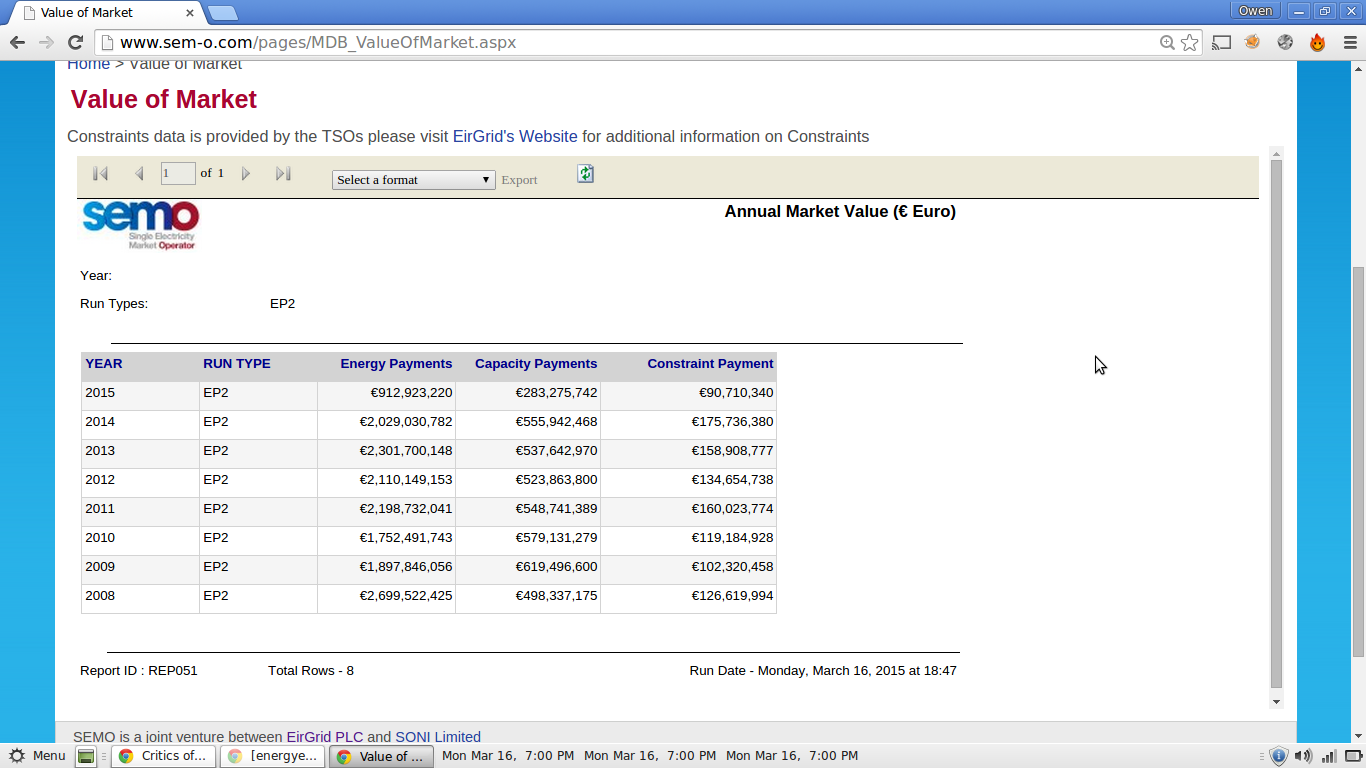
So gas (and oil) prices hit a peak in 2008. There then was a dip in 2009 and a slight rise after that. This is reflected in the Annual Energy Payments
(The market price per MW sold per half hour) below provided by SEMO :
As you can see Energy Payments, which are a direct reflection of wholesale prices, hit a peak in 2008 of € 2.7 billion and have not come anywhere close since. So our electricity bills should have come down since then by Mr Curtin's logic. But instead our bills have gone back up again and now exceed 2008 prices :
So Energy Payments (which gas prices determine) fell by about half of a billion euros between 2008 and 2011 but our electricity prices continued to rise in this period. So can you do the maths ? What else could be pushing up our bills ?
Lets look at the electricity bills in 2014. Have they come down yet ? Do you know how numeracy works - € 24.05 (2014) is greater than € 20.33 (2008) i.e. electricity was more expensive in 2014 than 2008 , but Energy Payments were higher in 2008 (€2.7bn) compared to 2014 (€ 2bn) (click on each table to zoom in) so the bills should have come down by Mr Curtin's calculations.
So what else could be pushing up our bills ?
Well, the answer is we are in the middle of an energy bubble that is really indefensible :
http://irishenergyblog.blogspot.ie/2015/01/energy-bub.html
All this additional capacity must be financed through electricity bills, whether that capacity is used or not. Excess capacity is financed through capacity payments and the PSO Levy. Most of this excess capacity is due to the € 4 billion investment in wind generation - it's not an anti-wind position to state this, it's simply a statement of fact.
Another factor is Ireland’s lower population density. We need about 70 per cent more metres of cables per person than the average, which feeds into higher prices.
This was always the case in Ireland. As can be seen from the below graph, it didn't prevent Ireland from having a very competitive electricity price during the 90s before they started this renewable gig :
In 2015 electricity prices will decline further, driven again by lower forward gas prices. The correlation is as clear as day.
Has anyone seen these lower electricity prices ? Last time I checked my bill the PSO Levy was going up once again. Can anyone find one of these bills with lower prices ? Please do let me know.
The situation is exacerbated by the fact that Ireland must import its gas from the UK through interconnectors, and Irish consumers bear this additional cost.
Funny then that we once had lower electricity prices that the UK during the 90s when we still were reliant on UK fuel imports :
Others have identified “hidden” network costs they argue are necessary to facilitate wind. It is true that Ireland is currently modernising an electricity network that for many years suffered from chronic underinvestment. Current investments also support traditional generation, increased demand in the regions, and indeed a more responsive, intelligent and modern grid generally.
It is now accepted by almost everyone that Grid 25 is required to facilitate renewables, including Eirgrid :
The implementation of GRID25 is essential if Ireland is going to meet its targets for generating electricity from renewable sources (link).
Next we are told:
Current investments also support increased demand in the regions
There is no expectation for "increased demand in the regions". In fact, there are gas plants lying idle in the Western Region for example, Tynagh which ran for the equivalent of 2 months in 2013 (link here) and Rhode oil plant in the midlands which ran for a total of 17 hrs in 2013 - "A further trend of decrease for the stations total running hours is predicted for the coming years. This is attributable to a lower demand from the National Grid" (link here).
Current investments also support traditional generation
Current investments in the grid have nothing whatsoever got to do with traditional generation. This shows a very poor misunderstanding of how power generation and grid infrastructure works. Traditionally, power stations were placed close to towns and areas of large population. The grid infrastructure was larger at the power stations and towns and then progressively smaller as it reached remote regions. With the advent of wind generation, grid infrastructure now has to be built inversely i.e. larger cables in remote locations are required to bring the energy to the towns and cities.
There are also other hidden costs which are directly attributable to wind such as constraints payments for conventional plant which I have written about here :
http://irishenergyblog.blogspot.ie/2014/12/whats-in-electricity-bill-part-2.html
You can see that they have risen every year since 2010 as wind penetrations got higher and the smooth running of plant got ever more interrupted. The Energy Regulator accepts that "More and more wind on the system adds extra costs."
Total investment in wind will reach €3.5 billion by 2020. This is a frightening number, leading several commentators to make the simplistic assumption that consumers will have to foot this bill.
Since we are engaging in simplistic argument, it is not the Irish consumer but the king of Norway who will pay. We import the largest proportion of our gas from Norway, and investment in wind will reduce coal and gas imports by nearly €300 million per annum by 2020. Consumers will benefit by not having to pay for these imports.
Why deal with simplistic arguments when one can actually look at the detail ? Could it be that simplistic argument is the coinage for a propaganda machine ? Dr Fred Udo has done an analysis using SEAI and Eirgrid data and found that running our CCGT in an efficient way would save more fuel than the investment in wind did.
http://irishenergyblog.blogspot.ie/2015/03/wind-turbine-build-outs-and-co2.html
That's right, using modern CCGT in an efficient way saves fuel - thats the rationale behind using fuel efficient generators whether its the engine in your car or the generator in a power plant. The King of Norway in no way feels threatened by 13th century technology. In fact, wind power is very reliant on gas for its own house load needs.
The deployment of wind creates economic growth in Ireland and investing in Irish wind instead of Norwegian gas boosts activity in the local economy. Analysis suggests that GDP would be boosted by €500 million per annum by 2020, creating thousands of jobs in the process.
Airtricity operate 25% of Irish wind farms - owned by SSE, a British company
Energia operate 25% of Irish wind farms - owned by Veridian plc, a British company which is ultimately owned by Arcapita Bank based in Georgia, USA.
Bord Gais operate 15% of Irish wind farms - owned by Centrica plc, a British company. It was rumoured in July last year that Qatar were attempting to buy a large stake in the company.
____________________________________________________________________