Showing posts with label UK National Grid. Show all posts

Wednesday, 26 December 2018

Ireland Exporting Fossil Fuel Power


According to Eirgrid's East West Interconnector brochure, one of the benefits of the interconnector to UK is that it "facilitates growth in renewable energy".  What is not often mentioned is that sometimes we in Ireland are actually exporting fossil fuel power through the interconnector. During the recent summer, when there was little or no wind, the interconnector was doing just this most of the time -  exporting fossil fuel electricity generated in Ireland to the UK :
The period of low wind this summer


https://www.gridwatch.templar.co.uk/


Because of EU emission rules, the carbon emissions for these exports will be counted in Ireland, the country of origin, which will benefit UK with emission free electricity. 


Wednesday, 4 November 2015

Interconnector to UK providing just 4% of peak demand due to capacity shortage in the UK


With the UK Grid operators today resorting to emergency measures to keep the lights on, Ireland imported much less than usual from the UK during peak demand at 5.45pm. The interconnector has a capacity of 500MW which would normally be running at full load, or near full load, during periods of high demand.

But today, during the peak demand period, the interconnector ran at just 176MW or 35% of capacity.

This amounted to just 4% of our energy demand needs.


Last year, Irish Energy Blog warned this may become a problem if the existing capacity shortage in the UK remained :

But it is interesting that Eirgrid have taken no account of the situation in the UK where National Grid recently stated that Britain's spare capacity has fallen to a seven year low, prompting emergency contingency plans to be put in place such as shutting down large factories during peak periods.
Surely in this climate, where the UK National Grid are considering restricting demand in their own country, they will also be reviewing exported power to Ireland via the two interconnectors ? 
And it's not just the interconnector that is running at low output - our windmills were running at 1% for most of the day :


Same situation in UK and France:

UK wind output (blue line)

French Wind Output - providing just 2% of demand


So we are back to the "Do Nothing" Scenario - relying on our old power plants like we used to before the Green Blob raised its ugly head.

While we will have to pay a bit more for electricity generated here than we would have to pay if we imported it from the UK, it will still be cheaper than if it was generated by wind power.

But still our leaders insist that wind power and interconnectors are "the future". 


Monday, 30 March 2015

One of the windiest nights of the year sees Ireland dependent on UK coal

With storm like winds hitting Ireland tonight, lets see how our electricity system is coping.

Jetstream Forecast

Between 9pm and 10pm wind speeds rose all around the country apart from 4 locations (click on picture to zoom in) :


So how efficient are our € 4.4 billion worth of wind turbines (2,200MW) at converting this energy sweeping across our country into power ?

Well at 9pm, they were producing 1,631MW and approx 218MW was curtailed. In otherwords, we shut down 218MW of wind power, about 12% of the potential power:


In the next hour, wind speeds rose in most areas around the country, notably in Cork and Donegal where most of the wind farms are (see Met Eireann data above).


Well, it turned out that our wind farms could not make use of this additional wind. Instead, wind generation dropped to 1,374MW, a drop in output of about 16%. Curtailment of wind rose significantly from 218MW to 483MW, an increase of 220%.  So 26% of available wind generation had to be dumped. Wind farm companies that have "Firm Access" will be compensated for this.

At 9pm we were importing 378MW from the UK (EWIC in the above graphs). By 10pm, we were importing slightly less - 340MW. Demand dropped in the same period from 3,790MW to 3,464MW, a drop of 326MW. As wind and UK imports do not provide the same type of power as that produced by conventional sources  - they are termed non synchronous generation sources - there is currently a cap of circa 50% on their use in the system at any one time (more explanation here). We can work out that total non synchronous generation (wind plus imports) at 9pm was 53% of demand, while at 10pm it was at a safer 49%. 

So part of the reason for all this curtailment of wind was to bring wind generation down to a safer level for system stability. But they had another option - switch off the UK imports and replace with the excess wind. But instead it seems that commitments made to the UK National Grid, or some other reason, meant that we were using power generated in the UK for 10% of our needs while at the same time shutting down 26% of available indigenous wind power. And what was this UK power made up of ? Well, the largest share was dreaded coal at 30% (which we are all taught to despise) and behind that was the even more dreaded nuclear (which we are all taught to fear) at 23% :


One can only wonder. Is there anyone left who actually thinks the people in charge know what they are doing here ? 

Why are we building more wind turbines when we are dumping more and more wind power ?


Thursday, 4 December 2014

The Correlation of UK and Irish Wind

Shock of the century - Ireland and Britain have similar weather systems !


Once again, there is talk of exporting Irish wind to the UK. It seems that the basic rules of supply and demand are not understood anymore. If you are going to supply a product, then it must be at times when the other party has a demand for that product. Otherwise, you end up paying them to take your product (See here for evidence of that payment structure in place for Irish wind).

As I type, (20:16 on 4th Dec) the latest update from http://smartgriddashboard.eirgrid.com/#all/wind
shows 355MW of wind for All Island. This is about 13% of total Irish wind capacity.

http://www.gridwatch.templar.co.uk/ shows 580MW, about 5% of total UK wind capacity. So right now, on a cold winter night in December, there is demand in the UK for Irish wind energy. But, we dont have it. In fact, we are importing 707MW from them.

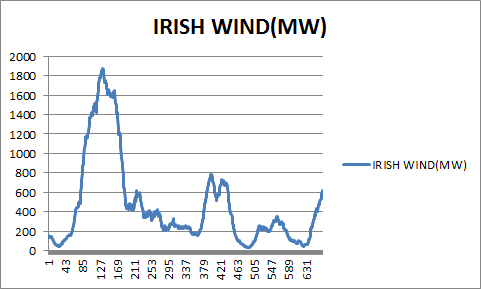
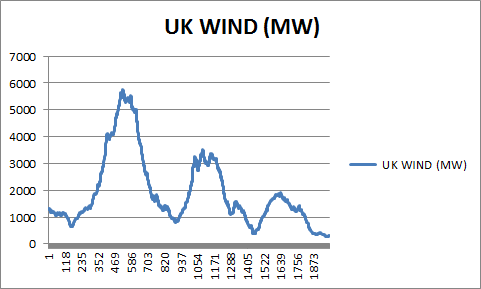
Below shows the wind profiles for All Island wind generation in Ireland and wind generation in UK for last week - from 20th to 26th November. Make up your own mind.  Are there any major opportunities for exporting wind to UK ?

All Island wind generation for Ireland - 20th Nov - 26th Nov 2014
http://smartgriddashboard.eirgrid.com/#all/wind

UK wind generation 20th Nov - 26th Nov 2014
http://www.gridwatch.templar.co.uk

Have the Irish authorities actually worked out the correlation of wind between the two Islands for a whole year ? I don't know, but it looks like their UK counterparts have done.


Wednesday, 29 October 2014

News from Germany and UK


The German Association for plant construction this month have issued a warning about the damage that increased cycling of power plants, due to balancing of renewables on the grid, is having on generation equipment :

http://www.fdbr.de/fileadmin/Dateien/Pressemitteilungen/FDBR-PM_2014_03.pdf

The FBDR is the German association for process plant construction in the energy, environment and process industries. Their press release of the 6thOctober 2014 below lays it bare in that that thermal power stations remain as a central factor for a reliable electricity supply and that existing plants are not technically laid out for the operational requirements of today, which naturally is being altered due to the highly intermittent input of increasing amounts of solar and wind energy on to the grid. As the press release points out even if Germany was to meet a 100% renewable potential, it would still need to guarantee it through a back-up performance of 80 GW by means of conventional power stations.

This rapid increase in renewables in recent years in Germany has put operational demands on existing gas and coal power plants, which are simply not technically designed for it. The plants must be more frequently switched on and off in order to be able to compensate for the fluctuations, which are associated with electrical inputs from sun, wind and water. The degree of load change is partly more than 200 times higher than that permissible for the power station. As a result the danger of lasting damage to the power  plants grows – along with increasing risks to the security of electrical supply.   On  their own the plant operators cannot come up with the necessary investment for the technical conversion of thermal power plants. Already we have reached the situation where the operation of conventional gas and coal power plants is barely profitable, even to the point that the regulated maintenance is more and more being postponed. Correspondingly the political process is being called upon, not only to promote pumped storage and transmission systems, but also to integrate the existing power stations into their planning. “If you want the Energiewende (energy transformation), you must also provide for your back-up cover”.


And the UK National Grid have issued a report stating that they are facing a capacity shortage this winter, with emergency measures including "load shedding" of heavy industrial users where factories will revert to their own sources of electricity generation i.e. diesel generators, in order to reduce peak demand (essentially a transfer from coal to diesel power) :

http://bishophill.squarespace.com/blog/2014/10/28/wheels-coming-off.html

So will the new 400 million euros East West Interconnector be lying idle over the winter as a result ?