Showing posts with label Demand. Show all posts

Monday, 4 May 2020

Fuel Consumption 2012 to 2018 - the Good, the Bad, and the Ugly


In the course of the transition we will gradually reduce our dependence on the fossil fuels – coal, peat, oil and gas – that currently dominate our energy mix - Alex White, Energy Minister, White Paper, 2015


Despite massive efforts to reduce carbon emissions and fossil fuel dependence by successive Irish governments, the efforts have largely proven a failure, as fossil fuel consumption rose by 15% between 2012 and 2018. The government placed an overemphasis on wind energy as the solution, which doubled in capacity during that time to 3,600MW. Demand may also have increased, which in of itself is a failure to reduce consumption habits, and an over emphasis on the generating of electricity. Demand could have been tackled through retrofitting, promotion campaigns aimed at reducing consumption, moving away from the GDP standard, encouraging saving rather than spending (central bank have been doing the opposite), and preventing population growth by curbing immigration.

The main driver of the increase was petroleum products, including natural gas (used in power stations), which has risen by about 20%.


Natural Gas increased by 20%
In 2012, gas generated half of our electricity, as it did again in 2018, but this time with a significantly higher gas consumption. When your car comes off the motorway and goes into ‘stop start’ urban driving it burns more fuel, just like power plants forced into such operation, as intermittent wind energy pours on and off the grid.   


In their favor, coal and peat decreased by 23% and 8% respectively. The reduction in these, contrary to the common held belief, was due to several factors  - an increase in gas, oil, renewables and electricity imports from the UK (the East West Interconnector began operation in late 2012).  The US achieved a 27% reduction in CO2 emissions during the period 2008 to 2017 by simply switching from coal to gas. So too emissions savings in Ireland arise from switching from coal to gas, a lower emitting fuel,  and importing electricity from the UK, where the resulting emissions are counted, and after that, renewables make up the rest of the savings.  


Peat decreased by 8%


For gasoil and diesel we can see that not only has dependence on transport risen, but  oil used in power generation has also, quite remarkably, increased. Much of this increase is due to an oil powered station in Kerry (Tarbert) which ran more in the grid, presumably because of the closures at Moneypoint. There are also more demand side units, which comprise of diesel generators.


We can also see that we are more addicted to air travel than ever, as jet kerosene consumption doubles. How could a virus pandemic ever be prevented from reaching our shores ?

So we have to ask the question, why are we still consuming high amounts of fossil fuels, after installing so many wind turbines ?  Media reports that show that a high percentage of our electricity came from wind fail to mention what we actually saved as a result. If I cycle from Dublin to Galway, but a car follows me all the way, what have I actually saved ? It is obvious now that they are not a long term solution to reducing dependence on fossil fuels. 

In 2020, there is still, regrettably, peat being used in electricity production, although there is an issue about the impact on employment in the midlands region that has still not being resolved. The renewables industry, as we now know, is not a big employer. 

The Energy Bubble


Generating Capacity for the Republic of Ireland, we have over twice as much as we need

The above graph shows how an energy bubble has been created in the past decade. Whereas in 2006, at the height of the building boom, we only needed enough generating capacity to cover 1.3 times the peak demand, we now have 2.4 times the capacity required. Peak demand levels in 2019 are the same as 2006 levels. All this capacity has to be paid for either through the market or from subsidies that are added on to energy bills. New fossil fuel plant are also in the pipeline.

The Cost 


The EU publishes an energy price report every two years. The last year available of full data is 2016; which shows a circa €490 billion bill for energy sources, €212 billion being imported fossil fuels, plus an additional tax squeeze of €280 billion, of which €76 billion in subsidies is for the renewable sector equating to €208 million per day or €150 from each citizen.

€48 billion was paid directly to wind and solar generators on top of the market price for generating 13% of EU’s electricity mix. 

The market price plus tax paid to gas and solid fuel generators, for generating 41% of the EU's electricity mix, were also €48 billion. 

Turkeys would not vote for Christmas if they were able to educate themselves.


Tuesday, 10 July 2018

Wind Taken Out of Government's Plans - NAMA for Wind Beckons

by Owen Martin


All Island Wind (in green) Vs Demand (in red) for the past two months - above and below graphs

The capacity factor for wind was 13% over the past two months according to data taken from Eirgrid's dashboard

There have been unprecedented low levels of wind energy in the past two months as the two charts above reveal.  The unusual hot and calm weather is due to a large area of high pressure in the Atlantic Ocean which is blocking the prevailing south westerlies :

High Pressure region in the Atlantic


Some green campaigners are saying that this is caused by "more energy in the climate" due to climate change, but actually in this case there is less energy. Cloudless skies, no wind, no rain, it looks like a climate devoid of energy to me. 

There is now around 4,500MW of wind installed on the island of Ireland, enough capacity to meet almost all summertime demand. However, as can be seen in the graphs above, wind has had a dire performance with a capacity factor of about 13% over the past two months. In other words, they've only performed at 13% of potential output. Historically, they have a capacity factor of 27% in Ireland. Most, if not all, wind farms will be making large losses. The longer this calm weather continues, the closer we get to a bailout for wind, or as Colm McCarthy put it, a NAMA for wind.


How much would a NAMA for wind cost ?


A megawatt of wind energy capacity costs somewhere in the region of € 1-2 million. So 3,500MW of wind (in the Republic of Ireland) would cost about  €5 billion to bail out. If we take a discount of about 50% for serviced debt and a haircut for shareholders, this means the cost to the taxpayer would be €2.5 billion.  This is roughly equal to the total wholesale cost in electricity bills, which comprise 50% of an average bill. So a NAMA for wind could cost the consumer about half of an average annual electricity bill. 

Monday, 12 March 2018

Interconnector Fault Causes Problems for Wind Farms During Beast from the East


As the "Beast from the East" hit Ireland on the 28th February, things were looking good for wind farmers. The east winds were predictable and constant, unlike the variable westerlies that hit Ireland most of the time. Wind energy became baseload power for the first time on the Irish grid. On the 1st March, the capacity factor for wind was 80%, a power output normally reserved for coal or gas generation. However, a problem occurred on the morning of the 28th. The interconnector to the UK (East West interconnector) tripped out. This meant that surplus wind generation could no longer be exported to the UK. High amounts of wind generation would have to switched off or "curtailed".


Wind generation and forecasted wind during Beast from the East. Note how accurate the forecast was
with one notable exception (see later)

East West interconnector fault on 28th February


A further problem happened on the 2nd March as the storm reached it's peak. Power cuts became a frequent event. Power cuts are inevitable of course during storms and periods of extremely high winds, which is very unfortunate for wind farmers as demand for their product, electricity, is reduced just when their supply is at it's highest. In fact, over the four or five days of the "Beast", demand was relatively normal. This is in stark contrast to the Big Freeze event of 2010 where demand reached over 5,000MW (and wind generation was abnormally low). During the Beast, demand reached a high of about 4,600MW on the 28th February. The periods of highest winds (1st - 3rd march) saw demand reach only 4,200MW.


Demand all time peak 2010 Vs Demand during Beast from the East 2018

Power cuts on the 2nd March

 On 1st March, wind energy was generating about 59% of the total electricity production, one of the highest penetrations ever. However, by the next day, as power cuts became widespread, wind energy was been curtailed by as much as 45%. Nearly 1,200MW of wind was been shut down at 4am. 

The period from 1st to 2nd March was when the storm was at it's most intense in Ireland. 
Wind curtailment can therefore be calculated as the difference between forecast wind and actual wind. 
Forecast wind generation was actually equal to demand at times.
The frequency of electricity, normally static at 50Hz, became erratic during the storm as the grid
operator struggled to manage high wind penetrations. This is from the 2nd March.

Had the interconnector been in operation, 500MW of this surplus wind could have been exported.  Demand, in fact, dropped by 10% on the 2nd March compared with the day before, presumably due to the power cuts. 

These are problems that will only intensify as more wind capacity is added and more and more generators are looking to get a piece of the demand "pie". Interconnectors, like storage, seem like an easy solution in theory, but in practice things are often different. 


Saturday, 4 November 2017

Flexible capacity to exceed 25GW in the UK by 2030

In the UK, flexible capacity from batteries, peaking plants and demand-side response is set to reach more than 25GW by 2030. That is over half of demand. And the reason is because of renewables :
The firm says the rise of intermittent renewables - which undermine the profitability of large baseload generators but still require backup power - will push annual revenues from flexibility to nearly £3 billion by the end of the next decade.

This is important because this capacity will not be as efficient as baseload generators such as combined cycle gas turbine generators. They will need to respond quicker and as a result they will have higher emissions.  So when the wind is not blowing, the grid operators will have to resort to these fast acting plant or reducing demand. It still remains to be seen how batteries will operate in practice on such a large scale. 

The same is happening here in Ireland. Capacity of demand side response units, usually diesel generators, are now at 260MW.

Full article here:

http://utilityweek.co.uk/news/flexible-capacity-to-exceed-25gw-by-2030/1316312#.Wf3-RWi0PIV

Monday, 16 October 2017

Data Centres Vs Steel Plants - A Comparison

SUMMARY

•  Steel plants use 60% of the energy demand of a data centre but provide 26 times as many jobs

• Port Talbot steel plant in Wales provides 28.5 jobs for every megawatt of demand compared to 1.5 at the data centre at Athenry 

• Approval for planning permission of any industrial project should require a high jobs to energy demand ratio of at least say six or seven. 


Last week, Apple received approval for their data centre in Athenry, County Galway to great fanfare in the media. I can only find one article (in the Independent) which dealt with facts (Revealed: Data centres to swallow 75pc of growth in Irish power demand). The article gives a good overview of the problems that lie ahead. 

I am not in favor of opposing something for the sake of opposing it. I'm in favor of discussing all the available facts and basing decisions on those. What we have now in Ireland is approving something for the sake of approving it which is just as bad as the other extreme.  I fail to understand how a country which prides itself on it's higher education credentials does not discuss the facts in relation to new projects such as data centres. 


David Hughes wrote previously on the Athenry data centre (The Cloud Bytes Back) :

To give an example Apple are seeking permission for a 240MW data centre in Athenry Co. Galway, which will create up to 215 jobs. The electricity consumption of this data centre will be the same as 420,000 Irish homes. This is ¼ of all Irish homes or every single house in Dublin City, Dun Laoghaire, Fingal and South County Dublin combined. Basically, the electricity needs of 1 Million people.
It seems the jobs figure has been revised downwards to 150 full time jobs according to the above Independent article.  So that's about 1.5 jobs for every megawatt of demand.  

Let's compare that to another high energy industrial user - steel plants in the UK. Port Talbot steel plant in Wales was due to shut down in the near future but the employees fought hard and the plant remains open for the time being. It employs nearly 4,000 people.


Port Talbot steelworks’ current demand for energy is about 140 Megawatts (MW), about half of which is internally generated. That works out at 28.5 jobs for every megawatt of demand.


A steel plant therefore generates about eighteen times more jobs per megawatt of demand than a data centre. Even if those jobs were cut in half by new technology, steel would still provide more jobs by a factor of nine.


Based on figures for Port Talbot then, steel plants use 60% of the energy demand of a data centre but provide 26 times as many jobs
The Government is keen to promote Ireland as being a location where it can meet the needs of the IT sector by providing certainty around planning and power supply
Interestingly, the government is not trying to promote Ireland as a location for steel plants which would create many times more jobs. 

The impact on energy demand, fossil fuel imports, emissions, electricity prices and 2020 targets will be enormous from data centres. As a consequence, it will be harder to attract other high energy industrial users that could provide many more jobs.  There needs to be a good payback for Ireland Inc. to compensate. Of course, they need to built somewhere to provide the demand for internet services.  But Ireland should not allow so many to be built here. We simply cannot afford it. 


Approval for planning permission of any industrial project should require a high jobs to energy demand ratio of at least say six or seven. 


Wednesday, 29 March 2017

The Impact of High Levels of Wind Energy on Conventional Plant

On Wednesday 25th January 2017 wind energy reached a new record of 2,400MW for the Republic of Ireland. This post will look at the impacts on some of the other generation sources.


CCGT ( Gas)


Only three out of eight CCGT ran during the day - two in Dublin (Poolbeg and Dublin Bay) and one in Cork (Whitegate). Presumably, the other 5 plants were paid capacity or constraint payments to shut down for the day.

Wind generation was unusually stable during the day and so Dublin Bay and Whitegate mostly followed demand while the output from Poolbeg had a flat profile. Dublin Bay ran the most efficiently. Whitegate's output hovered between 45% and 60% of it's maximum (or rated capacity otherwise known as load). Poolbeg, on the other hand, operated at about a quarter of it's rated capacity. Operating a CCGT at this level leads to higher specific emissions and fuel consumption, something like driving your car in second gear all the time. 

It would have been therefore preferable to have operated Whitegate on higher loads and take Poolbeg off the grid altogether. The requirement for two power stations to be on load at all times in the Dublin area probably lead to this less than ideal situation.


Coal 


Two out of the the three generators at Moneypoint operated for the day and like the CCGT mostly followed demand.   They operated at an average of 50% of maximum output with minimum output at 40%. A load of 40% capacity is likewise not exactly ideal in terms of efficiency. 


Peat


The three peat power stations are being run on baseload and as a result are not affected by high wind levels. The biomass component seemed to be out of action. The question arises as to why (like wind) peat still receives a subsidy if it is always allowed to operate in the electricity generation market (Though I think the peat subsidy is being phased out). 


OCGT (Gas)


Both open gas cycle units at Sealrock operated at close to full output for the day as like wind they have priority dispatch in the system.


Demand Side Units (DSU)


One relatively new problem for Eirgrid is that despite having all this additional generating capacity in place, matching supply with demand is not as straightforward as previously thanks to the presence of stochastic wind energy. Fast acting plant is one answer to this. Another solution is reducing demand during periods of high demand. Demand side units reduce the demand during peak times giving industrial users a choice to shut down production or use their own diesel generators. 

As more wind is added, more reliance will be placed on DSUs and ironically diesel generation. During this day, on average 18MW per hour of DSU was called on to help keep the lights on. Not a significant amount at this stage. But according to Eirgrid :


The capacity of Demand Side Units in Ireland has increased to 230 MW, and is set to increase further. 


East West Interconnector to UK (EWIC)

The UK interconnector played a crucial role on this day. For most of the time, Ireland sent across it's surplus wind but for an hour, between 6pm and 7pm, Irish generation was insufficient to meet the rise in demand as people arrived home from work and turned their kettles and cookers on. It's an unfortunate fact that you can't "switch the wind on". Also you can't simply switch a large power station like a CCGT on. 

The preferred solution by Eirgrid, presumably because it was cheaper than the other option discussed below, was to reverse the direction of electricity in the interconnector. However, the UK was strapped for generation at this time and (incredibly) France were reliant on UK imports. A precarious situation for the UK but 120MW of spare power for Ireland is not a significant amount for a system of their size.


There is still a shortfall of about 200MW at peak time (where blue line is higher than orange line in the second graph above) which I'm not sure how they made up. Possibly more hydro or DSU or some other peaking plant that I may have missed.

The other option available to Eirgrid would have been to simply increase output from Poolbeg as the demand began to rise. After all, it was being operated at well below optimum efficiency as discussed above.  This is presumably what would have happened if there was no interconnector. Usually the low cost of power purchased from UK would make importing a cheaper option but I can't imagine a grid with such a tight capacity margin as the UK's giving away low cost power during peak demand times. But I can only assume it was somehow cheaper in this case.


The power UK sent to Ireland was made up mainly of gas and coal generation with some nuclear and wind : 


The generation mix for the day is given below  :


Tuesday, 20 December 2016

Cooking the Christmas Turkey with Wind Energy

The following graph shows the Wind Energy profile and Demand for the past month for the island of Ireland :


1)  The black line is the maximum available wind output, i.e. wind capacity. This is about 3,000MW for the island of Ireland.

2) The two circles show periods when wind energy was increasing during periods of decreasing night time demand. This wind energy ends up being shutdown or curtailed.

The graph shows the trouble in relying too much on wind energy during the Christmas season. In short, the turkey is unlikely to get cooked. Maybe there will be a chance if families wait up all night, although chances are there won't be much wind then either. Most days, as you can see, the wind output falls far short of the potential wind energy available. 

I would like to wish all the readers a Very Happy Christmas and hope you get your turkey cooked despite the crazy energy policy !

Monday, 11 April 2016

Wind Energy will provide just 3% of Peak Demand

Eirgrid expect that somewhere between 4,000MW and 5,000MW of wind will be built by 2025 :


That's enough generation capacity to almost meet projected peak demand :


However, wind energy is not normal generating capacity. A duplicate generation system will have to be maintained alongside all this subsidized wind. How much will all these new wind farms contribute to peak demand - the answer is between 3 and 4%.

That's right, Eirgrid estimate that at least 96% of peak demand will have to be met by conventional, mostly fossil fuel (presumably), sources :

All this generating capacity will require capacity payments to remain viable skyrocketing energy bills. While Eirgrid maintain that wind has some capacity credit, this ultimately proves that it has zero, which is what the Danish consider it to be (and quite rightly). You need to back up wind with 100% dispatchable generation. Which right now means either fossil fuel, nuclear or biomass. Since the Irish government are currently not in favor of the last two, that means 100% fossil fuel back up.

Source : Eirgrid, Generation Capacity Statement 2016-2025


Saturday, 19 December 2015

The Electrification Paradox

It is hard to determine exactly what the Government's long term strategy for electrification is. Like a lot of their energy policies, it is very incoherent and full of inconsistencies. Take Eirgrid's new initiative to reduce peak demand by compensating households to switch off :
EirGrid has launched a competition to identify a company who will pay householders to reduce their energy consumption at high demand times. This is one of the first times a transmission system operator (TSO) has run such a competition.  This pilot project will benefit up to 1500 householders, who will see their annual electricity bills cut by up to €100 by participating in this scheme.The competition is open to companies who will work with homeowners and EirGrid to provide a service known as “demand response”. Demand response enables electricity customers temporarily reduce their electricity consumption in response to requests from EirGrid, resulting in savings on their bills.In Ireland, businesses and industry can already do this; however, it has not been available to homeowners until now.The goal for EirGrid is to manage demand on the national grid and give homeowners more control over their electricity bills. Fintan Slye, Chief Executive, EirGrid, said: “This is a really exciting development in the electricity market. We often hear about “Smart Grids” and their benefits – this is it in reality - technology innovation that puts money back in people’s pockets.  Any measure that helps reduce overall demand on the grid, while not affecting our daily lives at work and at home, can only be a good thing in the long term.”

The reason they need to do this is because so much of our electricity is set to come from intermittent sources, mainly wind. If you have an intermittent source, then demand must also become intermittent i.e. dependent on the weather.

But the Government's Plan is to increase rail electrification in the future :

Rail electrification substantially reduces the use of fossil fuels in public transport. There has been significant progress with the introduction of DART and LUAS, and the recently published Capital Plan 2016-2021 [40] provided for further such public investment in the Greater Dublin Area. Further rail electrification will be a priority in future capital plans.
This will have the opposite effect, substantially increasing demand for electricity during peak demand times when people are leaving work. So people travelling home on an electric train will get paid not to switch on their cookers and other appliances when they arrive home. But the demand due to increased rail electrification will far outweigh the reductions from Eirgrid's demand side measures. This means that more dispatchable power stations will be required, most likely from fast acting fossil fuel sources such as gas or oil, to ensure that when a train is due to depart, it actually does so.

As noted on this blog before, no proper analysis has been done on this in terms of emissions or fuel saved. If we ran more efficient gas plants, with gradual ramping to meet gradual increases and decreases in demand, would we have more or less savings than one with a system that used wind energy and fast acting inefficient gas and oil plants as back up ?

And if you took the billions been spent on new energy infrastructure and invested that in passive houses and energy efficiency, you would most likely have a lot more savings than the current plans.

But if you don't do the calculations and allow ideology take over, as during the Celtic Tiger, then you are doomed to fail.

Friday, 6 November 2015

Irish Energy Blog was right ! - Eirgrid revise down demand forecasts


Back in May of this year, Irish Energy Blog published an article questioning Eirgrid's demand forecasts. It was the only media outlet, as far as I can tell, in the country to do so :

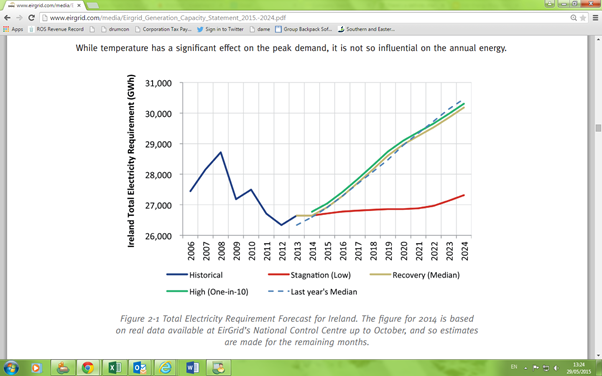
In Eirgrid's recent capacity statement, given a recovery scenario, demand for electricity by 2019 is forecast to equal demand at the height of the boom and after this it is forecast to exceed these levels. Ireland, like the UK, has a low energy to GDP ratio. We barely manufacture anything here, most of it is outsourced to China and India, so what exactly are Eirgrid expecting ? Perhaps there will be another industrial revolution, this time in Ireland. But in any event, I will put my blogger reputation on the line, and predict that these demand levels will not materialize. The rising cost of electricity for industry will surely drive any heavy industry out that might consider re-locating here - Irish Energy Blog, May 2015.


Many, if not all, reputable Irish newspapers published the view that new grid infrastructure was essential for increased demand without any question:

Others have identified “hidden” network costs they argue are necessary to facilitate wind. It is true that Ireland is currently modernising an electricity network that for many years suffered from chronic underinvestment. Current investments also support traditional generation, increased demand in the regions, and indeed a more responsive, intelligent and modern grid generally - Joseph Curtain, Irish Times March 2015.

Launched in October 2008, Grid25 is based on energy demand growing in the coming years - Paul Melia, Irish Independent, November 2014. 

The CEO of Eirgrid has now confirmed that Irish Energy Blog was in fact right :

Before the crash, construction made up a significant proportion of the GDP growth in the economy. I think we are all acutely aware that before the crash it accounted for more than 20% but now it is below 10%. What is driving economic growth today is very different. That in part is a reason the relationship between GDP growth and energy growth has changed. One no longer gets the close correlation we had in the years between 2000 and 2007 between GDP growth and energy growth. The make-up of the economy is different and cost competitiveness has become a significant focus for industry. Energy has become one of the areas where businesses have become acutely conscious of the need to manage their costs to ensure competitiveness. We only have to look at yesterday's announcement of the unfortunate closure of the Michelin plant in Ballymena to understand the impact of cost competitiveness on the sustainability of businesses. Businesses are much more conscious of managing energy costs. We are seeing the new standards in housing coming through in the new housing stock, so the use of energy per unit of residential housing is not as good. For all those reasons growth rates in energy are now not as correlated with growth rates in GDP - Fintan Slye, November 2015.


The reference to GDP is very interesting, this blog made that exact same point last May - Ireland, like the UK, has a low energy to GDP ratio.

The draft strategy reflects the change in economic circumstances and where we as a country, an economy and a society are now. When first developed in 2008, Grid 25, as it was then named, which included plans for the Grid Link project, was designed to ensure the electricity grid would continue to support the Celtic tiger economy with its high economic and energy growth rates. The past five years have changed that reality. There has been demand reduction to the point where estimated demand levels for 2010 will not materialise until 2025 - a 15-year delay - and, even then, growth rates will be less than a third of the rates previously forecast - Fintan Slye, November 2015.
This blog also pointed out this very fact - Grid 25 was based on the below graph - it didn't take a genius to figure out that things had changed since :


However, I still wonder whether the pylons will be required for wind farms in this region should they get planning. I would imagine the answer to that question is Yes. Do Eirgrid envisage that these wind farms will not receive planning permission ? The original document from which the above graph was taken is now unavailable and so one can't check but for certain I can remember reading in it that connection of renewables was another justification for the project.

Eirgrid's current statement on Grid Link seems to confirm that they are still accounting for more wind farms :

The Irish government committed to the EU that 40% of electricity generation would come from renewable sources by 2020. To achieve this target, EirGrid needs to connect significant levels of renewable energy in the south and east. As a result, we must improve the transmission grid in this area. We can then bring this new power from renewable sources and supply it to the entire country.

Finally, it's important to note EirGrid's legal obligation to connect electricity generators. As the national electricity transmission system operator for Ireland, we have a statutory function. Subject to direction from the regulator, this statute requires us to offer a connection to the grid for those who request it. When an electricity generator accepts our connection offer, we have to meet their needs. This means we are legally required to develop the grid in response to plans for new electricity generation, such as wind farms.


Tuesday, 27 October 2015

‘The Cloud’ Bytes Back - how Data Centres will cost Ireland dearly

Guest Post By David Hughes B. Arch CPMA, RIAI RIBA 


Cloud computing is now part of everyday life. From streaming services such as Spotify and Netflix to search engines and email from companies like Google and Yahoo to online storage services like DropBox… ‘The Cloud’ is both everywhere and yet seemingly invisible.

However in spite of its name, ‘The Cloud’ has some very earth bound needs and truly massive energy requirements. In fact, somewhat aptly, ‘The Cloud’ has overtaken world aviation in terms of its overall energy demand. 

These days Ireland seems to be a preferred location for the cloud’s physical footprint - data centres. These data centres will not simply serve Ireland’s data needs but the needs of all of Europe and beyond. This multiplies their energy impact on Ireland enormously and when you analyse the consequences, it is hard to see any silver lining.

To give an example Apple are seeking permission for a 240MW data centre in Athenry Co. Galway, which will create up to 215 jobs. The electricity consumption of this data centre will be the same as 420,000 Irish homes. This is ¼ of all Irish homes or every single house in Dublin City, Dun Laoghaire, Fingal and South County Dublin combined. Basically, the electricity needs of 1 Million people.

Electricity is a very expensive and capital-intensive form of energy. For every kWh coming out of a socket 2.7 kWh of Primary energy needs to be inputted at source. The transmission and distribution infrastructure or ‘grid’ is also massively expensive. This cost is ‘socialised’ and can account for 75% of a domestic electricity bill.

Cost Benefit Analysis?

As a society we may accept such costs to provide a benefit to 420,000 homes but is it really justifiable to socialise the same demand again for only 215 jobs? And Apple is only but one data centre.

Facebook’s 108MW centre will only create 40 jobs and use the energy of 180,000 homes.

In fact in total 1,000MW of data centres are projected for Ireland so on a pro rata basis will use the same energy demand as every home in Ireland.

40% Renewable Commitment.

In 2009 Ireland made a commitment to generate 40% of electricity from renewables. If we add this level of extra demand this makes that target much harder to achieve.

Last year the EPA stated that in relation to our 20:20:20 targets, we are only likely to achieve reductions of between 5% and 12% instead of the full 20% required. The SEAI calculates that the fine for this could be €1.6 Billion per annum.

The full 1,000MW of data centres could add 37% to overall electricity demand and will make our renewable targets proportionally harder to reach, the fines even higher again and last but not least will undo all of the CO2 savings to date.

In the end, trying to chase this growing demand from data centres, will spawn further Wind Farms, Pylons and Transmission lines and will leave the Irish with a second  ‘Universal Social Charge’ this time for either paying an EU fine or paying for the ‘grid’ or both.

Time for a Debate.

Given these figures it’s time for a debate on ‘The Cloud’ in Ireland. Are the numbers of jobs created in anyway justified in terms of its energy demands?

The responsibility seems to fall between a myriad of different agencies and departments pursuing different agendas but each with a focus too narrow to look at the bigger picture. As a result to date, data centres have slipped through the net unchallenged.

We are at a cross roads in terms of whether we follow a route of demand reduction or increase, however ‘The Cloud’ could create the perfect storm and sink Ireland into decades of legacy costs for very expensive and unnecessary electrical infrastructure, which could be just as painful as paying back the inflated property prices that lead to the bank bailout.


Sunday, 27 September 2015

Significant amounts of Generation in the pipeline

Eirgrid have announced that they are upgrading their transmission network to facilitate future increases in power generation.  Total planned generation will be 15,000MW by 2023 - three times that of peak winter demand. In otherwords, this is generation that is simply not required.


There is no mention of the cost or environmental impact of all this infrastructure. There is mention that in a period of volatile energy costs renewable energy sources can also contribute to cost competitiveness by reducing dependence on imported fossil fuels but as Irish Energy Blog has shown fossil fuel prices can come down in real life with investment in subsidized renewables preventing these savings from been passed on to the consumer :


Gas Prices Hit Six Year Low but still Electricity Bills rise


There is also the question of whether An Bord Pleanala (or the local planning authority) should carry out a cumulative assessment of this entire project, which includes new transmission and new generation, as it certainly looks like there will be significant environmental impacts.

Sunday, 31 May 2015

Eirgrid forecast higher demand than during the boom


In Eirgrid's recent capacity statement, given a recovery scenario, demand for electricity by 2019 is forecast to equal demand at the height of the boom and after this it is forecast to exceed these levels.


Ireland, like the UK, has a low energy to GDP ratio. We barely manufacture anything here, most of it is outsourced to China and India, so what exactly are Eirgrid expecting ? Perhaps there will be another industrial revolution, this time in Ireland.

It appears that Eirgrid are basing these high forecasts on data centres such as Apple moving to Ireland:
After some years of decline, demand in Ireland has shown some signs of increase. In the near future, more growth is expected to come from the expanding data centre sector which already accounts for over 200 MW of demand, and which is incorporated in our demand forecasts

 This means that data centres are highly energy intensive, consuming power equivalent to half the output of a conventional gas power plant on full load (Gas plants are usually 400MW). If this is the case, then erratic wind energy can in no way ever provide sufficient reliable power to a data centre. Some form of conventional back up power supply will always be required.

So why are these data companies always held up as a shining example by the green movement ?

But in any event, I will put my blogger reputation on the line, and predict that these demand levels will not materialize. The rising cost of electricity for industry will surely drive any heavy industry out that might consider re-locating here.