Showing posts with label non-synchronous power. Show all posts

Wednesday, 4 July 2018

Overcoming Grid Constraints Fails to Solve Inherent Problems with Wind Energy

In 2014, the maximum level of wind energy allowed into the grid was 50%. In 2017, this was increased to 60% and by November of last year trials were run at 65%.  So some of the obstacles to higher levels of wind energy such as grid constraints have been partly overcome, which theoretically speaking should result in higher wind outputs from individual turbines (the capacity factor). 

In 2014, the capacity factor for wind was 27%. In both 2016 and 2017, the capacity factor remained at 27% despite the higher wind penetrations allowed. 

An analysis of wind speeds shows that wind speeds were fairly similar for those years, with 2015 being somewhat higher.  I took a sample of six weather stations from around Ireland, the average wind speeds I obtained neatly fitted with the capacity factors for wind. 


Year2014201520162017
Average wind speed (knots)9.610.49.39.7
Capacity Factor Wind27%32%27%27%
Max wind penetration (SNSP)50%55% Trial from Oct55% Perm from Mar60% Perm from Mar - 65% trial Nov 

As can be seen from the last part of the table above, we went from allowing 50% wind into the grid to 60% and by the end of last year 65%. As wind had more access to the grid, we should have seen a higher capacity factor for wind.

This seems to suggest that we have already reached saturation point for wind energy. I would be interested to hear what people think. I have already written about market cannibalisation and diseconomies of scale. Here is strong evidence that supports that argument. Most of the best sites for onshore wind have been used up. The turbine layout at some sites is too dense and newer larger wind turbine models have failed to deliver any significant additional output. And after all, the wind resource itself is limited, particularly in Midland regions. 

Sources

Eirgrid Constraint Report 2017

http://www.eirgridgroup.com/site-files/library/EirGrid/Annual-Renewable-Constraint-and-Curtailment-Report-2017-V1.pdf

Wind speeds from Met Eireann website (in knots)

https://www.met.ie/climate/available-data/historical-data


2014
2015
2016
2017
Cavan
6.3
6.8
5.9
6.3
Kerry
9.5
10.3
9.1
9.3
Donegal
14.4
15.3
14.3
15.1
Cork
12.2
13.1
11.8
12
Tipperary
8.3
8.8
7.9
8.2
Carlow
7.3
8.2
7
7.3
All stations record wind speeds at 10m above ground level.

Note that total wind output did increase in 2017 by about 18% by adding an extra 530mw of wind capacity, an increase of about 20% on the previous years installed wind capacity. The capacity factor measures the actual output in relation to potential output if the entire wind turbine fleet had been operating at full output for the entire year. So theoretically if wind speeds increase so should the capacity factor. Or if wind speeds stay the same and the maximum level of wind permitted into the grid increases, then capacity factor should also increase.

Tuesday, 3 April 2018

Storms Linked to Power Station Trips

Eirgrid published this list of power station trips from the past few months:


I couldnt help but notice that most of these dates coincided with storms or very windy conditions:

5th october - Cyclone Xavier
12th october - Hurricane Ophelia
16th october - Hurricane Ophelia
21st october - Storm Brian
27th November - gale force winds
24th December - record wind penetration on the grid
3rd January - Storm Eleanor
17th January - Storm Fionn

It appears that as very high amounts of wind generation is allowed into the grid, the frequency can drop to a dangerously low level.


One of our key tasks is to maintain balance between electricity supply and electricity demand. Electrical frequency is the measure of balance between supply and demand. When supply and demand are balanced, the electrical frequency is at 50 Hz. We must maintain this balance on the system all day, every day. The normal operational frequency range is 49.8 Hz to 50.2 Hz [Eirgrid].

You can see from the above diagram that the frequency has dropped below 49.8Hz on a few occasions over this period.  As a result, the power station tripped and went offline. This then results in the frequency falling even further. At this stage, cutting demand is one of the few options open to the grid operator. This may explain some of the blackouts on these days.

Monday, 26 March 2018

The Energy Bubble is Clearly Unsustainable

by Owen Martin


The Energy Regulator has reported that there is currently a backlog of 36,000MW of renewable and conventional generation connection applications (See above graph). This would increase the current capacity of 10,500MW to a staggering 46,500MW if all of these applications were accepted. As the regulator points out we only have an electricity demand for about 7,000MW. 


Under normal circumstances, only capacity that replaced existing capacity or was required to meet additional demand or reserve requirements would be accepted. Now, because of the rush to meet EU targets, thousands of megawatts of inefficient and intermittent renewable generation are being added. Renewable generation, mostly wind and solar, make up about 70% of the planned generation figure. 


This will lead to a low capacity factor across the board, with all generators operating inefficiently and intermittently. As this blog reported recently, many wind farm companies are making losses. As more generation is added, the market share for all generators will be eroded and we will see more loss making generators. Which will require yet more government intervention to keep the lights on (and possibly another NAMA to be set up).


And it gets worse. The Grid will require a large upgrade as most of these solar and wind farms will be in remote and dispersed regions far away from centres of demand. The costs will simply keep rising exponentially. 

In particular, the CRU notes that the existing backlog of connection applications amounting to 36,000MW is already significantly in excess of the all-island total electricity requirement. Keeping the non-GPA process open to further applications during the consultation period would only increase this volume. This would potentially add to consumer costs with no discernible benefit. 

 For example, with this much renewable generation, it will become increasingly difficult to stabilize and manage the grid frequency. That is why more conventional generation is required to maintain stability and of course this adds to the costs. The Regulator refers to these generators as DS3 providers and has proposed giving them priority over renewable generation :
DS3 system services are required by the system in order to accommodate increasing volumes of non-synchronous renewable generation. The CRU decided in CER/16/284 that providers of those services will be prioritised for a connection offer under the non-GPA process, and requested the system operators to develop a process for this prioritisation. 

The regulator also plans on suspending some of the renewable generation which would of course be a wise decision and be in the interests of all consumers.  Naturally, the renewable lobby groups are not happy and have somehow managed to spin this as a decision that will "result in higher electricity prices." It's difficult to understand why they are lobbying for more supply in an already over-saturated market which will erode the market share of existing renewable generators. 

The energy regulator should stick to the facts and figures as presented in her document. That way she can defend her actions later. It could be the first time an energy regulator has stood up to the green lobby and protected consumer's rights. The Energy Bubble is clearly unsustainable. I for one am hoping that for the first time in recent Irish history, an Irish regulator does the right thing before it's too late.

Monday, 12 March 2018

Interconnector Fault Causes Problems for Wind Farms During Beast from the East


As the "Beast from the East" hit Ireland on the 28th February, things were looking good for wind farmers. The east winds were predictable and constant, unlike the variable westerlies that hit Ireland most of the time. Wind energy became baseload power for the first time on the Irish grid. On the 1st March, the capacity factor for wind was 80%, a power output normally reserved for coal or gas generation. However, a problem occurred on the morning of the 28th. The interconnector to the UK (East West interconnector) tripped out. This meant that surplus wind generation could no longer be exported to the UK. High amounts of wind generation would have to switched off or "curtailed".


Wind generation and forecasted wind during Beast from the East. Note how accurate the forecast was
with one notable exception (see later)

East West interconnector fault on 28th February


A further problem happened on the 2nd March as the storm reached it's peak. Power cuts became a frequent event. Power cuts are inevitable of course during storms and periods of extremely high winds, which is very unfortunate for wind farmers as demand for their product, electricity, is reduced just when their supply is at it's highest. In fact, over the four or five days of the "Beast", demand was relatively normal. This is in stark contrast to the Big Freeze event of 2010 where demand reached over 5,000MW (and wind generation was abnormally low). During the Beast, demand reached a high of about 4,600MW on the 28th February. The periods of highest winds (1st - 3rd march) saw demand reach only 4,200MW.


Demand all time peak 2010 Vs Demand during Beast from the East 2018

Power cuts on the 2nd March

 On 1st March, wind energy was generating about 59% of the total electricity production, one of the highest penetrations ever. However, by the next day, as power cuts became widespread, wind energy was been curtailed by as much as 45%. Nearly 1,200MW of wind was been shut down at 4am. 

The period from 1st to 2nd March was when the storm was at it's most intense in Ireland. 
Wind curtailment can therefore be calculated as the difference between forecast wind and actual wind. 
Forecast wind generation was actually equal to demand at times.
The frequency of electricity, normally static at 50Hz, became erratic during the storm as the grid
operator struggled to manage high wind penetrations. This is from the 2nd March.

Had the interconnector been in operation, 500MW of this surplus wind could have been exported.  Demand, in fact, dropped by 10% on the 2nd March compared with the day before, presumably due to the power cuts. 

These are problems that will only intensify as more wind capacity is added and more and more generators are looking to get a piece of the demand "pie". Interconnectors, like storage, seem like an easy solution in theory, but in practice things are often different. 


Monday, 25 December 2017

Technical Problems with High Levels of Wind on Christmas Eve

New Report Describes Total Decarbonisation Dream as Wishful Thinking


On Christmas Eve, wind was providing just over 60% of electricity demand. This is new territory for the Irish grid (or indeed any grid). Eirgrid began trials of allowing a maximum of 65% for wind energy (wind penetration) in November. Wind generation was also exceeding the wind forecast. 

Jolly good I hear you say. However, it can be troublesome balancing this level of wind as other plant are forced to run below their optimum efficiency. The additional unforeseen wind also creates more problems as scheduled plant are constrained off.  Variances in the frequency are a good indicator of just how much trouble these high wind conditions can cause. A stable frequency is required for a stable grid and a certain amount of conventional plant is required to maintain the frequency within a tiny range. 


As the wind level rises, the frequency falls below 50Hz. At around 15:40, some of the wind energy is shut off and the frequency returns again to 50 Hz.


These technical problems have been highlighted in a new report on the German electricity grid (Hidden Consequences of Intermittent Electricity Production).


Another important difficulty caused by intermittency is the increased vulnerability of the electricity grid to instabilities. This is particularly visible in countries that are not so well interconnected like Ireland. An example of a threatening oscillation occurring at a 400MW power generator (24/4/2014 between 21:40:40 and 21:41:00) is shown in Fig. 3 (adapted from M.Zarifakis et al.,  “Models for the transient stability of conventional power generations stations connected to low inertia systems”, Eur. Phys. J. Plus 132, No.6, 289 (2017), op. cit.).

Grid stability is now a major issue around Europe :
Further, if one keeps the current Alternative Current grid technology, a certain minimum amount (~ 20-25%) of “rotating mass” has to be present to guarantee stability.  If this cannot be sufficiently provided using biomass, and if fossil and nuclear based power stations are not allowed, problems will arise. Instabilities caused by large contributions of intermittent power e.g. from wind or solar PV pose a major threat to the stability of the electrical network of a country and to the safe operation of conventional generator systems, as exemplified in Ireland. If no economical solution can be found for such difficulties, conventional backup power based on fossil fuels or nuclear power will necessarily have to remain part of the electricity system.
Their conclusion is in agreement with the work carried out on this blog :

A last point is the economic feasibility of such a system. Germany, with currently an installed capacity of about 90GW in solar PV and wind, has one of the largest renewable systems installed in the world. The cost (including feed-in tariffs, subsidies, extra costs because of court cases due to unfulfilled promises etc…) is estimated between 250 and 300 billion Euros, integrated over the last 10 years. The CO2 reduction on world scale realized by this system is less than 1‰. As discussed above, a 100% iRES without backup or storage systems makes not much economical sense and will lead to a doubling or tripling of the total costs, compared to the conventional system in use now. It is to be expected that not many countries are able to pay for such a costly and inefficient system. The question can thus be raised if the current EU plans for the electricity sector are bound to fail? 

Finally, the electricity sector is only a minor part of the problem. If one wants to completely decarbonise our economy then one should also include other private and economic sectors. Given already the challenge of a 100% renewable electricity system and the complexity of replacing the present primary energy supply based mainly on chemical energy by renewables, this total decarbonisation looks to be wishful thinking, at least at the present stage of technology. Would it not be more useful to invest in research and development of conventional and new energy systems rather than blindly investing in an existing “green” technology which seems bound to miss its goal? The other question is whether decarbonisation should be our primary concern. Is this really the best investment for a better future for mankind, as discussed in B.Lomborg, “Cool It”?A critical assessment of the EU plans is also voiced in countries outside the EU, in particular the United States under the presidency of Obama. Does transforming the present primary electricity supply (based presently mainly on fossil and nuclear sources) into a 100 % intermittent Renewable Energy System, as imposed by the EU, need to be the challenge and moral quest of the 21stcentury? This will for sure affect our society and standard of living if current EU plans are not corrected for the problems that are emerging from the grand renewable experiment in Germany of the recent years.


The full report can be found here : 
http://revue-arguments.com/articles/index.php?id=76

Thursday, 16 June 2016

Rising Costs of Stabilizing Irish Grid

Synchronous Condenser in Australia (Wikipedia)

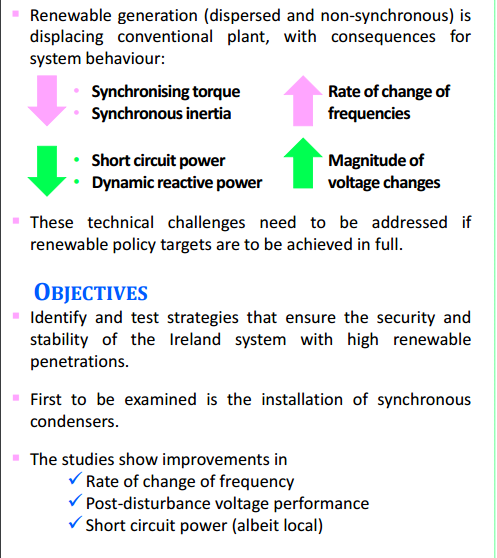
As levels of wind energy increase, fossil fuel generators and other devices are been called on to provide stability services to the Irish grid to help prevent blackouts. Its a simple engineering fact that as wind energy increases, the grid loses inertia and the frequency of electricity sent to your home becomes more difficult to control. The frequency of the Irish grid is set at approximately 50 Hertz, give or take about 1 Hertz, and all our appliances will not run outside this small range. 

Large power stations have trip switches that deactivate generators when the frequency moves outside this range so if the grid loses inertia for even a few seconds, there will be a cascade effect as generators drop out. A widescale blackout is the likely result. The rotational speed of wind farms is changing all the time and at different regions and it's because of this that they can't provide inertia to the grid. Gas and coal power stations are classed as synchronous generators because they provide stability to the grid, while wind farms and the East West interconnector are deemed non synchronous generators (SNSP). 

At the moment non synchronous generators are limited to 50-55% penetration in the grid. It is envisaged that this will have to rise to 75% in order to achieve the 20-20 targets. A consequence of this will be less synchronous generators online during high wind periods and increased risk of blackouts. So synchronous generators need to be paid more to maintain stability through what are called ancillary services.     


The diagram below shows that these ancillary or grid stability payments increased from € 24.5 million to € 26 million in the year to April 2016. 


POR means Primary Operating Reserves and SOR Secondary Operating Reserves. POR can step in up to 5 seconds and SOR up to 15 seconds to replace a generator that suddenly drops out. Tertiary Reserves (TOR1 and TOR2) take longer to start but can be maintained for longer time. These reserves are set by the single largest generator that happens to be online at the time, usually the East West Interconnector. However, demand for fast reserves, which are inefficient and high emitters, is increasing with higher levels of wind as wind fluctuations dominate the grid

The largest increase was for Reactive Power services. These are mostly provided by synchronous condensers which are able to provide stability in times of large voltage changes due to stochastic wind energy. Engineers at UCD provide a good overview of these devices here.  


Like battery storage units, synchronous condensers are net consumers of electricity but are essential for keeping the lights on with high levels of non-synchronous wind energy.  Adding units that consume more energy over their lifetime that they can generate is a consequence of the wind program and should have been included in a cost benefit analysis, which as we know, was never done.


Monday, 13 April 2015

The evidence that Ireland cannot become Denmark

And why Curtailment of Wind Power will become substantial by 2020


We currently have over 2,000MW of wind. Theoretically, we are at the stage where it should be easy to export some of our excess wind energy, which we can't use, to the UK as curtailment levels are still relatively small (in 2013 we curtailed about 3.5% of our wind) and should not pose problems to the UK system which is 11 times greater than ours. When we reach really high levels of wind, we will want to export a lot more surplus wind energy to our neighbours.

When you extract the data from Eirgrid's website (See here) for the year 2014, electricity exports to the UK amounted to just 6.5% of what we imported.  So for every 1MW of electricity that we import, we export just 0.065 of a MW. So what is going on ?


Days like the 23rd February 2015, give us a clue because large levels of wind penetration occurred. Figure 1 shows wind output which remained unusually high throughout the day - between 1,500MW and 1,969MW which is a record for Ireland (A similar analysis was done for 30th March here).


Figure 1: Wind Generation 23/02/15 - output was very high throughout the day

The shortfalls between the blue line and red line gives an indication of the level of wind 
curtailment that occurred.  Demand was about 4,000MW, so if we take 1,700MW of wind 
and 500MW of imported power that gives  us total non-synchronous generation of 2,200 - 
over half of demand. This means Eirgrid had to curtail approx 200MW of wind to keep 
within the 50% non-sync limit. 

So the logical thing to do would be to instead of curtailing this wind, export it through the interconnector 
to the UK. Figure 2 shows that we were actually importing electricity about 70% of the time, and 
close to the maximum permitted by the interconnector which is around 500MW. 

If we assume that average demand was around 4,000MW, then this meant that just circa 1,500MW of 
wind could be accepted by the grid (4,000*50% less 500 for the interconnector) at any one time because
we were importing electricity. 


Figure 2: EW Interconnector Flows 23/02/15 - we were importing close to 500MW of electricity from UK from 8am till 10pm


So the fact is that we are not able to export wind energy except at night. This means that a large proportion of our wind cannot be exported and the situation is exacerbated by the fact that high wind speeds tend to occur during daylight hours (as wind is a function of heat).

 When we get to higher levels of wind at 4,000MW or more, we will be at a stage where wind will sometimes exceed even the daily demand.   Taking into account all the constraints in the system - baseload plant that must be running, 50% limit on wind and interconnection etc - this means substantial amounts of wind will have to be curtailed (i.e wind farms will be shutdown) unless it can be exported - currently this is not the case for around two thirds of each day on average and we have no reason to believe this will change in the future.

This presents a problem for the Irish renewable experts because Denmark is often held up as an example of what Ireland can do. But Denmark has 6GW of interconnectors and can export wind at any time to Sweden and Norway. These countries have a lot of hydro which can be switched on and off at the flick of a switch to facilitate the intermittency of Danish wind. This then, perhaps, gives us a clue as to what is going on in the UK.

The UK has only around 900MW of hydro which is kept running as baseload power regardless of what wind is doing.  Figure 3 shows an example of a day with large levels of wind penetration in the UK system. Like Ireland, it is CCGT (gas plant) which is ramped down to accommodate the wind. The CCGT fleet in figure 3 has very low output which means they are running very inefficiently, like a car running in 1st gear. The UK do not want our wind at this time because, frankly, they do not have space for it. Nuclear must be kept running at baseload level and cannot be ramped down. There is a little more freedom with a coal plant but they too are designed mainly for baseload. An interconnector to France won't alleviate the situation as 80% of their electricity is powered by nuclear which cant be ramped down either.

And I might add that windy days in UK tend to occur at the same time as windy days in Ireland (see previous articles on this blog).


Figure 3: The UK system on a windy day

It will become all too clear in the coming years as to how this situation pans out but the phrase "badly thought out" springs to mind. Denmark, we are not, and can never be.

What this means is that it will be very difficult for us to achieve our renewable targets. The only way the UK will take our wind is if we compensate them for their CCGT running more inefficiently. This might sound like a mad idea (and yes it is) but the regulations already facilitate for such an arrangement - see here, its called negative pricing.

What this means for consumers is higher bills - either more payments to shutdown wind farms or payments to compensate the UK grid to take our wind (negative pricing).

By the looks of it, most likely Ireland will overtake Denmark in one aspect - as the country with the most expensive electricity in Europe by 2020.


Monday, 30 March 2015

One of the windiest nights of the year sees Ireland dependent on UK coal

With storm like winds hitting Ireland tonight, lets see how our electricity system is coping.

Jetstream Forecast

Between 9pm and 10pm wind speeds rose all around the country apart from 4 locations (click on picture to zoom in) :


So how efficient are our € 4.4 billion worth of wind turbines (2,200MW) at converting this energy sweeping across our country into power ?

Well at 9pm, they were producing 1,631MW and approx 218MW was curtailed. In otherwords, we shut down 218MW of wind power, about 12% of the potential power:


In the next hour, wind speeds rose in most areas around the country, notably in Cork and Donegal where most of the wind farms are (see Met Eireann data above).


Well, it turned out that our wind farms could not make use of this additional wind. Instead, wind generation dropped to 1,374MW, a drop in output of about 16%. Curtailment of wind rose significantly from 218MW to 483MW, an increase of 220%.  So 26% of available wind generation had to be dumped. Wind farm companies that have "Firm Access" will be compensated for this.

At 9pm we were importing 378MW from the UK (EWIC in the above graphs). By 10pm, we were importing slightly less - 340MW. Demand dropped in the same period from 3,790MW to 3,464MW, a drop of 326MW. As wind and UK imports do not provide the same type of power as that produced by conventional sources  - they are termed non synchronous generation sources - there is currently a cap of circa 50% on their use in the system at any one time (more explanation here). We can work out that total non synchronous generation (wind plus imports) at 9pm was 53% of demand, while at 10pm it was at a safer 49%. 

So part of the reason for all this curtailment of wind was to bring wind generation down to a safer level for system stability. But they had another option - switch off the UK imports and replace with the excess wind. But instead it seems that commitments made to the UK National Grid, or some other reason, meant that we were using power generated in the UK for 10% of our needs while at the same time shutting down 26% of available indigenous wind power. And what was this UK power made up of ? Well, the largest share was dreaded coal at 30% (which we are all taught to despise) and behind that was the even more dreaded nuclear (which we are all taught to fear) at 23% :


One can only wonder. Is there anyone left who actually thinks the people in charge know what they are doing here ? 

Why are we building more wind turbines when we are dumping more and more wind power ?


Saturday, 28 February 2015

Putting the brakes on


Wind turbine braking system
Example of brakes on a wind turbine

As I write on a very windy night in Ireland, we are curtailing 220MW of wind to keep non-synchronous generation under 50% of total demand (at times it reaches 51%).

But the remarkable thing is that we are still importing 150MW from England. Imported electricity is a form of non-synchronous generation, just as with wind. So in effect, it is competing with wind to get in on the grid in the restricted non-sync slot. So surely we should be allowing that additional 150MW wind in and exporting the surplus to the UK. But instead we are importing coal and nuclear power, when we could use up all our wind, and paying wind farms to shut down.

So we need to get the message. UK does not want our wind energy during the day and at peak times. They are generating enough of their own - 5.5GW at the moment and have no intention of ramping down their CCGT gas plants any further to allow Irish wind in. If they ramp them down any further, they will most likely use up more fuel and create more emissions than if they were running at full load (it results in inefficiencies like driving your car in first gear).

We cannot sell our excess wind to England whenever we want, only when they want, which is during the night when demand is low and they can pay us a low price.

The trouble is that Eirgrid and the authorities now know this so why are there still plans for exporting wind energy after 2020 ?

Tuesday, 11 November 2014

The Limit on Wind and Interconnection in the System


Graph for 18th October, 2014:


At present, the maximum amount of power from wind generation and interconnection that can be accommodated into the grid at any one time is 50%. This was confirmed by Eirgrid in their System Operational Constraints update back in March this year. In March, when the capacity factor of wind was 33%, this limit had been reached, with the excess wind power "constrained" off.  In December 2013, when wind had a capacity factor of over 50%, this limit was met on twelve different days.   Given this situation, it is curious that the current Irish energy policy revolves around more interconnection and more wind.

The problem is that wind and imported power provide "non synchronous" power which is incapable of providing the type of stable power produced from conventional sources. Exceeding this limit of 50% will alter the frequency of electricity sent to houses and factories damaging equipment and tripping the switches on the grid causing a blackout. There are efforts underway to change what is known as the "rate of change of frequency" (RoCoF) to try to accommodate more non synchronous generation but it is still not known if conventional plant can withstand these fluctuations or operate at the ranges required. Conventional generation operators claim that it could take several years before these questions can be answered. They are also worried about the costs involved with no additional benefits for them. Presumably, the consumer will eventually pick up the cost for this potentially disastrous experiment.

Eirgrid are now using a new computer tool since May called WSAT (Wind Security Assessment Tool) which monitors the amount of non-synchronous generation in the system at any one time. An example of the limit being reached recently can be seen on the 18th October (see graph above). At 14.45 during the day, wind generation was hovering around the 1,500MW mark. It had begun to rise further as demand had begun a downward trajectory. At this point demand was 2,985MW, Wind 1,561MW and the East West interconnector was exporting 54MW to the UK. The net non-synchronous power was 1,507MW, 50% of demand. Eirgrid then "shut off" 200MW of wind to bring back stability to the system. The new Great Island CCGT gas plant (presumably on testing mode) saved the day ramping up quickly to fill the gap. North Wall and Aghada OCGT also provided some additional peaking power from a more inefficient gas source.


So the next time you hear someone talking about powering the electricity grid with 100% wind or a politician talking about the need for more interconnection, you will know they are talking beyond their expertise.