Showing posts with label Electricity prices. Show all posts

Wednesday, 2 November 2022

Energy Crisis - Part Two Electricity Bills

Three ways Electricity bills could be made more affordable:


1)   Most wind farms in Ireland are (hypocritically) profiting from the current higher gas prices (Weren't renewables supposed to do away with expensive dirty fossil fuels?). When gas prices were low in 2014 and 2015, wind farms were getting the gas price plus a top up to a fixed price. Now when gas prices are far exceeding this fixed price, they are receiving the massive surplus. So it is a lose - lose situation for the consumer. It is an arrangement that is indicative of the parasitic nature of wind energy which can only be accommodated in a grid dominated by fossil fuel or hydro generation. 

This win-win arrangement for wind energy could be reversed so that wind farms only receive the fixed price originally intended or if that is not legally possible, the excess profits taxed at a special rate and handed back to the consumer in the form of reduced electricity bills.


2)  Time to pass on those savings - when gas prices were low in 2014/15, hardly any of the fall in prices was passed on to consumers. See the following newspaper articles :

2015 - "most firms are dragging their heels in passing on recent falls in wholesale gas and electricity prices to consumers".

Make some electric savings by changing energy supplier - Independent.ie


2015 -  "Irish consumers pay the fourth-highest energy bills in Europe, according to EU statistics. Little of the large recent falls in wholesale gas and oil prices have been passed on to consumers".


Airtricity was paid €32m to run power station for just 50 hours - Independent.ie


Not for the first time in Ireland, a Regulator failed to do their job. Pressure could be put on the energy companies to pass on that saving now, in particular, ESB which is semi state. Failing that, a special tax could be introduced which would be based on the pro rata decrease in gas prices over that period seven years ago.  So if gas prices fell by 20% over one year back then, then corporate taxes on energy companies could be increased from 12.5% to 15% with the additional taxes passed on to consumers of course. This would provide some justification for the tax, rather than simply hitting the energy industry with an arbitrary tax. 


 3) And of course, cancelling all carbon taxes would reduce the cost of all types of energy.


Saturday, 18 September 2021

Record Prices hit the Irish Electricity Market

 On Thursday the 9th September, prices in the All Ireland Electricity Market hit record highs of €4,680 per MWh, well over 20 times the normal price :


The scale here is from €0 to €5,000 MWh


What a normal day looks like, prices rise to about €150 MWh


These prices may have had something to do with the UK switching on coal plant that same week, the cost of which can be very high. Margins are set to get even tighter in the UK as this week one of the interconnectors to France went on fire causing wholesale prices to rise even higher there. Low outputs of wind energy have plagued both Ireland and the UK for many months now. In essence, high prices in the electricity market go hand in hand with low amounts of reliable generation.

There have been three Amber Alerts and seven Notifications of Tight Generation Margins issued this month in the Single Electricity Market (SEM). An Amber Alert means there was expected to be enough energy to meet demand, but possibly not enough in reserve should something go wrong. They can also be issued if there are significant frequency / voltage deviations which can happen when there aren't enough large power stations on the grid. The notification of Tight Generation Margins seems to be a prelude to an Amber Alert. 

System Alerts can go from Alert (Amber) to Emergency (Red) to Blackout (Blue) and finally to a Restoration state. Up to the end of August of this year there have been six system alerts on the grid. In the previous decade, they averaged just one per year.


Saturday, 26 December 2020

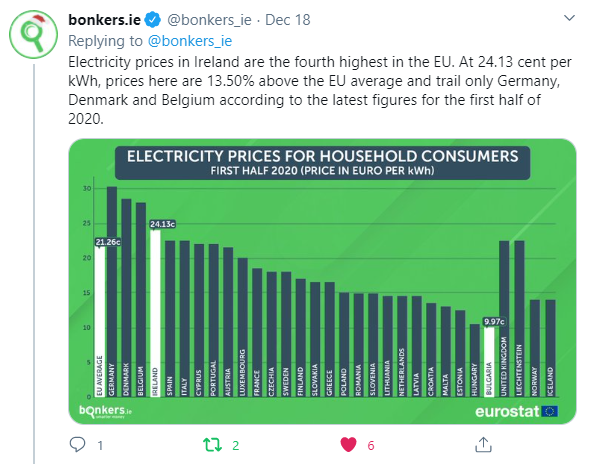
Electricity Prices have gone Bonkers !

Bonkers.ie rightly point out that Ireland has one of the highest electricity prices in the EU :


 But they fail to point out that this was not always so, an assumption one would make from their second tweet. If Ireland was always an island, then surely we always have had high electricity prices ? (Yes, I also hear you say but surely we don't have to import as much fuel now with all the windmills we've built - unfortunately bonkers.ie does not address this point either)


It's just a fact of life, they say, everything is expensive here in Rip Off Ireland ! 

Well the truth is that during the 1990s and early 2000s, Ireland had comparatively cheap electricity, even cheaper than the UK as economist Colm McCarthy has often pointed out.  Irish Economy.ie wrote this back in 2009 :

What puzzles me, however, is that Irish electricity costs were not always particularly high relative to our trading partners. In fact, a chart (figure 3) in the Department of Enterprise, Trade and Employment paper shows that electricity prices for industrial users in Ireland were well below those paid in the EU-15 for most of the 1990s, and were still no higher on average than in the rest of the EU-15 in 2002-2004. Yet in 2008 Ireland was the second most expensive country for industrial users in the EU-15. According to IBEC, Irish companies have seen industrial electricity prices rise by 70% since 2000.


We can see that Richard Tol and Colm McCarthy have been proved correct in the comments underneath the article :

Richard Tol

The fuel costs of wind are indeed zero. The capital costs are not. Without subsidies, wind barely competes — even in Ireland where the climate is favourable and other electricity is dear. Wind also has negative externalities for other power generators, first and foremost in its demand for reserves but perhaps also in higher cycling costs. 

colm mccarthysays:


The main things that have changed between the 1990s and the 2000s/2010s is the construction of 4,000MW of wind farms and supporting network infrastructure, funded both directly and indirectly in electricity bills, carbon trading and the growth of energy hungry data centres.  We are now paying the price for all of these ideological policies which have been implemented without any cost benefit analysis. There was also the change to the euro. 

It certainly has nothing to do with the importing of fossil fuels, most of which has been very cheap throughout much of the 2010s. 


Saturday, 28 November 2020

The Great Electricity Rip-Off

 Joe Duffy's show on Friday did a great job of highlighting the expensive electricity bills that many people are facing now :

https://www.rte.ie/radio1/liveline/podcasts/

Irish Energy Blog, Wind Aware Ireland and The Academy of Engineers have all been proven right, we warned long ago that society would be locked into high energy costs for many years because of the mad rush for wind energy at all costs. 

http://irishenergyblog.blogspot.com/2016/04/irelands-defunct-energy-plans.html

http://irishenergyblog.blogspot.com/2015/03/whats-in-your-electricity-bill-part-5.html

And it's not just because of the PSO Levy, wind energy drives up all of the system costs of electricity, such as network costs (more here).

The impact from high energy bills during a freezing winter may have a worse impact than Covid-19. 

Sunday, 4 October 2020

Higher Electricity Prices and Higher Emissions

What consumers were promised :

"We are introducing structural changes in the electricity sector that will create a more attractive investment climate for existing and new players, deliver increased competition, reduce the cost of electricity and offer greater choice for consumers” - Minister Dempsey, 2007

Electricity costs will fall in the longer term. The wind is going to be free forever and a day — there is no cost on that — the only cost is getting the technology in place - Minister Ryan, 2008.

DOUBLING the amount of wind energy on the national grid is key to preventing higher electricity bills in the future according to Energy Minister Pat Rabbitte, 2014

To date, developer-led onshore wind energy has been the most cost effective technology available to Ireland - Minister Ryan, 2020


What has happened in reality :

From 1st October 2020, electricity bills are to rise by almost €90 a year for more than one million customers. Electric Ireland will increase their prices by 3.4%, which will add €35 a year to the average bill, and PrepayPower will also be making a similar hike.

The PSO Levy will rise by 130% from about €38 to €88 per year. 

Electricity network operating costs and the cost of wind energy are the respective reasons cited for these hikes. Of course, the electricity network needs to be built out to facilitate more wind energy so this is an indirect cost of wind. 

And we are no better off as emissions have risen anyway :

Emissions from EPA 


I wont be advising you to switch energy supplier, the problem is a system problem, and switching just avoids us addressing the main issue here, which is our obsession with expensive and ineffective wind energy.