Tuesday, 25 November 2014

SEM-O confirms negative pricing in operation

In this document, on Slide 24, it states :

SMP (System Market Price) bounded by Market Price Cap (€1000/MWh and                    - €100/MWh)

So here we have evidence that wind energy can be exported to UK (and elsewhere) at a negative price. In other words, the Irish consumer will have to pay up to €100 per MW for the British grid to take excess unwanted Irish wind power. In Denmark, this already occurs with the Danish consumer paying neighboring countries to take their wind.

Yet another cost of having too much wind in the system......


Monday, 24 November 2014

Financial Crash waiting to happen ?

Green bubble update

I have since been contacted on my green bubble article here and updated it accordingly. The results sound pretty ominous. Are our politicians and Dept officials about to make the same mistake again ? 

This puts the total capital cost at € 8 billion, with Irish/EU banks exposed to € 6.4 billion in loans to a sector that must be kept afloat by long term unsustainable subsidies in the form of REFIT. Surely, as ESB pointed out in their recent submission on the Green Paper, these subsidies are not sustainable for a mature technology such as wind energy ? So you have to ask the question: are the banks really expecting these loans to be repaid ?

Tuesday, 18 November 2014

Dublin Electricity Generation - An Analysis Part 1


The first four days of November was characterized by very high winds. This article will focus on the CCGT generators in the Dublin / East Coast region over this period and will be covered in two parts. Some of this will get a bit technical - but alas, that is the nature of the subject.

Figure 1 shows Forecast Wind and Actual Wind and the profiles of 4 units in the region:
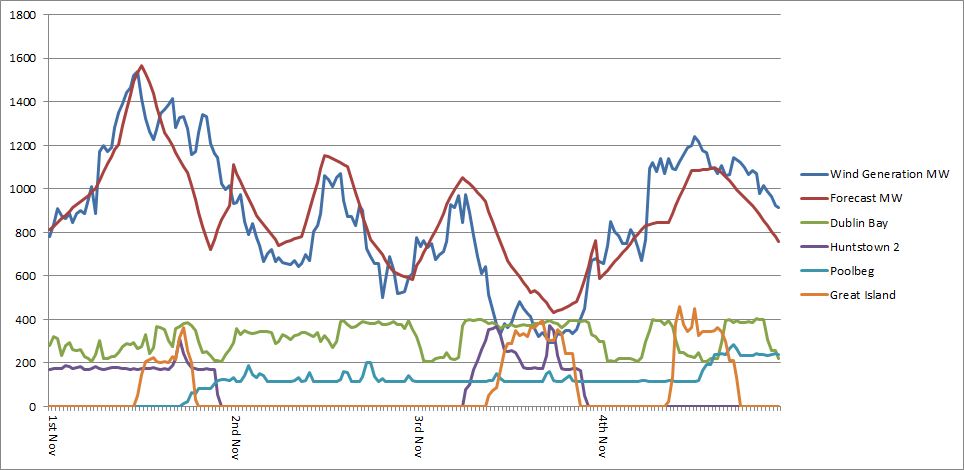
Figure 1: Total Wind Generation and Forecast for the Republic (Eirgrid) and Profiles of Dublin Generators (SEMO)
1st Nov - 4th Nov, 2014. Two fossil fuel plant must be running at all times for voltage.

Dublin has the largest electricity demand in the country and as a consequence, there is a requirement for two generators to be running at all times in the region to maintain voltage control. So we can see that Dublin Bay is run continuously and either Huntstown or Poolbeg is run alongside. Great Island is been run in "reserve", ramped up to full output when required. For example, on the 3rd, when the projected wind output did not materialize, Great Island and Huntstown saved the day. On the 2nd, Huntstown came offline and was replaced by Poolbeg, fulfilling the two generator requirement. But Huntstown did not shutdown completely. We know this because a CCGT cannot come online instantly. It takes a few hours to start from "cold" as the steam builds up pressure. It would therefore not have been possible for it to step in on the 3rd, within an hour of the wind dropping off, unless it was running in reserve. The wind output dropped by two thirds (from 976MW to 335MW) within the space of 4 hours as demand rose on the Monday morning. There was not much margin for error.

So there was total reserve, that we know about, with a potential output of 870MW running behind this period of high wind (Great Island and Huntstown 2). The regulations state that there must be back-up generation, known as reserve, equal to the single largest in-feed in the system, which usually works out at 480-500MW. But this is the minimum amount of reserve required and is usually made up of different types of generators with different response capabilities. These units are then run offline on "part load" with a combined minimum load of 480-500MW, but they would be capable of ramping up to full load if required, like what happened here.

Figure 3 shows the Scheduled Output (known as Market Scheduled Quantity or MSQ) for Huntstown for the day in the blue line. It was due to run at 11am as demand hit about 3,500MW. So it would have been kept "warm" during the early morning, running in reserve. It is possible that one of the other generators could have suffered a "forced outage", which would also have led Huntstown to step in earlier than scheduled. But in this case, the wind dropped out as the weather system moved on. In the former case, about 400-450MW would have dropped out instantly. In the latter case, the wind drops out at a slower rate but with a potential larger drop in output. In this case, it dropped out over 4 hours, but with a total loss in output over the period equivalent to about 1.5 times that of a conventional power station. So when comparing the two events, there are pluses and minuses, but with both you need "back-up" to plug the gap, as can be seen in the red line. Huntstown gradually ramped up over the 4 hours eventually reaching near max output. It also ran for a couple of hours more than scheduled later in the day as wind output remained below forecast.
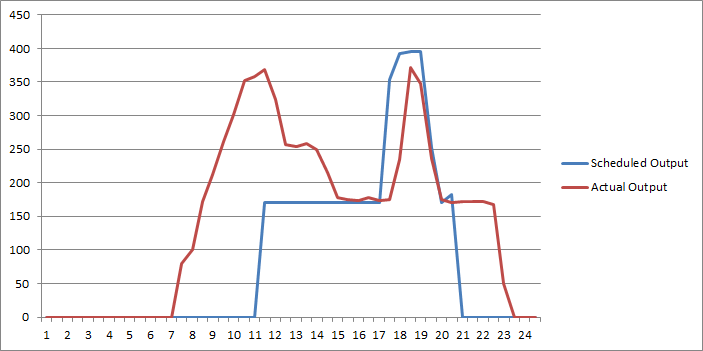
Figure 3: Huntstown 2 Scheduled Output Vs Actual Output (SEMO) - 3rd November 2014


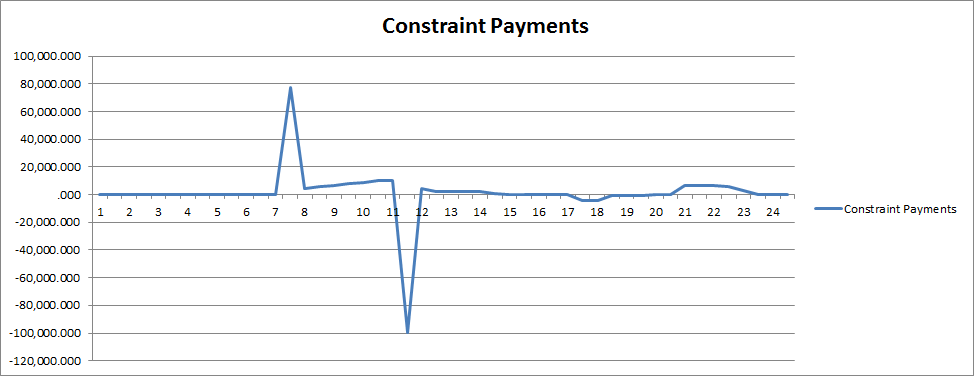
Figure 4 shows the constraint payments in Euros that the unit received for running in the system earlier than scheduled. They received a large payment at 7am for "constraining on" and had to pay back a large payment at 11am for "constraining off" as it's output fell, with smaller payments received over the rest of the day. The overall net effect was additional income of € 63,000 on top of Energy Payments of € 240,000 for the day. The Energy Payments are based on the Scheduled Output and the constraint payments are to compensate for running the additional hours outside the schedule. The unit would also receive Capacity Payments, for making capacity available during the day, in effect compensation for running in reserve behind the wind to cover the staff and fuel costs involved (exact amounts unavailable at time of writing).


Figure 4: Huntstown Constraint Payments for 3rd Nov, 2014. Euros (€) on Vertical Axis with Hour on Horizontal Axis


There are no constraint payments or Scheduled output (MSQ) for Great Island as presumably it is still in testing mode.

The need for additional reserve ?


Forced outages work out at about one per month on average. It is very rare that two units will drop out on the same day. This occurred just once this year - on 13th September, when one unit each from Moneypoint and Tarbert failed to come online. So the TSO (Eirgrid) will have to make sure there is surplus dispatchable plant available when these unforeseen events occur. But with high wind penetration, such as the above, additional risk is built into the system. Forecast wind that does not materialize, leads to a very similar situation as a forced outage of a conventional plant - there is a loss in projected output that must be met by other forms of generation. These over-estimated forecasts occur on average about three times a month (based on Eirgrid All Island Wind and Fuel Mix Reports), with varying degrees of lost output as one might expect. Figure 5 shows the All Island Wind Generation (dark blue line) and Forecast (torquoise line) for May 2014. There are a couple of quite large variances between forecast and actual wind output. (Reports for October and November will be interesting to see when available)


Figure 5: All Island Wind Generation and Forecast May 2014
The risk of this type of forecast error and a forced outage occurring on the same day is greater than that of two forced outages occurring on the same day. This event occurred three times this year - on 24th February (Moneypoint and a 200MW drop in wind), 7th (Lanesboro and a 300MW drop in wind) and 27th April (Moneypoint and a 100MW drop in wind). Of course, one could argue that the wind producing zero or near zero output like it did for long periods in July and September is also the equivalent of a forced outage.

So there is a need to maintain surplus conventional (dispatchable) generation, in a system without wind. But during periods of high levels of wind penetration in the system, such as we had during October and November, Eirgrid must maintain more levels of reserve (above the minimum required), i.e. fossil fuel plant on standby (kept "hot" and burning fuel), because there is always the risk that an error in wind forecasting, such as the above, will coincide with a failure or failures in fossil fuel plant. Eirgrid's Mission Statement is simple - "to keep the lights on", and that means covering for every eventuality.

Part Two will look at Poolbeg and Dublin Bay CCGT plants in more detail.

On a side note, in relation to the other type of forecast error, i.e. where wind generation is higher than the forecast (also occurs quite a few times every month), this does not necessarily lead to any benefit in the system either. This is because the additional generation occurs outside the Scheduled Output for Wind. More on this in a future blog post.


Saturday, 15 November 2014

Renewable Targets 2020

Can Ireland realistically meet its renewable targets by 2020 ?


Ireland has a target of 40% of electricity consumption from renewables by 2020. It is at around 20% at the moment. It is envisaged that the vast bulk of the targets will be met by wind generation. This graph shows how wind has been doing in the past few years:


The first thing that struck me is that the graph seems to be an inverse of a graph I published on a previous blog in relation to CO2 intensity (the third graph in that link). So the same logic applies - adding more wind to the system does not necessarily lead to an increase in the fuel mix for wind. Some 300MW of wind was added between 2011 and 2013 but we are still at about 16% of total fuel mix for electricity consumption. There's been a slight increase of just over half a percent from the position of wind in 2011. If we extrapolate this growth rate out to 2020, we come out with a fuel mix percentage figure for wind of 20.5% in 2020 (with a total installed wind capacity of 3,944MW). When you add in the other renewables (assuming Moneypoint won't be converted to biomass), unless a miracle occurs and God grants us high consistent wind speeds just below the cut out speed for a wind turbine, we will be well under the target of 40%.  

So one has to ask what exactly are the Irish authorities expecting from this huge over investment in electricity generation ? Even if they somehow manage to push through the planning system another 1,000MW to bring total wind capacity to 5,000MW, this will only bring us to 22%, with a total figure for renewables of 26% - 28%. They may be banking on an increase in large industry using their own diesel generation power, reducing demand, and increasing the fuel mix that way. But diesel generation capacity, (known as Demand Side Units), only stands at 160MW at the moment. Its hard to see it making a big impact, but is certainly one to watch in the future. This form of generation will appear off the books as most of it will be off grid so to speak. It's purpose is to reduce electricity consumption from the grid. In any event, one wonders how an increase in diesel generation is making a transition to sustainable forms of electricity generation.

There is also another potential problem in that some of the present older wind capacity will need to be replaced. There is some evidence from Denmark of technical issues with larger turbines of 2MW and above. Any difficulties in obtaining finance to replace old wind fleet or technical issues with the newer larger turbines will also pose problems.

Will the European Commission fine Ireland for not meeting its targets ?


Much is made in the Irish media of fines from Europe of €400 million for not meeting the targets. In reality, it takes many years of proceedings in the European Court before it ever reaches a position that a Member State is fined. In fact the number of times this has happened in the whole history of the EEC/EU is still in the teens. There is a website funded by the EU’s Intelligent Energy Europe Programme ‘Keep on Track’, whose function is to track the progress towards the EU’s 20% renewable energy by 2020 programme :


The website’s press release of 6th October 2014 could not be clearer: 
14 EU Member States will fail to meet their 20% renewables target by 2020, as progress stands today”.
Indeed France, Spain, UK and Poland are not expected to meet the targets :


And Germany is now in doubt after a reform of their renewable supports (EEG) in August 2014, which reduced significantly the previous generous renewable subsidies. This reform gained popular support due to the soaring electricity prices, amounting to a doubling of electricity rates, since these renewable supports were introduced in 2000. So it is clear Ireland will not be alone. Take for example Poland. 90% of Poland’s electricity comes from coal and the Polish Prime Minister, Donald Tusk, last year stated that (see link at bottom of page) :
"Poland will continue to back coal and invest in the coal-mining industry” 
Poland has never implemented generous support schemes for renewables.

The EC is also on a slippery legal footing when it comes to Member States Renewable Action Plans. In relation to Ireland, there are many complaints that our NREAP (National Renewable Energy Action Plan) prepared back in 2009 completely disregarded the provisions of the Aarhus Convention and International Environmental law. There was for example, no consideration of alternatives, no cost benefit analysis, no quantification of emissions savings, no Strategic Environmental Assessment, inadequate provision for public participation (only a two week timeframe), no means for members of the public to get affordable access to justice. One of the main principles of the Aarhus Convention, now ratified by 47 members, (eventually and begrudgingly by Ireland in 2012), is that the public should have a say in plans that affect the environment when all options are open. But the door has been closed on the public since 2009 after a poorly advertised two week consultation and the Irish State pressed ahead with large scale wind energy development plans. 

A complaint by a chemical engineer, Pat Swords, was accepted by UNECE Meeting of the Parties (which is the 47 countries to have ratified the Convention) in July this year :


So we now have the above declaration in International Law, which is automatically a breach of Community and National Law. This decision requires :

"that the Party concerned [the EC] ensure that the arrangements for public participation in its member States are transparent and fair and that within those arrangements the necessary information is provided to the public. In addition, such a regulatory framework and/or clear instructions must ensure that the requirements of article 6, paragraphs 3, 4 and 8, of the Convention are met, including reasonable time frames, allowing sufficient time for informing the public and for the public to prepare and participate effectively, allowing for early public participation when all options are open, and ensuring that due account is taken of the outcome of the public participation. Moreover, the Party concerned must adapt the manner in which it evaluates NREAPs accordingly" 
In essence not only does the Commission have to report on progress on the above to UNECE in December 2014, it already having being determined that progress to date has been inadequate with regard to its International Treaty Obligations, but proceeding further with the NREAP in Ireland is a breach of International, Community and National law, for which liability will most definitely ensue.

So we can see the difficulties the European Commission, itself having breached International Law in relation to the acceptance of Ireland's plan for meeting the targets, will have with taking Ireland to task over failing to meet those targets. In fact, the onus is now on the Commission to sort out the legal failings in Ireland's renewable plan.


Poland will stick with coal, PM pledges

Friday, 14 November 2014

The Green Bubble - are we heading for another crash ?

London financier warns of impending Green Bubble 


In an earlier blog, I showed that there are clear signs of an energy bubble in Ireland. In the above video, Per Wimmer speaks about an international green bubble. With banks leveraging up to 80% of the green industry, are our banks once again over-exposed to an over subsidized sector ?

We have around 2,000MW of wind energy in Ireland and it costs around €1 million to install a MW of wind. So that works out at a total capital cost of €2 billion. My own investigation into company accounts in Ireland shows that the 80% leveraging figure applies in Ireland too. This means Irish and EU banks are exposed to €1.6 billion in loans to the wind industry in Ireland**. The means to repay these loans is entirely dependent on REFIT, PSO and the other subsidies for wind energy which the consumer pays through electricity bills that are among the highest in Europe.
There are so many similarities between the green bubble and the credit bubble that it's almost scary - Per Wimmer
Investors in property were able to avail of a myriad of tax reliefs throughout the housing boom and once again investors in wind energy can also receive tax relief in the form of EII (Employment and Investment Initiative).  The housing boom was characterized by disproportionately high property prices and the green boom is likewise characterized by our disproportionate high electricity prices. There was a strong reluctance from commentators and the media to report independently and fairly on the housing boom. We can also see a very similar Group Think mentality with regards to wind energy.

Another interesting similarity is the lack of regulation. We have an energy regulator who is powerless to prevent the high electricity prices and green subsidies / levies, unlike in the UK where he can at least hold energy companies to account. And whilst the lobby groups main complaint during the boom was "too much financial regulation", in an Irish Wind Farmers Association / AIB document titled 2020 Energy Finance, it is stated that "to unlock more [wind energy] funding we need to remove regulatory barriers".

The only attraction for banks is the guaranteed income from wind energy in the form of subsidies, but how long realistically can households and industry keep funding this ?  As Per Wimmer points out, this is hardly sustainable green energy. In the latest PSO Levy Decision Paper, the regulator pointed out that cheap gas prices resulted in a lower wholesale price. But what will happen when the price of gas rises in tandem with the rise in wind energy subsidies in the next few years ?

Are we going to see another financial collapse or will we keep feeding the beast ?


Wednesday, 12 November 2014

Eirgrid Publish Winter Outlook

The report is available here:

http://www.eirgrid.com/media/Winter%20Outlook%202014-15.pdf

In summary, they are saying that there is an all island excess capacity of 2,920MW. But it is interesting that they have taken no account of the situation in the UK where National Grid recently stated that Britain's spare capacity has fallen to a seven year low, prompting emergency contingency plans to be put in place such as shutting down large factories during peak periods.

Surely in this climate, where the UK National Grid are considering restricting demand in their own country, they will also be reviewing exported power to Ireland via the two interconnectors ? In this scenario, where the interconnectors are switched off, this would leave an all island excess capacity of 1,848MW, leaving things slightly tighter than expected.

Over 2,500MW of Wind energy shrinks to 415MW !


When it comes to keeping the lights on in the depths of winter, you can't rely on wind energy, and that is why Eirgrid have written off 85% of the installed wind capacity on the island. Known as the capacity credit of wind, this is a measure of its contribution to generation adequacy and is very important when assessing the chances of delivering a stable supply of electricity as the nights draw in.

Increased oil use


The other interesting thing to note is that DSUs (Demand Side Units) have now reached 161MW in the South. This is where customers reduce the load on the grid by using their own dispatchable forms of generation, i.e. diesel generators. Since when did increasing oil use in electricity generation become part of a strategy to "de-carbonize our grid" ?

Tuesday, 11 November 2014

The Limit on Wind and Interconnection in the System


Graph for 18th October, 2014:


At present, the maximum amount of power from wind generation and interconnection that can be accommodated into the grid at any one time is 50%. This was confirmed by Eirgrid in their System Operational Constraints update back in March this year. In March, when the capacity factor of wind was 33%, this limit had been reached, with the excess wind power "constrained" off.  In December 2013, when wind had a capacity factor of over 50%, this limit was met on twelve different days.   Given this situation, it is curious that the current Irish energy policy revolves around more interconnection and more wind.

The problem is that wind and imported power provide "non synchronous" power which is incapable of providing the type of stable power produced from conventional sources. Exceeding this limit of 50% will alter the frequency of electricity sent to houses and factories damaging equipment and tripping the switches on the grid causing a blackout. There are efforts underway to change what is known as the "rate of change of frequency" (RoCoF) to try to accommodate more non synchronous generation but it is still not known if conventional plant can withstand these fluctuations or operate at the ranges required. Conventional generation operators claim that it could take several years before these questions can be answered. They are also worried about the costs involved with no additional benefits for them. Presumably, the consumer will eventually pick up the cost for this potentially disastrous experiment.

Eirgrid are now using a new computer tool since May called WSAT (Wind Security Assessment Tool) which monitors the amount of non-synchronous generation in the system at any one time. An example of the limit being reached recently can be seen on the 18th October (see graph above). At 14.45 during the day, wind generation was hovering around the 1,500MW mark. It had begun to rise further as demand had begun a downward trajectory. At this point demand was 2,985MW, Wind 1,561MW and the East West interconnector was exporting 54MW to the UK. The net non-synchronous power was 1,507MW, 50% of demand. Eirgrid then "shut off" 200MW of wind to bring back stability to the system. The new Great Island CCGT gas plant (presumably on testing mode) saved the day ramping up quickly to fill the gap. North Wall and Aghada OCGT also provided some additional peaking power from a more inefficient gas source.


So the next time you hear someone talking about powering the electricity grid with 100% wind or a politician talking about the need for more interconnection, you will know they are talking beyond their expertise.