Showing posts with label bank debt. Show all posts

Sunday, 27 December 2020

The Financial Wonderland of Covid-19

According to economic experts, Ireland does not have to worry about paying back the massive borrowings that were needed to fund the endless lockdowns : 

“Government debt does not have to be paid back, particularly the kind that sits minding its own business in the vaults of the ECB” - Chris Johns, Irish Times

 The problem with that is Article 123(1) of the Treaty on the Functioning of the EU :


 This means that it is illegal for any Member State to use the ECB as a bank overdraft facility.  The only reason why we can afford the luxury of endless lockdowns is our access to lots of free money. The Irish government have already borrowed €20 billion interest free this year and they plan to borrow another € 20 billion next year.   This is in addition to around €35 billion borrowed at very low interest rates since 2015 from the ECB's PSPP programme, prior to the covid "pandemic". So the free money bonanza that has enveloped the EU is not a new thing as some commentators have argued. 

All this free money being created by the ECB has resulted in the ECB becoming the largest single creditor of the member states in recent years. The German Council of Economic Experts have warned that this could present a threat to monetary policy independence in the long term.

In 2008, after the banking crash, the debt laden on to the backs of the Irish was paid back through taxation. This makes the situation at present different as there is no pressure to increase taxes. 

The natural effect of all this free money is massive inflation but we have not seen any sign of that yet (it may help to reduce government debt by de-valuing the euro). What is the most likely outcome - my guess is that we will see some inflation next year but more importantly negative interest rates will skyrocket so that most of the extra cash lying around on deposit will be recouped.   

There is already a similar precedent for this in the EU banking system, when deposits were confiscated in Cyprus in 2013 in what became known as a bail in. 

So as Mr Johns maintains, the ECB may well continue to play ball by printing infinite quantities of free money but the price will be an eradication of savings, either through inflation or negative interest rates or a combination of both. It will also mean that the EU will once again bend and mold its own laws laid down in it's treaties. This further erosion of the rule of law will sow yet more discontent within the union. 

Sunday, 22 September 2019

The Motor Industry is Unsustainable because of Debt


Gross new lending for car purchase was €2.1 billion over the past twelve months, the largest amount of new lending recorded since the series began. Non-PCP hire purchase agreements were the main driver of the increase in new lending
- The Central Bank of Ireland, August 2019


The number of motor cars could be reduced, if the Government really wanted to do it, by capping car loans for petrol and diesel vehicles. 

Instead, they prefer the more trendy and coffers-friendly solution of carbon taxes. 


Thursday, 26 July 2018

If We Really Care about Sustainability Then Lets Look at our Debt

by Owen Martin

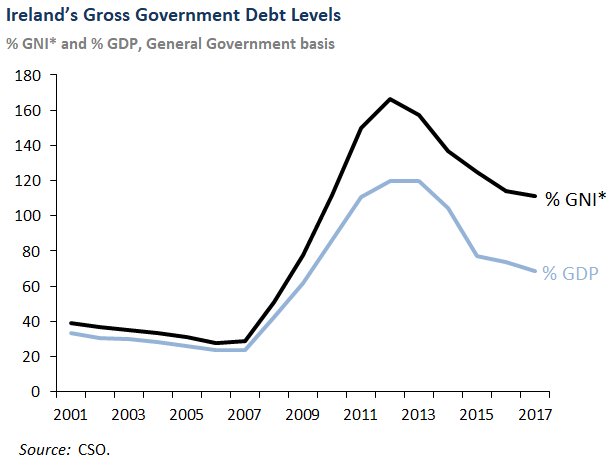
The chart shows the latest data for Gross Irish General Government Debt over the period 2001 to 2017, with the 2017 outturn showing a level of 111.1 per cent for debt-to-GNI*.


Ireland's debt burden is understated by standard GDP comparisons. Using adjusted Gross National Income (GNI*), which adjusts GDP for the impact of foreign multinationals who book their large non Irish profits here, our debt burden remains high at 111% for 2017. Our government still runs up deficits each year adding to this debt. Government spending is still out of control. 

Ireland's unemployment rate in 2012 was 16%, it is now at 6%, a fall of 62%. Yet, social welfare payments (excluding pensions) have only fallen by €2 billion, from € 14.5bn to € 12.5bn, a fall of just 14%.  How can this be justified?

Our EU contribution has doubled since 2012 to €2.6bn. Our already bloated health sector, one of the most well funded in Europe, has had an increase of €1 billion in it's budget. The funding for housing has more than doubled to €3.3 billion. Superannuation and retired allowances have increased by €50m to €570m. Foreign Aid spending has increased by €40 million to €500m.  Spending on public broadcasting has also increased, now reaching € 255 million.

This level of debt and spending is clearly unsustainable and allows us basically to consume resources beyond our means - the very definition of unsustainability. Yet many politicians from all sides want to increase spending and debt further, whether it's hikes in public sector pay or bringing in more migrants who require public housing and medical services.  

This should be target number one on the list for groups like the Citizen's Assembly. But of course it doesn't even feature in climate change discussions as climate policy is just another justification for more spending, more taxation and more debt. 


1) https://whereyourmoneygoes.gov.ie/en/
 

2) Unemployment rate was 5.8% in may 2018. population increased by about 4% since 2011, according to CSO.


Tuesday, 17 April 2018

ESB - A Financial Perspective

This post will be a longer examination into the financials of electricity generation plant around the country (mainly wind). It will get a bit technical in places but I will do my best to explain terms used. 

ESB is the largest energy company in Ireland and is 95% owned by the Irish State. Last year, it recorded a loss of €31 million after writing down the value of their generating assets by € 276 million. The operating profit before the impairment was € 490m, the lowest profit in the past five years.


Following impairment reviews of the generation assets ESB recognised an exceptional impairment charge of €276 million in relation to Moneypoint (€142 million), Aghada Unit 2 (€69 million), Synergen (€30 million), Poolbeg (€21 million), Marina (€1 million) power stations and €13 million across five wind farms

Moneypoint is a critical piece of infrastructure. Without it, the 400kv lines in the west of Ireland will have insufficient voltage to carry the power eastwards.  The impairment now means that Moneypoint coal power station is practically worthless. However, it must be noted that Moneypoint has been around since the 1980s.


Two of their power stations are to close altogether - Marina and Aghada (steam unit)
Capacity contracts were not accepted for ESB’s open-cycle gas unit at Marina and the conventional steam unit at Aghada and, after many years of excellent performance and service to electricity customers, once I-SEM starts in May, there will be no commercial basis for the continued operation of these units. 
The loss of the steam unit at Aghada will increase emissions from the site as this generator would be more efficient than the open gas cycle turbines built there around the same time in the 1980s (there still remains a separate and very efficient CCGT at Aghada built in 2010).

The published accounts do not show a breakdown of operating profit into fossil fuel / renewables (which seems to be a trend among the large energy companies), which would have been very useful.  But there are indications that the renewables part of their business is not performing as might have been as expected. 

Return on Capital Employed (ROCE) 

The Return on Capital Employed (ROCE) is used as an indicator for the Return on an Investment i.e. how much one pound spent on assets generates in profits. I have calculated it by taking the Operating Profit (profit before interest and tax) and divided by total assets less current liabilities.  The sweet spot seems to be in the 14-17% range and this crops up in successful companies from across different industries. Successful Irish companies like Ryanair, Kingspan, Glanbia and Kerry Gold have ROCEs in the region of 14 - 17%. In the UK, Marks and Spencer's recent report shows an ROCE of 14%


The ROCE for ESB seems to be around 6% historically. The highest I can find was 10% in 2007 when the prices of fossil fuels peaked. It now stands at 4.6% for 2017, which is historically low.  It has dropped every year for the past three years from 6.5% to 6.1% to 4.6%. Low wholesale prices are of course a contributing factor. However, the average wholesale price rose from €41.82 in 2016 to € 47.48 in 2017 so we should have in theory have seen an improved ROCE ratio.

Comparable companies like SSE and E.ON have recently reported ROCE ratios in the region of 10% so ESB's ratio is comparatively low.

Interest Cover

A company needs to have enough profit left over from paying normal business expenses to cover interest payments on their loans. From Investopedia:
The interest coverage ratio is used to determine how easily a company can pay their interest expenses on outstanding debt. The ratio is calculated by dividing a company's earnings before interest and taxes (EBIT) by the company's interest expenses for the same period. The lower the ratio, the more the company is burdened by debt expense. When a company's interest coverage ratio is only 1.5 or lower, its ability to meet interest expenses may be questionable.

ESB in 2016 had a healthy interest cover of 3.5. However, this has dropped below the safety threshold to 1.1 in 2017.


Financial Statements

I will only be taking a look at the Generation part of ESB's business. ESB also have a retail and grid development business. The financial statements for the gas power station and wind farms are published on the CRO website. Only financial reports for 2016 and 2015 are currently available. There was a deterioration in profits in 2016.  Presumably, things got even worse for the company in 2017. 


Gas power

A look at the most recent accounts (2016) of ESB's gas power station in Dublin shows that it was still making good profits despite the low gas prices. Dublin Bay (400MW) made net profits of €28m and €43m in 2016 / 2015. The drop in profits was presumably due to a drop in wholesale prices of 18%. It had very healthy ROCEs of 19% and 29%.  With accumulated profits of €41m by the end of 2016, the power station was doing very well. In 2015, a dividend had been paid out of € 37 million. It proves that the business model for gas generation is still very strong. The power station was built in 2002 so a very strong performance after 13-14 years of operation. 

Of course, it is based in a high demand centre and is generating power to the grid most of the time. I was unable to find financial statements for any other power stations. I presume most of the other ones wouldn't have been as profitable.

Wind power

I looked at the financial statements of nine of ESB's wind farms in the South of Ireland. A total of 175MW of wind generation. 2015 is a good year to begin with as most of the farms had high load factors, equal to or above the national average of 33% (except for one - Derrybrien). All wind farms made an operating profit, however two made net losses, most notably Garvagh Glebe, a 26MW wind farm in Leitrim which made a loss of € 480,000 despite having the highest load factor at 42%. This was because of very high interest payments - which were about 45% of turnover. 

The average ROCE was 6%, in line with the overall average for ESB Group. Another Leitrim wind farm, Blackbanks, had the highest ROCE at 11%. Blackbanks has a smaller 10MW output and interestingly has smaller (0.85kw) turbines than nearby Garvagh which has 2MW turbines, yet the smaller wind farm had double the ROCE of the larger one (remember that ROCE is based on profit before interest). This seems to fly in the face of conventional wisdom that says the bigger the turbine, the bigger the return.

Combined operating profits in 2015 for the nine wind farms was € 9.2m and net profits was € 2.1m. Depending on how you measure it, this gives an operating profit of €52,000 per MW and net profit of €12,000 per MW for 2015. Compare this with the gas power station in Dublin which had an operating profit of € 127,000 per MW and a net profit of € 107,000 per MW in the same year. Gas power was 2.5 times more profitable in 2015 than wind before interest and and nine times more profitable after. Operating profit, however, is the best way to compare the two generation sources as the gas power station had paid off most it's loans by 2016 and so had very low interest payments. Therefore, gas, which has fuel input costs, is two and half times more profitable than wind, which has no fuel input costs (and wind gets priority on the grid). This fact deserves a separate article on it's own but presumably the much higher load factor for gas has a lot to do with it.

By the end of 2015, accumulated profits from all these wind farms was € 14 million. One dividend of € 1.5m was paid out by Mount Eagle wind farm in Kerry. Again, this wind farm has the smaller older style wind turbine. 

In 2016, the average load factor was still decent at 31% but the ROCE had switched to negative. All wind farms made a net loss apart from two. Combined losses for the year were € 5m. Over the two years, combined losses were € 3m. 

In 2016, interest cover went from positive to negative. Average interest cover over the two years was 1.09, which falls short of the recommended baseline of 1.5. The ROCE would need to rise to at least 10% to reach a safe interest cover and to 15-16% to reach an ideal one.

The worse performing wind farms were the larger ones built in 2010 and 2011. The larger 2MW turbines on average cost 4.5 times more than the smaller older models for 2.3 times the capacity.  In fact, these newer wind farms had high accumulated losses by the end of 2016 of € 6m and some had notes in their accounts stating that they were dependent on financial support from ESB group, which indicates that the higher output from their bigger turbines was not enough to compensate for the additional associated costs.

Two dividends were paid out, € 1m from Mount Eagle and € 1.5m from Blackbanks, both older wind farms with smaller 0.850KW turbines. They were both in good financial health by the end of 2016. 

In total, ESB group had loans outstanding of €170 million to all nine wind farms by the end of the year. 

In 2017, total impairments for wind farms was € 13 million. In Northern Ireland, the value of a wind farm in Tyrone had been written down by nearly €5m :
A review of the Hunters Hill 20 MW wind farm in Co. Tyrone, Northern Ireland was undertaken at year end. An impairment loss of €4.9 million has been recognised in the income statement in respect of this wind farm. This impairment has arisen as a result of a reduction in load factor.
ESB Networks division were also investing heavily in the grid infrastructure required to support renewables :
The focus of the 2017 investment in the transmission network was on continuing the reinforcement of the system to facilitate the connection of new renewable electricity generation. 
Capital investment in the networks businesses continued in 2017 with €644 million (74% of total capital investment) invested in the networks infrastructure in ROI and Northern Ireland (NI)
Conclusion

ESB's traditional generation model in Ireland has changed from investment in reliable power generation to renewables. However, there are signs that things have not turned out quite as planned with wind energy, in particular the newer and more costly wind farms have built up considerable losses. In essence, the older profit making gas generation fleet is subsidizing the newer loss making renewable generation. The older and smaller wind farms may well be benefiting from better sites, but it could also be the case that the smaller 1MW technology is more efficient. These smaller wind farms have by and large turned out to be good investments.  The same cannot be said for the more recent wind investments.

There are still gains to be made from conventional baseload generation. As the grid becomes increasingly unstable in the future, there will be gains to be made for ESB in building fast acting fossil fuel generators that can be switched on quickly. If Moneypoint is converted to gas, it will certainly be profitable like Dublin Bay, but will leave ESB (and Ireland) increasingly dependent on gas lines from the UK which may not be as dependable in the future

Wholesale prices are recovering so we should be seeing better profits for ESB. Investing in large loss making wind farms may be negating some of the benefits from higher wholesale prices. Other benefits from investing in wind farms such as carbon credits are no longer financially lucrative as the carbon price has fallen too low. ESB's investment in wind energy should be reviewed.

ESB Financial Report for 2017 : https://esb.ie/docs/default-source/investor-relations-documents/annual-report-and-financial-statements-2017-single-pages.pdf?sfvrsn=dae93bf0_2

Sunday, 8 April 2018

Brookfield Renewables Sale Part 2

Canadian company Brookfield Renewables sold two wind farms to Greencoat Renewables last week - Knockacummer and Killhill. I took a look at Knockacummer in my last post. This time I will examine Killhill.  Things don't look any better from a financial point of view.

Killhill is outside Cashel in Co.Tipperary. It has sixteen Enercon 2.0 MW turbines and was commissioned in 2014. The latest accounts show operating profits for 2015 and 2016 but a net loss for both years after interest is accounted for. In fact, since it came into operation, it made a loss every single year  and now has accumulated losses of nearly € 900,000. It had net current liabilities of €3.2m and was completely dependent on financial support from Brookfield, the parent company, to meet it's debts. There were about €37m of loans outstanding by the end of 2016. 

Im speculating, but it could be that the banks will be paid out of the sale proceeds leaving the company completely financed by equity under Greencoat. This could account for the apparently large, but undisclosed, sale price of both wind farms. 

Thursday, 5 April 2018

Canadian Company Sell a Loss Making Wind Farm for a Profit to State Backed Investors

A wind farm sold for a profit in the region of €7 million last year made a net loss of € 4 million in the latest accounts filed with the companies office for 2016.

The wind farm, Knockacummer, in Cork, has a capacity of 87.5MW, was commissioned in 2013 and has thirty five 2.5MW turbines. It was sold by Canadian company Brookfield Renewables.

It paid interest of € 12m (at 7.5%) in 2016, which was 54% of it's turnover. The interest was higher than it's operating profit which turned the profit into a net loss. It also made a net loss in 2015. 

At 31st December 2016, it was carrying Accumulated Losses of € 5.7m.

It's outstanding loans stood at €145m at end of 2016. €3.8m of which was written off by Brookfield during the year. The company was financed by loans from Brookfield, which in turn was financed by external loans. 

The buyer was Greencoat Renewables. Last year, the Irish State, through ISIF and AIB, acquired a 33% stake in the company. Which could potentially rise to 49%

Greencoat also bought another loss making wind farm, Lisdowney, last month

One has to question as to why the Irish State is helping to purchase loss making wind farms. Are we looking at another NAMA in the making ?


Saturday, 22 July 2017

Why are Politicians Obsessed with Climate Change ?

by Owen Martin

The Irish government has recently had to endure scandal after scandal in just about every department - justice, health, finance, housing etc. But there is still only one issue in town - climate change.
Fifty years on and there has been a clearing-out of another generation, this time by the running, shorts-wearing avocado smashers. To what will they bring their focus, energy and vigour? One thing they have promised is to take climate change seriously. On election as Taoiseach, Leo Varadkar said he wanted to see a new ambition on climate change. But he and his colleagues should do more than that; they should define it as the most important challenge to be faced; they are, after all, in Andrew O’Hagan’s phrase, the “globally warmed generation” - Diarmaid Ferriter, Irish Times

This week, yet another National Mitigation Plan was announced by the government to loud fanfare. 

David Whitehead, a geologist and paleoclimatologist from Galway, lays out quite simply the futility of the Paris Agreement and such climate mitigation plans as they relate to Ireland :


A peer-reviewed paper in the Global Policy journal has modelled the impact of the CO2 emission reduction promises, called Intended Nationally Determined Contributions (INDCs), made ahead of the Paris climate summit. The climate impact of all Paris INDCs, if every nation fulfilled them by 2030, which is most unlikely, and if the climate models used to assess the temperature effect of CO2 emissions are accurate, which is perhaps even more unlikely, the temperature reduction would be 0.048°C by 2100. If the INDC’s were extended for another 70 years and every nation fulfilled them by 2030, and continued to fulfill them until the end of the century, and there was no ‘CO₂ leakage’ to non-committed nations, the entirety of the Paris INDCs would reduce modelled global temperature rises by just 0.17°C by 2100.  The Irish Times cannot have it both ways; if the models are correct the impact of the Paris agreement is negligible and if they are incorrect the rationale for the Paris Accord is unfounded. Paris is just symbolic virtue signaling by western governments and less developed countries signed up because it promised them large cash transfers. Now Turkey states that unless it receives the money it will not ratify Paris. Other countries will follow. Ireland is the second most carbon efficient economy in the world in terms of CO2 emissions in relation to GDP, and would probably be first if our GDP figures were correct, which we all know they are not.  Ireland is also the most carbon efficient economy in the EU and so for us to be pay huge  fines  levied by the EU for a failure to meet the  2020 and 2030 CO2 emissions targets, agreed to by Eamonn Ryan on ideological grounds, would be  economically  very damaging and  an act of political lunacy -  David Whitehead. BA(Mod. Nat.Sc.)TCD, FIMMM, C.Eng.

These facts are not secret nor are they in any way over complicated for policy makers and the media to understand. If climate change is a serious threat to the world, Ireland can play no role in combating it and in any case we are at present a very carbon efficient economy. So our politicians should be fully focused on the other big issues they urgently need to deal with. 

Ireland has a serious debt problem, the worst in the EU relative to our GDP. We have out of control public sector spending. Our public sector workers enjoy far higher salaries and pension entitlements than those in the private sector. Our social welfare spending is much higher than the EU average.  A housing bubble is manifesting itself once again in Dublin city. Despite spending more on health than anyone else in the EU, apart from Iceland, we still have a dysfunctional health system. Elements of trusted organisations like the police force, care and charity organisations have revealed themselves to be corrupt. Pension funds are repeatedly raided by our cash hungry government. The idea of retiring in your 60's on a state pension seems less and less likely by the day.  Socialist dogma coming from the media and government opposition benches prevents even a debate on most of these important issues, let alone solutions to be put forward. 

If nobody in the House of Lords has never heard of the economic theory "comparative advantage", then you could safely bet a lot of money that nobody in either two parliaments in Dublin have heard of it.  

One more anniversary. 200 years ago, 1817, saw the publication of David Ricardo’s Principles of Political Economy, which contains the first exposition of the principle of comparative advantage, a thoroughly counterintuitive idea that was once described by Paul Samuelson as the only proposition in the whole of social science that is both true and surprising.Comparative advantage takes Adam Smith’s division of labour one step further and explains why free trade benefits everybody, even countries that are the worst at making things, even countries that are the best at making things. But it also, in my view, explains prosperity – what it is and why it happens to us and not to rabbits or rocks - Matt Ridley, the case for Free Market Anti-Capitalism

The fact is that it is not our energy or climate policy that is unsustainable. It is our massive debt, welfare and government spending that is unsustainable. It is the raiding of pension pots and rainy day funds that is unsustainable. It is our high income taxation policy that is unsustainable. It is the PSO levy that is funding renewable energy projects that is unsustainable. The government must know this and they know, because of our education system, that there will never be a free market anti capitalism system as Matt Ridley describes that might help address these problems. Although perhaps its too late for that now anyway.

So the government must propagate the idea that the end of the world is nigh anyway. They must call attention to a problem much bigger than all these issues and then use all the instruments of the State to help fight it.  They must choose an issue that most people do not understand. And this is where climate change comes in. No longer do the politicians have to deal with the real issues. They can continually make themselves look good to a gullible public by pretending to combat a fake and larger enemy until the house of cards does finally crumble. 


Friday, 24 February 2017

Ireland's Debt Problem

An economic policy based on rising debt and low corporate tax rates is not and never was sound policy - by Owen Martin

While the Irish media make a fuss over who will be the next leader of Ireland's biggest political party (Fine Gael), everybody ignores the real elephant in the room. According to the European Banking Authority, Ireland has the largest combined private and government debt as a percentage of GDP in the EU and two thirds higher than that of the US. 


 I'm not sure how this graph is not sending shockwaves through the Trump obsessed Irish media and political establishment - From EBA 


While Greece, Italy and Portugal have higher Government debt, Ireland's private sector debt to GDP dwarfs those countries. Which means that for the size of Ireland's economy, it's private sector has taken on alot of debt.

But not only businesses and industry. We have the 5th highest household debt as percentage of net disposable income in EU with about twice as much debt as income per household. This may explain how we rank so high in numbers of new cars across the EU.   People are taking out car loans that perhaps they can't really afford. It shows that we as a nation are still addicted to debt.


Denmark, Netherlands, Iceland and Norway all have higher household debt than Ireland but these countries are doing much better when it comes to Government debt as percentage of GDP. Ireland ranks 5th in terms of Government debt to GDP. So while Greece and Italy have higher levels of government debt, they have about half of the household and private sector debt. Denmark's high level of household debt doesn't seem as bad considering they have half of Ireland's Government debt to GDP. 


Norway have the wealthiest government in Europe. In fact, they are far ahead of second place Luxembourg and Finland. Norway has slightly more household debt than Ireland. But that kinda makes sense - they are a wealthy country. Ireland has the 5th poorest Government in Europe (Italy and Greece lie at the bottom). Our government has dismal revenue, in part thanks to our low corporation tax rates. Yet we carry roughly the same household debt as Norway and have an even higher private sector debt to GDP.  This is called "living beyond our means".  Yes, Ireland could do with the € 13 billion in tax revenue owed from Apple. Laughably, the Irish government is appealing this decision


Irish Govt has the worst revenue in Europe yet reject a €13 billion EU tax ruling made in Ireland's favour

Of course if all that debt was used wisely, perhaps we could become richer. We are reliant on Norway's gas which arrives to us through UK pipelines. The Irish government have banned fracking so this dependence will continue for the foreseeable future. Imagine if some of that debt was being used to extract our own gas reserves.


Ireland spends the most on health after Iceland in Europe, yet we still have a permanently dysfunctional health system

Ireland has the third highest electricity prices in Europe.

The Irish government takes pride in divesting from fossil fuels and pushing through massive renewables and electricity infrastructure programmes that cost billions and without any proper assessment in the name of climate change.  We pride ourselves on having a massive welfare program and our representatives want to take in more refugees (without any proper assessment). Green/Left politicians cry out as to why we don't do more to tackle climate change, take on more debt (One cannot go the EIB looking for €5 million or €10 million; one needs to go looking for €2 billion. It is there.) and take in more refugees. Ireland is trying to save the world on a sinking ship but our politicians and media don't even realize we are on one.  Have we learned anything from the crash in 2008 ?


POSITIVES


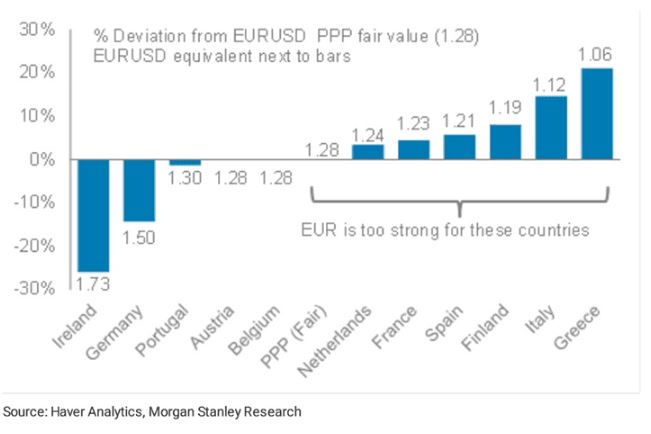
On the positive side, exports are still strong and benefit from the stronger dollar as against the euro. If we went back to our own currency, it would be a strong one as the above graph shows. Presumably thanks to our exports. However, the weaker sterling is not good for exports to Britain. There is a chance that Ireland may actually benefit from Brexit if companies there relocate to Ireland. 


https://data.oecd.org/gga/general-government-deficit.htm#indicator-chart


Ireland has managed to get out of it's budget deficit abyss and back to something fairly normal. If Multinationals move out we could see some real problems, but we would no longer see the massive distortions to our GDP anymore. Perhaps that could be a good thing in the long run. Living on a false economy (now known as Leprechaun economics) is what got us into trouble last time.

I can't see how Ireland's economic fundamentals are much different to that of the Celtic Tiger era.   If anything, things have got worse.

Sunday, 12 February 2017

Price of Electricity and Renewables Revisited

Previous work by Willis Eschenbach and Euan Mearns showed the relationship between Electricity costs and per capita installed renewable capacity. A new European Commission report shows the increases in electricity prices since 2010. I put this on a graph alongside the increase in share of electricity from renewable sources [Figure 1].


Figure 1 : Increase in electricity prices 2010-2015 plotted alongside increase in share 
of renewables in electricity generation 2010-2014

So the UK went from renewables providing 7% of electricity generation in 2010 to 17% in 2014 resulting in almost a 50% increase in prices over the same period. Ireland is in the top five increases in electricity prices over this period. Denmark seems to be an outlier (although they started off from very high prices) but most countries who invested heavily in renewables saw a sharp rise in electricity prices. 

Something that struck me was the proliferation of PIIGS countries at the top of the graph. So I labelled the top government indebted countries on the same graph [Figure 2] :


Figure 2: Top 7 member states with highest Government debt as % of GDP 


Greece, Italy and Portugal are the top 3 indebted countries in the EU (Debt of general government, as a percentage of GDP). Most of the countries investing heavily in renewables are also running up the biggest fiscal deficits. They have put environmental sustainability above economic sustainability. However, surely the two are linked ? If capitalism is the driver of climate change then living beyond your means must be twice as bad.


References
_________________


1)  Monitoring progress towards the Energy Union objectives – key indicators - see Page 62
https://ec.europa.eu/priorities/sites/beta-political/files/swd-energy-union-key-indicators_en.pdf

2)  Share of electricity from renewable sources in gross electricity consumption (%) - unfortunately this only goes up to 2014, whereas the prices in 1) goes up to 2015, so if a more recent report comes out I will update this blog. Still, Figure 1 is indicative of the electricity price/ RES-E trend.

3)  Risk Assessment of the EU Banking System - See Figure 1

Monday, 29 June 2015

The economics of electricity generation


The general definition of economic sustainability is the ability of an economy to support a defined level of economic production indefinitely - Thwink.org 
Able to be maintained at a certain rate or level  e.g. "sustainable economic growth" - Definition of Sustainability, Oxford English Dictionary


Traditionally, when you wanted to build a new gas plant, you obtained a bank loan on the basis that the output and hence income of the plant could be determined in advance and was at a price linked to the wholesale cost of gas. There would be a certain amount of downtime for maintenance but your plant would be running for most of the year. This meant that the bank was satisfied that you could meet your repayments.

Total generation capacity in the country was linked to demand for electricity in the economy with some spare capacity for reserve. This meant that the cost of your electricity bill was pretty much directly linked to the amount of electricity you consumed with a few added extras to keep the system running and of course, profitable.

During the last decade, with the advent of intermittent renewables, most notably wind generation, both of the above sound economic principles began to be unwound.

Wind generation requires a subsidy because the output of wind is uncertain and therefore banks would be wary of funding such intermittent generation. The wind might blow, then again it might not. If your 20MW wind farm is only generating at half output i.e. 10MW, the subsidy you receive in effect brings your output up to 16MW (10MW multiplied by € 80 / €50 ). In otherwards you would only have received 10MW * €50 = € 500 MWh but instead you will receive 10MW * 80 =
€ 800MWh. Now the bank will be much happier.

If we now go back to our gas plant that has received bank funding, its output is starting to become more uncertain as intermittent wind is pushed onto the grid. Therefore, its income which was once fairly regular becomes staggered and less certain. Now, the banks will become worried, how certain are the loan repayments ?

So once we introduce alot of intermittent generation such as wind and solar into the system, all forms of generation, which were once dispatchable and reliable, become intermittent. This means that some form of subsidy needs to be introduced for the gas plant either in the form of a REFIT style subsidy on the market price or a capacity payment to ensure the plant remains financially viable throughout periods of high wind and solar penetration. So now, we enter into a new era of electricity generation economics where subsidies are required to maintain all generators, not just the renewables. We reach a stage where the gap between supply and demand is so large that there is simply not enough peanuts to go around for everybody and so subsidies are required for all. This differs from the heavily subsidized farming industry because demand for farming products is always equal to or above supply.

This situation that we then have is the exact opposite of the free competitive electricity market we were promised by the Fianna Fail government, when in 2006 they broke up ESB's monopoly on the market and set up Eirgrid to run the national grid. The fact is that when ESB controlled the electricity market, electricity was much cheaper (and no, I don't work for them).

The housing bubble evolved in exactly the same manner - there was a huge over-supply of houses, developers required subsidies in the form of tax reliefs and cheap credit (we now know that all that cheap credit was in effect a taxpayer funded government subsidy) and there simply was not and never could have been enough demand to maintain that level of supply indefinitely.

So the question is how long will it take for the levels of over investment in the electricity market to begin to become unsustainable and the bubble bursts ? It will most likely happen when the level of electricity bills becomes so high that more and more consumers fail to pay the bills on time or at all. Disconnections will rise. Quite a large proportion of the hikes in energy bills are loaded on industry. When most of them decide to jump ship to more competitive countries, as in the case of Cadburys, we are deep trouble, not just because of the resultant job losses, but because there will be a significant hole in the funding of the electricity bubble. When holes begin to develop at the bottom of a pyramid, the whole pyramid eventually collapses.

When this happens, subsidies to generators will be slashed, loan repayments will no longer be met, and the banks will be facing another hole in their balance sheets. In effect, this means that today, the electricity generation assets on the balance sheets of banks are significantly overvalued. Their current valuation is only as good as the ability of the electricity consumer to continue funding indefinitely the ever wider gap between electricity supply and demand (and the supporting grid infrastructure required to support it).

It may turn out that because electricity is a necessity good, the bubble will continue for longer than the housing bubble. This then means that people will have less discretionary spending in direct proportion to the increasingly higher electricity bills. So there will be a period where the electricity bubble will impact other sectors in the economy, themselves already impacted by the higher bills (e.g. a designer clothes shop will be impacted twofold with less customers and higher bills).

There are alot of industries dependent on discretionary spending in Ireland and along with the water charges (water is another necessity good), the hikes in energy bills will put a squeeze on them. Cold weather will also increase the demand for coal and oil - necessity goods which are now heavily taxed. With government policy, and the majority of investment, focused almost solely on electricity generation and windmills, people have little choice when it comes to heating their homes e.g. the investments into retrofitting and energy efficiency are tiny compared to wind energy.

In this scenario, different sectors in the economy will start to feel the squeeze and we will see another recession. This will be the beginning of the bottom sections of the pyramid collapsing. On top of this will be the disappearance of large industry - another section at the bottom of the pyramid gone. The electricity bubble will have collapsed but, like the housing bubble, will have brought down alot of other industries with it.

But whatever the sequence of events - one thing economists know for certain is that an economic bubble will eventually collapse.


Monday, 9 February 2015

€20 billion committed to under Ireland's Renewable Energy Action Plan


What follows is an analysis by Pat Swords, an environmental engineer, on the costs committed by the Irish government in their Renewable Energy Action Plan (NREAP). The bailout of Anglo Irish Bank ended up costing the Irish people around € 29 billion, so the costs committed under NREAP, mainly for windmills and pylons, will come to at least two thirds of that of the infamous bank. The wind industry and other interested parties require vast long term subsidies to make these huge capital investments viable and the Irish people have been signed up to pay up for generations once again. At the end of this programme, when the subsidies finally come to an end, we will have no choice but to setup a NAMA for windmills, as Colm McCarthy the economist pointed out, adding more billions to the cost. 

There are also many costs to society that can't be so easily valued - for example the loss of jobs as big industry moves out. Consider this letter to the Energy Regulator from Kerry Group, for example, who are trying to fight in a very tight competitive international market with domestic policy dragging them down in a whirlpool of electricity levies, charges and subsidies while their competitors benefit from cheap fuel prices (and by the way - no, fossil fuels do not receive the equivalent of REFIT). 

And what cost to put on tourism and bloodstock jobs ?


The costs committed to in Ireland's Renewable Plan 

by Pat Swords BE CEng FIChemE CEnv MIEMA


Ireland's Renewable Energy Action Plan (NREAP) was prepared in 2010 without any proper assessment of costs and impacts.  For instance if we take Table 10 on page 138, it gives us the bottom line, i.e. 4,094 MW of onshore wind and 555 MW of offshore:

Link to Ireland's Renewable Energy Action Plan (NREAP)

If for Ireland at €2 million per MW onshore (workings provided below) and at least €3 million per MW offshore, that is as near as be dammed €10 billion. Then we have the East West Interconnector at €0.6 billion, with more and even longer interconnectors to come to the UK and France - see page 79 of the NREAP -  so we can conservatively lob in another €3 billion for interconnectors. 

We also have Grid 25 at some €4 billion and potentially rising:
Not only is there over 800 km of high voltage in Grid 25, but as the All Island Grid Study demonstrated, there is an additional 5,000 km of medium voltage grid connections required to connect all these wind farms to the high voltage grid - see here and here.

So clearly there is already a billion euros gone to ESB for the medium voltage networks, in addition to Grid 25 which is Eirgird and the high voltage network.

So we are now well in excess of €18 billion for turbines, interconnectors, high voltage grids and medium voltage grids.

Then there is the roll out of smart meters, which are on page 77 of the NREAP. So we can throw in another billion or two there.

If we look at (former Green Party leader) John Gormley's Carbon budget:

  • The target is underpinned by analysis conducted in the recent All Island Grid Study which found that a 40% penetration is technically feasible, subject to upgrading our electricity grid and ensuring the development of flexible generating plant on the electricity system. 

So we have to mothball our current base load CCGTs at 55% efficiency to replace them with open cycle fast response gas turbines which are only 35% efficient. So given that a CCGT costs £0.9 million per MW installed (see page 16 below) and an open cycle plant (OCGT) about £0.6 million per MW installed (see page 26), and we are going to require at least 1,000 MW of fast response power to balance the grid fluctuations, there is going to be no change out of another € billion.


So all in all over €20 billion plus was committed in capital investment alone. To that you have to add the operating costs, profit for the wind investors, costs of inefficient operation of the grid and for what?

If you go to the bottom of the DCENR's REFIT page there is a link to Part III Supplementary Information.

Part III.10
Supplementary Information Sheet on environmental protection aid
Emissions
Annual savings per 100 MWs installed
Tonnes of oxide

Carbon Dioxide
0.19  ml.


So this was what was claimed back in 2007 as the justification for all this so called 'environmental protection'. In other words for each 1,000 MWs of installed capacity, 1.9 million tonnes of CO2 savings.

If we go to the latest NREAP progress report to the EU, see below, we can see that the Irish NREAP progress report dated February 2014 claims 1,763 MW of wind energy by 2012 and 2,738,072 tonnes of CO2 savings. If we look at Table 1 b, then wind was responsible for (4,247 / 5,659 ) or 75% of the renewable electricity, therefore 2.05 million tonnes of CO2 savings. 


So this is 2.05 / 1.763 = 1.17 million tonnes of CO2 savings per 1,000 MW of installed capacity.

However, we do know this claimed for saving is untrue, as the calculation method is false, in that it does not allow for all the inefficiencies induced on the grid. See page 29 of the NREAP progress report:

  • The limitations and caveats associated with this methodology include that it ignores any plant used to meet the associated reserve requirements of renewables. These open cycle plants will typically have lower efficiency and generate increased CO2 and NOx emissions compared with CCGT and these emissions should be incorporated into the analysis. The purpose of presenting a simplified analysis here is to provide initial insights into the amount of fossil fuels that are displaced by renewables and the amount of emissions thereby avoided.

As they have been 'stung' by criticism of fraudulent claims, the SEAI produced yet another one of their reports. This time where they claim their modelling allows for inefficiencies on the grid, such that for 2012, wind saved 1.5 million tonnes of CO2 - link to new SEAI report

So now we are at 1.5 / 1.763 = 0.85 million tonnes per 1,000 MW of installed wind capacity, which is less than half of what they claimed for when REFIT was initiated back in 2007 to fund the building of this infrastructure in this place. Furthermore, it has to be said that the report above is highly suspect, in that the modelling in it concluded that more ramping up and down of gas plants occurred, when there was no wind on the grid, yet it is well known that power plant operators are complaining that they are now ramping their plants more to compensate for wind energy input (see example here). Indeed, the whole grid is being redesigned, not with the goal of fuel efficient generation, but instead to prioritise fast response, as the documentation from the Irish grid regulator below shows (plant with fast response do not use fuel as efficiently as slower operating ones). So the SEAI paper above is not truthful:

  • The management of variability and uncertainty is critical to a power system with high levels of wind penetration. Detailed analysis by the TSOs has shown that portfolios that are capacity adequate are unlikely to be adequate in terms of ramping over all the necessary timeframes to efficiently and effectively manage the variable renewable sources and changes in interconnector flows while maintaining system security - from All Island Project report

Not surprisingly, the ESB and other generators are against all of this:


So what are we actually doing, spending billions and billions, wrecking all of our grid and financial viability of our electricity services and all we can claim, using a dodgy computer model is that we have saved 1.5 million tonnes of carbon dioxide, which is nothing given that Ireland's own CO2 emissions are 58 million tonnes and global emissions are 35 billion tonnes per year.

So we saved 0.004% of global emissions, if we look at the UK Met office official data for global temperatures, with the vertical bars for uncertainty, then since we started all of this renewable gig in the EU in 1998, global temperatures have gone nowhere.

clip_image004


Are we mad, as we are certainly behaving that way?


------------------------------------------------------------------------------------------------------------------------

Workings for cost of onshore wind in Ireland


  • The cost of onshore wind has been assessed internationally by a report completed for the German renewable industry, the main detail of which in relation to total investment costs (GIK -Gesamtinvestionkosten), can be found in the Table below: