Showing posts with label heating. Show all posts

Sunday, 28 June 2020

Green Programme for Government will be Terrible for the Environment


The top three priorities for the new FF/FG-Green coalition government are housing, climate and the ending of direct provision. 

There is a commitment to increasing the housing stock by 50,000 each year, which means building another Cork city every year. These houses will presumably be needed for the additional million people who will be coming to Ireland in the next decade or two .  If there truly is a housing crisis, then the first thing any logical government would do is "hit the pause button" on immigration. This is simple supply vs demand economics. 

This means more concrete, more electricity, more heating, more power stations, more pylons, more emissions, more cars, more hospitals, more public services, more data centres, more spending, more imported goods, more imported food, more air flights, and increased pressure on water supplies and sewerage infrastructure. It means less green areas, less trees, less plants, more pollution, more waste. 

The housing and immigration policy is directly at odds with their climate policy of raising the carbon tax, the purpose of which is to get people to consume less petrol and home heating oil.

More cities and housing estates will make it more difficult to find small micro solutions to energy and community needs (a popular green concept for a while) .  It will require large scale solutions and projects such as power stations, pylons and motorways.

There are also plans for more wind farms, including offshore wind farms which will have a serious impact on our marine environment. The wide scale industrialization of our environment will be seen in the future as madness. Irish wind farms have already caused irreversible environmental damage.  The 4,000MW of wind farms we have already installed have failed to curb emissions and fossil fuel imports.

The Government plans to enact the Climate Action Bill within the first 100 days. This will set in law a target of reducing greenhouse gas emissions by 51% by 2030 and down to zero by 2050 and a ban on sales of new and secondhand petrol and diesel cars by 2030. 

If you were to buy a basic petrol car such as a Fiat Punto, which does 120 g of CO2 per km, you could drive it for nearly 170,000 km before you would have emitted the equivalent 20 tonnes of carbon dioxide released during the manufacture of an electric car. As Pat Swords pointed out :


if you want to be able to charge 3,000 electric cars in an hour, which is only 0.15% of the number of cars out there, you need a new 300 MW power plant, which is large enough to cover 10% of the current country's demand. It's pretty obvious that unless you string up the country with new power stations and pylons, none of this is going to work, unless the public is prepared to spend a lot of their hard earned cash on electrical vehicles, which they will just have to park most of the time, as they don't have the hours to stand in line, awaiting an opportunity to get a charge in at one of these new 'charging infrastructures'. 

With two million cars currently in Ireland, that means we will need over 600 new power stations to replace the entire fleet of petrol and diesel cars !

Of course, none of this scrutiny is taking place in the media who are grossly incapable of doing their job.

Sunday, 28 April 2019

The Gaping Holes in the 2040 Plan for Electric Vehicles

Reports of my demise have been greatly exaggerated


Mark Twain wasn't the only one to whom this applied.

Sales of diesel cars in Germany are increasing again, 33.1% in the first quarter of 2019 versus 32.3% this time last year. Down a bit from the nearly 50% four years ago. However, purchasers are canny and recognise a good buy, particular so that with the new Euro 6 emission standards, even the Environmental NGOs have to recognise that they are very clean. A 95 to 99% NOx emissions reduction on previous Euro 5 emission standards based on actual measurements driving on the street.

Also on the plus side a diesel car has less CO2 emissions than an electric car.

Just goes to prove that our lords and masters with their forthcoming ban on internal combustion engines have their heads once again in the clouds.

  The principal findings of the study are:

• In the natural turnover of the vehicle fleet, the significantly reduced NOX emissions from Euro 6d diesel passenger cars will be as effective as zero emission vehicles in helping cities become compliant with air quality standards. 

For NO2, PM2.5 and PM10, no appreciable effect on air quality compliance or population exposure is observed between any of the modeled diesel passenger car scenarios or their replacement with equivalent zero emission vehicles. [Full Report can be read here].  


It's unsurprising to see that even though Norway are throwing six grand of subsidies per electric vehicle per year, giving them free access to bus lanes and exemption from tolls, have the cheapest electricity in Europe (lots of hydro), the whole electrical vehicle initiative in Norway is running into big practical difficulties.


Same maths as I was doing below in the Irish situation and we won't have those levels of subsidies! Also interesting in that Japanese carmakers are renowned for being driven by their engineering departments, they do practical sums and don't let marketing spin dominate decision making. In other words if you assess technology trends because you are fully immersed in all aspects of them, you can make rational decisions about future investments, for example, Honda :


As to what this bubble economy electrical vehicle initiative actually delivers, well a short analysis of this lunacy:
  • An electric car with a 100kWh battery has thus emitted 15-20 tons of carbon dioxide even before the vehicle ignition is turned on. This calculation assumes a 50-70 per cent fossil share in the electricity mix [Link]. 

If you were to buy a Fiat Punto, which does 120 g of CO2 per km, you could drive it for nearly 170,000 km before you would have emitted the same 20 tonnes of carbon dioxide. 

Recently, our 'rulers' announced their plan for 2040. Let's just focus on one 'trendy' aspect:
So lets look at some simple sums, not a strong point of our glorious rulers, but relevant for plans which are meaningful and don't end up as an awful mess. To put the above into perspective, the CSO figures tell us that we have some 2 million cars in this so called 'Republic'. I accept that if one has enough money to buy a top range Tesla, one gets a 100 kWh battery pack, which on a good day can do something close to 400 km. This is what one is entitled to expect from what is a 'car' after all. However, the problem is when one needs to recharge it, as a domestic house is typically only set up for 7 kWh. So if you turn off all your other electrical appliances and wait 14 hours, you'll be ready to go again. Not very practical is it?

However, not to despair as they are going to build out new charging infrastructure for us instead. Well that 100 kWh battery may theoretically be 'supercharged' in something like 30 minutes, but let's assume that such a charging point can charge three such Teslas in an hour. This means that it has to deliver 300 kWh in an hour equivalent to 0.3 MW. So if we build a thousand of these, we then need a 300 MW power station to supply them. By international standards, this is a medium sized power station, which would be comfortably able to cover 10% of the average demand currently on the Irish grid.


So in simple terms if you want to be able to charge 3,000 electric cars in an hour, which is only 0.15% of the number of cars out there, you need a new 300 MW power plant, which is a large enough to cover 10% of the current country's demand. It's pretty obvious that unless you string up the country with new power stations and pylons, none of this is going to work, unless the public is prepared to spend a lot of their hard earned cash on electrical vehicles, which they will just have to park most of the time, as they don't have the hours to stand in line, awaiting an opportunity to get a charge in at one of these new 'charging infrastructures'. 

This is actually some pretty basis stuff and you would think that before they go off announcing their grandiose plans, they would have thought about it first. After all the data is published and readily available, such as from the SEAI's annual publications:


Transport uses some 42% of energy consumed in Ireland, more than double that which goes into electricity generation. If that energy demand is to be switched from fossil fueled vehicles to electric vehicles, then the electricity infrastructure we have would need to be more than doubled, even allowing for the fact, that the current grid is somewhat lightly loaded at night. Think about this one, you get an allocated slot to drive your Tesla to the new charging infrastructure to hook it up between 2.30 and 3.00 am - is this progress?

Cost Benefit Analysis 


There was a Strategic Environmental Assessment completed for this Project Ireland 2040, but it does not include a cost benefit analysis for EV's : 

Even when the above embedded CO2 impact of EV's is not included, the costs still do not stack up : 


 • Driving an EV for 200,000 km @ 437grams CO2  per kWh of electricity from the Grid,  assuming 90% charging efficinecy and 0.2kwh per km, runs to CO2 emissions of about 19.5 tonnes of CO2.

• Driving a Diesel Skoda Superb 200,000 km @ 4.7 litres per 100km and 254grams of CO2 per kWh of fuel  (10.4 kWh per Litre) runs aboput 125grams of CO2 per km or emissions of 25 tonne of CO2 over a 200,000 km vehicle life.

• The Tax/Exise Revenue on Motor Fuel runs at about 66%

• Revenue foregone on diesel fuel over 200,000 kms (9400 litres) @ 66% of €1.30 = €8,065 Revenue foregone

• EVs availing of Toll refunds of up to €500 per year could cost an additional €5,000 over a vehicle life. http://www.etoll.ie/electric-vehicle-toll-inc/

The total cost of direct and indirect subsidies for EVs could touch €25,000 per vehicle over 10 years and 200,000 km for a saving of up to 5 tonnes of CO2. Under ETS the value of a tonne of CO2 saved ranged between €15 and €25 per tonne over 2018 (see page 9

Spending €25,000 to save CO2 that could be saved for  €75 to €125 under ETS makes no sense.

If Air quality is the argument in Urban areas then tackling solid fuel heating emissions should be the approach. The 2016  Residential Solid Fuel and Air Pollution Study North South Ministerial Council (NSMC)  reckoned something like 93% off Urban Air Pollution ( which account for some 1200 deaths annually) was caused by Solid Fuels related pollution. The Report urged switching from solid to liquid fuels as the most effective remedy to improve Urban Air Quality.

Thanks to Pat Swords and John Callaghan for the number crunching. 

Wednesday, 18 January 2017

Green Economics Brings Down Government


Green Party Northern Ireland manifesto for 2016 election


I always knew Green policies were bad because of, among other things the underlying economics, but I never thought I'd see the day when they would bring down a government assembly like it has in Northern Ireland. I blogged about the Renewable Heat Incentive scheme (known as Cash for Ash) before here. For every £1.00 spent on wood pellets, a participant in the scheme got paid £1.60. It didn't dawn on the people in charge that this was an invitation to burn as much wood as possible, effectively leading to the government burning it's own money. And lots of it. 

The cost of this outrageous scheme is estimated to be over £1 billion over the next 20 years. A huge sum for Northern Ireland which relies on a £10 billion block grant from England every year and runs a fiscal deficit of about £ 9 billion. Now there are claims that whisteblowers were ignored and pressure exerted by officials to keep the scheme going. 

You didn't need to be a trained economist to know the scheme couldn't work. Although the Green Party only has 2 seats in the assembly, there is a strong green ethos in the ruling party, the DUP. Their leader, Arlene Foster, took much of the blame and responsibility for the design of the scheme.

I could find no mention of renewables or green energy in the Sinn Fein (the second largest party) manifesto for 2016. It appears it was taken off the agenda in favor of their "Green Paper on Irish Unity".  Their leader, Martin McGuinness who was the Deputy First Minister, resigned last week over the matter forcing another election. 

Hopefully there is a lesson in all this - green policies and green economics are mostly for the scrapheap. The only people they benefit are the very rich in society.

Thursday, 29 December 2016

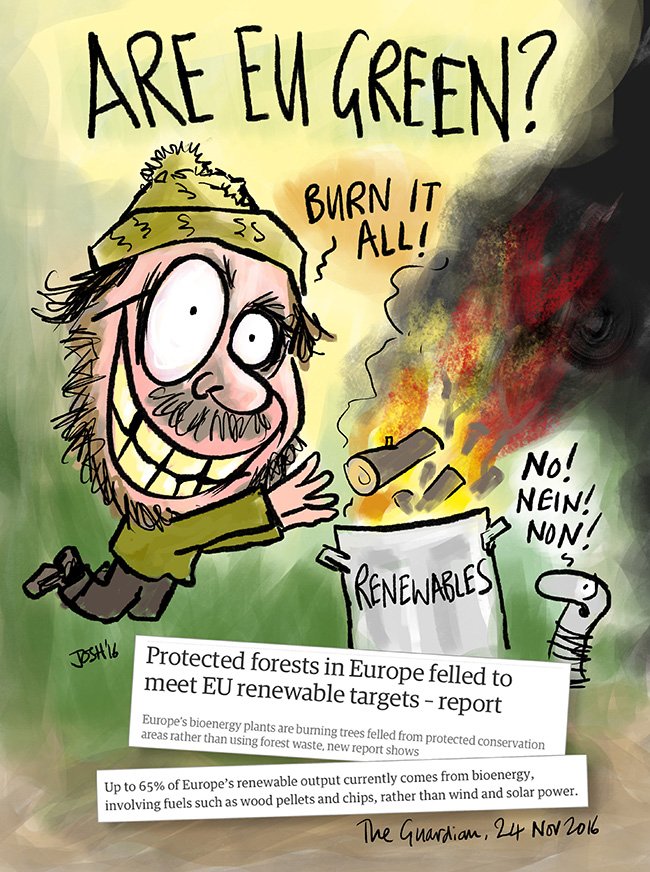
Cash For Ash - How Green Feel Good Polices Damage the Environment

        The remedy is sometimes worse than the disease - Francis Bacon

Josh cartoons


Green polices are mostly ideological and rarely based on any kind of robust analysis. This was never more evident in the Cash for Ash scheme that was setup in Northern Ireland where amazingly, farmers got paid a profit to burn wood pellets. There are reports that farmers with empty sheds could qualify for the handsome subsidies. There are also reports that people are burning the wood pellets right around the clock with windows and doors open to allow the heat out.   The impact on the environment of course is entirely negative. 

A full report on this crazy scheme can be found here in The Irish Times.

Tuesday, 5 April 2016

Ireland's Defunct Energy Plans - Rising Greenhouse Emissions and Energy Prices

Government is organized opinion.
The politician's promises of yesterday are the taxes of today.
                                                           - William McKenzie King 

According to the European Commission, Ireland is one of just eight EU countries to have increased it's greenhouse gas emissions between 1990 and 2012 :


This is despite the fact that we have replaced most of our oil power stations with gas and installed 1,4oo wind turbines.  There is a small reduction since 2009 but this is obviously more to do with the recession than renewable energy. 

The Environmental Protection Agency (EPA) are now getting worried :

  • • Ireland is unlikely to meet 2020 EU greenhouse gas emission targets for sectors including  agriculture, transport, residential, commercial, non-energy intensive industry and waste;

  • • Ireland’s emission reduction target is 20% below 2005 levels by 2020: EPA projections indicate that emissions will be 6 - 11% below 2005 levels by 2020;

  • • Agriculture and transport are projected to account for over three-quarters of Ireland’s non-Emissions Trading Scheme emissions in 2020:  agriculture (47%), transport (29%);

  • • Current and planned policies and measures are not sufficient to meet the 2020 targets.

Of course, if you prepare to fail, you fail to prepare. There are proper assessments which need to be undertaken before one could even contemplate taking on such a challenge. For example, the progressively lower capacity credit of wind energy means it can only have negligible impact on GHG emissions. 

But it gets worse. The government are now introducing a Renewable Heat Incentive to try to meet its 12% target for Renewable Heating but have failed to include households. They have cited cost as the reason. This is one of the initiatives that might actually have worked. But what they have in fact done is pushed up the cost of electricity for very small reductions in GHG emissions. Ireland now has the highest base cost of electricity in Europe (Eurostat) :


But we were told that all this wind energy would reduce the wholesale price. This is not happening either. So we have locked ourselves into expensive and ineffective policies for decades preventing money being spent on policies that could have worked. 

Tuesday, 8 December 2015

If you really fear climate change, then you should be very worried


Reality is that which when you stop believing in it, it doesn't go away - Philip K Dick. 

Reality is divinely indifferent - Richard Bach

Greenhouse Gas Emissions from each sector in 2013 (Source:EPA)

Our government is fully committed to both wind farms and fighting climate change but a simple analysis of the figures shows that they have no hope of combating it without doing something major about agriculture emissions, converting most of our power stations to biomass and introducing legislation that will alter our fast moving modern society altogether. Green lobby groups are rightly angry because they see the writing on the wall - no amount of wind farms can ever stave off the alleged dangers of climate change. If you are a believer in man made climate change, then you need to change your government and do it urgently.


The Irish government officially accept that climate change is a serious threat to Ireland and that we need to reduce our emissions to stop it's effects. The action they are taking in response is to enact a Climate Bill which is pretty much toothless, setting up a panel of experts and forcing ministers to give speeches on progress (or lack of) - in otherwords, it encourages talking shops rather than action. The other action they are fully committed to is installing wind turbines up and down the country. Apart from this there is occasional lip service to energy efficiency and the possibility of giving more subsidies to non dispatchable plant such as wave or solar. But energy efficiency initiatives dont sound all that "sexy" and politicians always prefer building things rather than conserving.

I have no doubt that the development and advancement of onshore wind energy projects will be and must be a significant element of Ireland's energy policy and its approach to combating climate change in the years ahead - Minister for Energy, Alex White, December 2015.

The Irish Greens are pretty extreme in their belief in climate change. There is the very vocal Friends of the Earth, the RTE television star Eamon Ryan, leader of the Green Party and many others who seem to be in well paid jobs and are fully committed to fighting climate change. One wonders what will happen them if we experience global cooling in the next few decades. One thing they are united in is their vocal criticism of the government. Are they right ? Well, given that they believe in climate change, then they are right to be angry. Because building more wind farms wont have any effect.

The Electricity Sector


Emissions from electricity make up about 20% of Ireland's total emissions. EPA state that :

Emissions from Energy (principally electricity generation) decreased by 11.1% (1.42 Mt CO2eq) in 2013. This reflects decreases in coal and peat used in conventional fossil fuel fired power stations for electricity generation, by 16.4% and 9.5% respectively, and also a decrease in natural gas use of 8.3% in 2013. Electricity generated from renewables increased by 6.6% between 2012 and 2013.

But another significant reason for the drop in emissions in 2013 was the East West interconnector which came online at the very end of 2012. Importing electricity from the UK is good for your emissions count because they are counted in UK, not Ireland. The new interconnector provided about 8% of our electricity in 2013, emissions free, and resulted in a complete gas power station lying idle for most of the year (Huntstown CCGT plant in Dublin).

Electricity consumption increased by just 0.2% during 2013 which is the equivalent of about 10,000 more homes to power. Despite this there was a reduction in emissions of 11%. A spin person might attribute all this to wind, but as you can see from the below there were four other very significant factors which resulted in less emissions and given wind increased by 13%, an overall saving of 11% is a poor enough showing. One can see the clear ineffectiveness of wind from these statistics :


Factor that reduced CO2 emissions for 2013
% Change
Reduction in Coal
-16%
Reduction in Peat
-9.5%
Reduction in Gas
-8%
Increase in Interconnection
+220%
Increase in Wind
+13%
Total reduction
-11%
Note: Biomass increased and hydro decreased by the same amount cancelling each other out

So what if we doubled our wind capacity ? Given the technical limits of wind on the system and the requirement for 5 large power stations to be running at all times to provide stability to the system, the most we can ever do is half our emissions in the electricity sector. This would give us a 10% drop overall - and this is a very generous figure, considering the larger turbines recently installed will require more maintenance than their older models and also the not insignificant back up plant inefficiencies that will result from large levels of wind penetration. Somewhere between 5-7% is probably a more accurate figure but let's allow 10% for now. This would reduce overall emissions by 10%. That leaves the remaining 80% to deal with.

Current Outlook : Ireland intends to carry on building more wind farms. Large scale biomass and nuclear have been ruled out as options by Government completely eradicating any chance of making meaningful reductions in emissions. Many new data centres are been planned around the country in the next few years which will significantly drive up demand for electricity and associated emissions.


Agriculture Sector


Agriculture is the largest "offender" at 32%. One solution is that we carve up half of agricultural land, dispose of the animals and plant it with trees. This then would cut down agri emissions to 16%. We could then convert some of the power stations to biomass and use some or all of the wood for electricity. This then would leave electricity emissions at about 5%. But, we would need some serious machinery to cut all these trees down and transport them and there would be an increase in imports of polluting oil, so this may well bring us back up to 20% for agriculture. But bear in mind that the current government are opposed to large scale biomass electricity generation.

Current Outlook: Ireland plans to increase its food exports and thereby increase its herd. There are no plans to change land use to forestry. Ireland's Prime Minister has asked for a free pass on agriculture emissions at the Paris climate summit citing the recession and lack of investment. 

Transport Sector


The transport sector makes up 19% of total emissions. There would need to be mandatory purchases of new electric vehicles with generous grants made available. Charging would need to be at night only and restrictions on charging made during spells of low wind. Otherwise, more dispatchable plant would be needed which would increase emissions in the electricity sector. One way out of this would be the above mentioned full conversion of large power stations to biomass.

Dublin Airport would need to restrict passengers to about 5 million, one quarter of current figures. This will push up prices and Ryanair would be a thing of the past. It would also drive up Ferry use negating some of the emission reductions.   Large supermarkets would have to reduce in size as there would need to be restrictions on large delivery vehicles. Having very few fuel stations would instantly take out most of the large fuel tankers on our roads, themselves consumers of oil.   Perhaps we can use some of that forested land to plant biofuels and further lower emissions. We could get down to 5% with some serious repercussions for modern society.


Current Outlook : Transport emissions have recently begun growing again. Sales of new cars are up and higher than EU average, as are sales of heavy goods vehicles. Traffic on Dublin's M50 motorway is growing at 10 times the European average.  More people have flown through Dublin Airport this year than ever before.


Residential Sector


Residential emissions are 11%. Mandatory passive housing could maybe get this down to 8%. Maybe more land could be used to grow fuel for biomass heaters with a combination of district heating intiatives getting it down to 5%.

Current Outlook : emissions are rising due to increased coal use, doesn't seem to be much focus by government on CHP or district heating initiatives.

Industry Sector


The same retrofitting schemes could be done for industry getting it down from 15% to 7%.

Current Outlook: emissions decreasing slightly, but with electricity costs predicted to match or exceed Denmark's in the years to come there might not be any industry left wiping out all of this sector's emissions. Most likely government would grant exemptions to industry at this stage from green levies, much like what has happened in Germany.

Waste Sector


Waste emissions will increase in the future when Poolbeg waste to energy plant opens so lets bring that up to 6% from 2.5%.

Current outlook: Poolbeg plant will open soon, not aware of any other similar plants in planning

Conclusion


These changes would bring emissions to 48% of current levels - from 57MT to 27MT. This is a very generous figure as there are all sorts of unintended consequences with the above changes e.g. how many people will buy diesel generators and go off grid altogether ?

The changes are startling to those used to modern comforts. There will no longer be a guarantee that when you plug something into the wall that you will get electricity out. That holiday you had once a year - that will have to go. 

It all hinges on agriculture and how we decide to use this land in the future. More trees means less CO2 in the atmosphere, reducing emissions further. Enda Kenny, Ireland's Prime Minister, has asked the COP21 leaders for a pass on Ireland's agriculture emissions thereby making the transition required to halt climate change all but impossible, unless we do without electricity, heating and modern vehicles altogether. Quite rightly, then, the greens are angry at Kenny's capitulation to the agriculture sector. Without changes in use for significant amounts of agriculture land, no serious dent in our emissions can be made. Significant reductions in the other sectors, as you can see from above, depend on land changes in the agri sector. 

So we have a government who tell us that climate change is a very big threat to us, but who have bet all their chips on wind turbines and other non dispatchable technologies. The most this can do is reduce our emissions by 10%, if even that, which will have negligible impact on the projected impacts of climate change. Let's remind ourselves once again what our energy minister's plan to combat climate change is :


I have no doubt that the development and advancement of onshore wind energy projects will be and must be a significant element of Ireland's energy policy and its approach to combating climate change in the years ahead - Minister for Energy, Alex White, December 2015.

So ask yourself the question, is our government really serious about combating climate change or are they just paying lip service to the new trendy ideology ? Why are they pushing wind energy as the number one solution when they must know it can only make a tiny dent in our emissions ? Is there something else driving this mad rush for wind farms ? Most likely, it makes them feel good that they are doing something, even though it is something akin to trying to hold back the Titanic with an elastic band.

Reality shows us that the economy is recovering, and we desire more than ever the comforts of modern living - fast cars, airplanes and Irish beef.

So if you really believe in climate change, then you should be worried, very worried.


Tuesday, 13 October 2015

Ireland's air quality is good but particulate matter above WHO Guidelines


The Environmental Protection Agency (EPA) have issued a report which shows that Ireland's air quality is good relative to EU standards but that particulate matter levels are above World Health Organisation (WHO) Guidelines.

The culprit is not our power plants - which are now mostly gas powered - but our home heating and transport sectors.

  • Burning of solid fuel and emissions from vehicle exhausts remain the main threats to air quality in Ireland - EPA, Air Quality in Ireland 2014

So we have on the one hand, a Government spending billions of our money because of their obsession with de-carbonizing our very clean power stations and on the other hand, a Government organisation pointing the finger of blame (quite rightly) for pollution at our transport and heating sectors.

It is like a surgeon operating on a patient's stomach to mend their broken leg.

The full EPA report can be accessed here :

http://www.epa.ie/pubs/reports/air/quality/epaairqualityreport2014.html#.Vh1dlIrd_VM

For a complete history of Ireland's transition to a largely pollution-free power generation system, Pat Swords has written an excellent document here :

Clean Energy - What it is and what we are paying for ?


Monday, 28 September 2015

Government inconsistent on city pollution and coal


State wide ban on smoky coal


Today, the Department of the Environment will introduce a State wide ban on "smoky" coal. While attempts to curb pollution, particularly in cities, are admirable, the Government are guilty of inconsistency in this matter. For many years, diesel has been encouraged through lower taxation with the result that diesel cars and fuel are cheaper to buy than petrol alternatives. This has resulted in increases of local emissions in built up and city areas. As economist Colm McCarthy explains :

Diesel engines give better mileage than petrol, hence causing lower emissions of greenhouse gases into the atmosphere per kilometre travelled. But they produce higher emissions of local pollutants, including particulates and nitrogen oxide, and these are known to have adverse effects on human health, especially in built-up areas.


 Attempts to control this pollution have failed and in the wake of the Volkswagon emission scandal, its safe to say has failed miserably.

 But it is beginning to look as if a mistake has been made in Europe. Encouraging diesel to cut emissions of carbon dioxide, a greenhouse gas, is a worthy objective. But the control of low-level emissions from diesel through regulation seems to have failed. The European Commission is proposing a tougher testing regime, the standard bureaucratic response: if a policy fails, it needs to be intensified - always reinforce failure [sound familiar - admin note].

 So if the Government is concerned about city pollution, perhaps it can take a look at it's own failed policy in relation to motor vehicles (I have previously written about the benefits of using CNG for public transport).

And if it's concerned about coal pollution, then maybe it can take a look at Moneypoint power station and the options open to converting it to less polluting alternatives. People have a choice not to buy smoky coal, but the people of Clare and Kerry do not have a choice (except moving out of the area).

Could it be that it better suits it's owners bottom line to use cheap coal ? Then by the same logic, shouldn't ordinary people have the same right to avail of cheaper methods of heating their home ?