Showing posts with label economic recovery. Show all posts

Tuesday, 12 October 2021

Why Inflation will not be Temporary


The current conventional wisdom is that inflation in Ireland will only be temporary as the economy recovers from the covid lockdowns. But this can only be the case if there was deflation during the lockdowns which the re-opening induced inflation would now be negating. The only deflation that occurred during the lockdowns that I can remember was petrol prices. Core consumer items such as food, electricity bills and rent did not fall or at least not in any noticeable way. A period of deflation is not equivalent with an economy being closed down. A rental freeze is not deflation. This is the mistake the economic experts are making. They also have not taken into account the effects of the large government spending. 

When a hotel or other business is shutdown, its prices do not reduce, the service simply ceases to exist. In fact, inflation will likely occur. Say two hotels close down in a region leaving only one hotel open. This will lead to a period of inflation as the remaining hotel raises its prices to take advantage of the increased demand and reduced supply. The difference between this scenario and the lockdown was that  during the lockdown all three hotels were shutdown meaning there was no deflationary pressure. Then when the hotels opened, they could charge high prices because people had a lot of savings. This was an unintended consequence of the high level of unemployment support.  And the same happened with rent, an opportunity was missed during lockdown to bring about rental deflation through a smaller Pandemic Unemployment Benefit. Instead, the government went along with the calls from the most populist spending cheer-leaders.  

Another point that is missed is that many businesses may never re-open again. This will bring further inflationary pressure as supply reduces. 

As you can see from the graph above, the sharpest fall in prices was in November 2020 when year on year deflation reached -1.5%. This was the sharpest fall in a decade. In less than 12 months however , the inflation has skyrocketed to +3.7%.

While there are other factors impacting inflation right now, such as our high dependence on global supply chains, the high levels of pandemic payments paid out last year are part of the reason why Ireland has inflation above the EU average and even above UK's inflation rate of 3.2%. People saved up, then spent most of it in-between the lockdowns leaving little pressure on businesses to drop their prices. Little haggling took place with landlords who should have been under severe pressure to drop their rents during a period of very little house moving by job hunters both within Ireland and those coming from abroad. 

But as every economist should know but seems to have forgotten, all this money had to be printed, which was happening at a high rate prior to the pandemic anyway. Too much money printing or quantitative easing (or whatever you want to call it) , and the inflation snail eventually catches up with you. Too much money ends up chasing too few goods.  And then the snail begins to look like a rabbit. 


Saturday, 28 March 2020

Rainy Day Blues

It's been a very strange six months in Irish history. It began in October when the finance minister failed to top up the Rainy Day Fund he had set up the previous year. At a time when the economy was very strong, this seemed like a reckless move and so it has has proven to be in light of recent events. Unfortunately, government ideas of merit are not followed through with the same enthusiasm as the bad ones are.

After this, an early election was called in January 2020, which led to an historic result, but one that was still very much in favor of the status quo.

Then, a month later, as government formation talks continued to drag out, the coronavirus pandemic landed on Ireland's shores. This event has shaken the global order at its very core. The consequences of open borders and free trade are now very real for everyone. Critical thinkers of the global based economic system, who were branded outdated and backward as recently as January during the election debates, are now being proven correct weeks later. It was the governments allegiance to this system that prevented them from acting early,  closing the airports, and putting travelers from Italy in quarantine as the Icelandic government did right from the start. A contact from Iceland wrote to me :

Iceland put everyone in quarantine coming from Italy very early on and a few days later everybody coming from a ski resort in Austria. Now there are more than 6,800 people in quarantine at home. Last week everybody living in Iceland (not tourists) coming home from abroad had to go into quarantine. Authorities also put a big effort into contact tracing. A team of policemen and health workers (at least 60 people) trace every single case. Everyday 50% of new confirmed cases are amongst those in quarantine.

Back in Ireland, a match with Italy on the 7th March was cancelled but thousands of Italians were still allowed to wander the capital Dublin that weekend. In the week before the scheduled match cases in Italy had jumped by 5000. There is some talk about China not releasing information quick enough. I disagree, the authorities in Europe had plenty of notice, they just failed to act decisively. Iceland have managed to slow the virus, comparatively speaking. Since the 11th March, cases in Iceland  have increased by about 12 times, whilst in Ireland cases have increased by about 50 times. The cases are most likely understated in Ireland, because Iceland have tested 3% of their population, including people who do not have symptoms.

Now that we are in lockdown, climate change is well and truly off the agenda. Which reminds me, if we are in the middle of a climate crisis with the ice melting as the schoolchildren (sorry, teachers) are so fond of reminding us, why were schoolchildren flying fossil fueled airplanes to Italy to ski in the snow in February on their holidays ?

Monday, 17 June 2019

Spending Overruns Undermine Emissions Targets


The European Court of Auditors expect that many EU countries, including Ireland, will not meet their 2020 targets for the share of total energy from renewables :


  • six Member States are unlikely to meet their 2020 target as they need an increase in the share from renewables by: the Netherlands 7.4 pp, France 6.7 pp, Ireland 5.3 pp, the United Kingdom 4.8 pp, Luxembourg 4.6 pp and Poland 4.1 pp.  

  •   the Netherlands shows the largest gap, with an actual average share of 5.9% for 2015/2016, versus an indicative RED trajectory of 7.6%. The gap to the planned NREAP share of 9.7% renewable energy in 2016 is even larger. 

    •  for 11 Member States (Belgium, Cyprus France, Greece, Ireland, Luxembourg, Malta, the Netherlands, Poland, Portugal and the United Kingdom), currently implemented renewable energy policies and already planned renewable energy policy initiatives appear today to be insufficient to trigger the required renewable energy volumes purely domestically. 

    • In addition, for 7 Member States (Austria, Germany, Latvia, Romania, Slovenia, Slovakia and Spain) there is some uncertainty related to 2020 renewable energy target achievement. Their capability of meeting their 2020 national binding targets will to a great extend depend on the levels of energy demand in case there would be a large increase in energy demand that brings their energy consumption back in line with the original trend indicated by the latest EU reference scenario.   

This should be seen as a serious indictment of Ireland's wind only policy which has completely failed to reduce emissions at any meaningful level. The idea that the EU will fine every one of these countries, that are also unlikely to meet their targets, now seems increasingly unlikely, as the widespread impracticality of the targets becomes manifest.

Ireland has already spent €86 million in buying carbon credits to offset it's high emissions with the cost potentially running to billions over the next decade. As with health and foreign aid policy (in fact every policy), Ireland's answer is always to spend more (taxpayers) money instead of doing some actual analysis to uncover the root cause of the problem.


Sustainable Economics is a Sustainable Environment


The simple fact, as this blog has pointed out previously, is that the more the government spend, the higher the emissions. Higher welfare spending, for example, results in more resources consumed beyond our means, more imported goods, higher immigration and more waste material like plastics. High government and private debt also encourages more wasteful spending.

A policy that would encourage more savings and less debt would result in lower emissions. Higher savings means more deferred purchasing, which means lower emissions in the short to medium term. 

It is perhaps somewhat ironic that the most climate change obsessed government in Irish history is also the worst offender when it comes to out of control spending. The Irish Fiscal Council last week reported that the government breached post financial crisis spending rules last year, and the increases in spending in recent years were not "conducive to prudent economic and budgetary management".   They warned that the spending had reached a similar magnitude to those prior to the 2008 crisis (funnily enough when the green party were last in government). Cormac Lucey has worked out that the cost of the spending overruns last year was € 3,500 per person living in the state. Instead of putting away the additional tax receipts into a rainy day fund, which would have lowered emissions, every cent has been squandered. 

And the more the government continues to spend recklessly, the more carbon credits they will need to purchase to offset the extra emissions meaning that the spending overruns are set to become a vicious cycle. If Ireland wants to get serious about reducing emissions it  needs a prudent government.


Friday, 24 February 2017

Ireland's Debt Problem

An economic policy based on rising debt and low corporate tax rates is not and never was sound policy - by Owen Martin

While the Irish media make a fuss over who will be the next leader of Ireland's biggest political party (Fine Gael), everybody ignores the real elephant in the room. According to the European Banking Authority, Ireland has the largest combined private and government debt as a percentage of GDP in the EU and two thirds higher than that of the US. 


 I'm not sure how this graph is not sending shockwaves through the Trump obsessed Irish media and political establishment - From EBA 


While Greece, Italy and Portugal have higher Government debt, Ireland's private sector debt to GDP dwarfs those countries. Which means that for the size of Ireland's economy, it's private sector has taken on alot of debt.

But not only businesses and industry. We have the 5th highest household debt as percentage of net disposable income in EU with about twice as much debt as income per household. This may explain how we rank so high in numbers of new cars across the EU.   People are taking out car loans that perhaps they can't really afford. It shows that we as a nation are still addicted to debt.


Denmark, Netherlands, Iceland and Norway all have higher household debt than Ireland but these countries are doing much better when it comes to Government debt as percentage of GDP. Ireland ranks 5th in terms of Government debt to GDP. So while Greece and Italy have higher levels of government debt, they have about half of the household and private sector debt. Denmark's high level of household debt doesn't seem as bad considering they have half of Ireland's Government debt to GDP. 


Norway have the wealthiest government in Europe. In fact, they are far ahead of second place Luxembourg and Finland. Norway has slightly more household debt than Ireland. But that kinda makes sense - they are a wealthy country. Ireland has the 5th poorest Government in Europe (Italy and Greece lie at the bottom). Our government has dismal revenue, in part thanks to our low corporation tax rates. Yet we carry roughly the same household debt as Norway and have an even higher private sector debt to GDP.  This is called "living beyond our means".  Yes, Ireland could do with the € 13 billion in tax revenue owed from Apple. Laughably, the Irish government is appealing this decision


Irish Govt has the worst revenue in Europe yet reject a €13 billion EU tax ruling made in Ireland's favour

Of course if all that debt was used wisely, perhaps we could become richer. We are reliant on Norway's gas which arrives to us through UK pipelines. The Irish government have banned fracking so this dependence will continue for the foreseeable future. Imagine if some of that debt was being used to extract our own gas reserves.


Ireland spends the most on health after Iceland in Europe, yet we still have a permanently dysfunctional health system

Ireland has the third highest electricity prices in Europe.

The Irish government takes pride in divesting from fossil fuels and pushing through massive renewables and electricity infrastructure programmes that cost billions and without any proper assessment in the name of climate change.  We pride ourselves on having a massive welfare program and our representatives want to take in more refugees (without any proper assessment). Green/Left politicians cry out as to why we don't do more to tackle climate change, take on more debt (One cannot go the EIB looking for €5 million or €10 million; one needs to go looking for €2 billion. It is there.) and take in more refugees. Ireland is trying to save the world on a sinking ship but our politicians and media don't even realize we are on one.  Have we learned anything from the crash in 2008 ?


POSITIVES


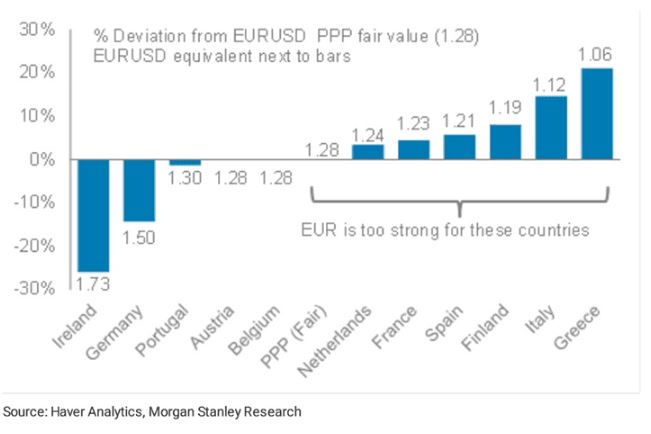
On the positive side, exports are still strong and benefit from the stronger dollar as against the euro. If we went back to our own currency, it would be a strong one as the above graph shows. Presumably thanks to our exports. However, the weaker sterling is not good for exports to Britain. There is a chance that Ireland may actually benefit from Brexit if companies there relocate to Ireland. 


https://data.oecd.org/gga/general-government-deficit.htm#indicator-chart


Ireland has managed to get out of it's budget deficit abyss and back to something fairly normal. If Multinationals move out we could see some real problems, but we would no longer see the massive distortions to our GDP anymore. Perhaps that could be a good thing in the long run. Living on a false economy (now known as Leprechaun economics) is what got us into trouble last time.

I can't see how Ireland's economic fundamentals are much different to that of the Celtic Tiger era.   If anything, things have got worse.

Saturday, 10 October 2015

Ireland's economic recovery - are we not missing something here ?


Recovery is underway in earnest, of that there is no doubt. Many more people are at work than when the crisis was at its worst. But it is as well to recognise that the public finances remain constrained. Huge debts assumed to fund large budget deficits and rescue the banks must be repaid. This is the backdrop against which all fiscal promises must be assessed during the election - Irish Times, 8th October 2015.

But, apart from the obvious large debt, isn't there another more pressing problem facing Ireland in the coming years. Minister for Jobs and Enterprise, Richard Bruton, spelled it out back in February, but nobody in the media seemed to pick up on it :

“Unfortunately, due to a cost base which is significantly out of line with competitor countries, it appears likely that the company will proceed [with re-locating to Poland],” he said in a statement today.

Costs for business are far too high in Ireland, and energy costs are contributing to this. As ESB and economist Colm McCarthy have pointed out, the Irish government are locking the country into high energy costs for decades. We have a situation where the design of the electricity grid has to be completely overhauled to facilitate large amounts of intermittent wind (with the cost picked up by the consumer not the wind industry) and where low gas prices cannot be passed on to the consumer. 

Moreover, the Exchequer is more heavily reliant these days on income tax receipts than previously. This imposes its own limitations, although universal social charge cuts will be centrepiece of the budget next Tuesday and further cuts to come will be signalled. Take note, however, that fiscal projections underpinning the 2016 plan assume another 47,000 jobs will be created on top of some 53,000 new jobs this year.

Low costs for business are essential for job creation and indeed preventing job losses. If the jobs cant be created or even worse, if more industry moves out, then the fiscal projections underpinning economic recovery fall asunder. Income tax receipts fall, welfare costs go up - add in the debt and we will be in dire straits.

Don't be surprised if in the coming months you see shocked politicians expressing their sympathy to those made redundant and shocked media reports examining how and why such a large company could leave Ireland during its "recovery".