Showing posts with label government spending. Show all posts

Monday, 17 June 2019

Spending Overruns Undermine Emissions Targets


The European Court of Auditors expect that many EU countries, including Ireland, will not meet their 2020 targets for the share of total energy from renewables :


  • six Member States are unlikely to meet their 2020 target as they need an increase in the share from renewables by: the Netherlands 7.4 pp, France 6.7 pp, Ireland 5.3 pp, the United Kingdom 4.8 pp, Luxembourg 4.6 pp and Poland 4.1 pp.  

  •   the Netherlands shows the largest gap, with an actual average share of 5.9% for 2015/2016, versus an indicative RED trajectory of 7.6%. The gap to the planned NREAP share of 9.7% renewable energy in 2016 is even larger. 

    •  for 11 Member States (Belgium, Cyprus France, Greece, Ireland, Luxembourg, Malta, the Netherlands, Poland, Portugal and the United Kingdom), currently implemented renewable energy policies and already planned renewable energy policy initiatives appear today to be insufficient to trigger the required renewable energy volumes purely domestically. 

    • In addition, for 7 Member States (Austria, Germany, Latvia, Romania, Slovenia, Slovakia and Spain) there is some uncertainty related to 2020 renewable energy target achievement. Their capability of meeting their 2020 national binding targets will to a great extend depend on the levels of energy demand in case there would be a large increase in energy demand that brings their energy consumption back in line with the original trend indicated by the latest EU reference scenario.   

This should be seen as a serious indictment of Ireland's wind only policy which has completely failed to reduce emissions at any meaningful level. The idea that the EU will fine every one of these countries, that are also unlikely to meet their targets, now seems increasingly unlikely, as the widespread impracticality of the targets becomes manifest.

Ireland has already spent €86 million in buying carbon credits to offset it's high emissions with the cost potentially running to billions over the next decade. As with health and foreign aid policy (in fact every policy), Ireland's answer is always to spend more (taxpayers) money instead of doing some actual analysis to uncover the root cause of the problem.


Sustainable Economics is a Sustainable Environment


The simple fact, as this blog has pointed out previously, is that the more the government spend, the higher the emissions. Higher welfare spending, for example, results in more resources consumed beyond our means, more imported goods, higher immigration and more waste material like plastics. High government and private debt also encourages more wasteful spending.

A policy that would encourage more savings and less debt would result in lower emissions. Higher savings means more deferred purchasing, which means lower emissions in the short to medium term. 

It is perhaps somewhat ironic that the most climate change obsessed government in Irish history is also the worst offender when it comes to out of control spending. The Irish Fiscal Council last week reported that the government breached post financial crisis spending rules last year, and the increases in spending in recent years were not "conducive to prudent economic and budgetary management".   They warned that the spending had reached a similar magnitude to those prior to the 2008 crisis (funnily enough when the green party were last in government). Cormac Lucey has worked out that the cost of the spending overruns last year was € 3,500 per person living in the state. Instead of putting away the additional tax receipts into a rainy day fund, which would have lowered emissions, every cent has been squandered. 

And the more the government continues to spend recklessly, the more carbon credits they will need to purchase to offset the extra emissions meaning that the spending overruns are set to become a vicious cycle. If Ireland wants to get serious about reducing emissions it  needs a prudent government.


Thursday, 26 July 2018

If We Really Care about Sustainability Then Lets Look at our Debt

by Owen Martin

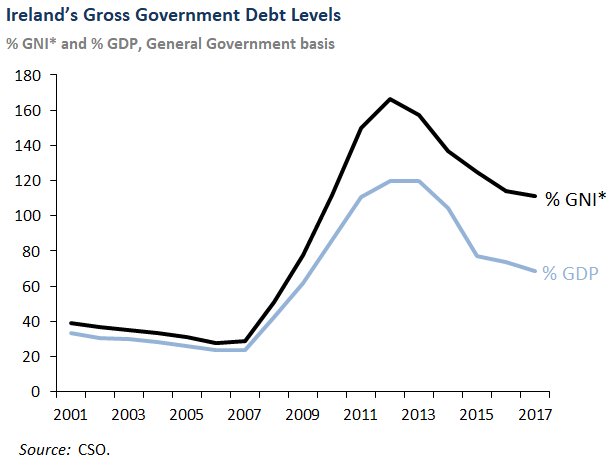
The chart shows the latest data for Gross Irish General Government Debt over the period 2001 to 2017, with the 2017 outturn showing a level of 111.1 per cent for debt-to-GNI*.


Ireland's debt burden is understated by standard GDP comparisons. Using adjusted Gross National Income (GNI*), which adjusts GDP for the impact of foreign multinationals who book their large non Irish profits here, our debt burden remains high at 111% for 2017. Our government still runs up deficits each year adding to this debt. Government spending is still out of control. 

Ireland's unemployment rate in 2012 was 16%, it is now at 6%, a fall of 62%. Yet, social welfare payments (excluding pensions) have only fallen by €2 billion, from € 14.5bn to € 12.5bn, a fall of just 14%.  How can this be justified?

Our EU contribution has doubled since 2012 to €2.6bn. Our already bloated health sector, one of the most well funded in Europe, has had an increase of €1 billion in it's budget. The funding for housing has more than doubled to €3.3 billion. Superannuation and retired allowances have increased by €50m to €570m. Foreign Aid spending has increased by €40 million to €500m.  Spending on public broadcasting has also increased, now reaching € 255 million.

This level of debt and spending is clearly unsustainable and allows us basically to consume resources beyond our means - the very definition of unsustainability. Yet many politicians from all sides want to increase spending and debt further, whether it's hikes in public sector pay or bringing in more migrants who require public housing and medical services.  

This should be target number one on the list for groups like the Citizen's Assembly. But of course it doesn't even feature in climate change discussions as climate policy is just another justification for more spending, more taxation and more debt. 


1) https://whereyourmoneygoes.gov.ie/en/
 

2) Unemployment rate was 5.8% in may 2018. population increased by about 4% since 2011, according to CSO.


Wednesday, 10 January 2018

The Climate-Energy Problem : A Response


Engineers Ireland yesterday published a fairly in-depth article that caught my attention. There are some points I do agree with, for example, on the conservation of oil and the contribution of fossil fuels and Industrial Revolution to people's lives. I have done a short rebuttal of some of the other points made --


It goes without saying that the second stage of the Industrial Revolution is irreversible and must be sustained by new energy sources because the vast majority of people now reside in cities and earn their living in economic sectors which did not exist before 1900. These people cannot now return to their great grandparents’ employment in agriculture which has been mechanised.


1) Developed world people are not reproducing at rates like before when  huge families were the norm. Only poorer regions like Bangladesh and India have sustainable birth rates (higher than average IQ populations tend to have lower birth rates - see Japan and Hong Kong for example). If people in these poorer regions are using 35 times less oil per person than in the developed world (as stated later in article), then they can return much easier to an agricultural society as before. The Industrial Revolution in the developed world is therefore sustainable if there were low levels of immigration.


The problem is that this transition is unsustainable without the enormous mechanical energy output of more than a billion newly-invented oil, coal and gas-fuelled machines which have caused atmospheric carbon dioxide to reach 400 parts per million.
2) Co2 levels of 400 parts per million are low historically speaking and has helped greening of the planet.

An oil-burning heater does not increase anybody’s productivity. It has an HPM of zero hence heating oil is wasted oil, yet over 30% of global oil production is used for heating. Moreover the 700 litres of diesel emits almost 2 tonnes of carbon dioxide, yet biomass is an alternative which is both carbon-neutral and cheaper than oil.


3) For biomass to be sustainable you would have to cut down trees with a handsaw and transport it with a horse or wheelbarrow so you're back to pre-Industrial Revolution times.

It could and should initiate reforestation, dedesertification and carbon capture.


4) Renewables are often built on forested land displacing green spaces which should be left as forest areas (see Coillte) . Extra CO2 in atmosphere is leading to de-desertification in regions like the Sahara.

During the recent financial crisis in the US, the pragmatic Ben Bernanke pronounced, “Quantitive Easing is wrong in theory but it works in practise, and the Fed will drop money from helicopters if required.”

If something is wrong in theory but works in practise then query the theory. In the situation Bernanke found himself conventional economic theory had become obsolete and by dropping money from helicopters he averted an unnecessary decline in demand in the US economy which is now consumer-driven since the cost of production is so low.

Today an increase in the money in circulation causes an increase in demand which causes an increase in the quantity of products coming down existing, paid-for, automated mass-production lines (and from China, Korea etc.) This benefits manufacturers, distributors, retailers, and consumers.

In fact the exact opposite is true and the following chapter makes the irrefutable case that the free-market has within itself the seeds of its own destruction. 


5) Printing of the money supply, welfare state, government debt, mass immigration are all unsustainable.  Want to reduce CO2 ? Then you need to tackle all of these. These factors are not the fault of the free market - they are the caused by Government policy.

Why should any highly profitable oil company be serious about developing an alternative-to-oil which is less profitable than oil?


6) Oil has a high Energy Return on Investment (EROI). That is, the energy emitted through consumption is many times that of energy required to extract it. The same is not true for alternatives at the moment. It is interesting that as wind energy has increased in Ireland, offsite diesel generation has also done so. There are now nearly 400MW of demand side units.

It is interesting that all talk of Peak Oil has stopped or is not taken seriously anymore.

At any rate, why should it be up to Oil companies to develop a serious alternative ? Were motor cars developed by the horse industry ?

By Owen Martin

Saturday, 22 July 2017

Why are Politicians Obsessed with Climate Change ?

by Owen Martin

The Irish government has recently had to endure scandal after scandal in just about every department - justice, health, finance, housing etc. But there is still only one issue in town - climate change.
Fifty years on and there has been a clearing-out of another generation, this time by the running, shorts-wearing avocado smashers. To what will they bring their focus, energy and vigour? One thing they have promised is to take climate change seriously. On election as Taoiseach, Leo Varadkar said he wanted to see a new ambition on climate change. But he and his colleagues should do more than that; they should define it as the most important challenge to be faced; they are, after all, in Andrew O’Hagan’s phrase, the “globally warmed generation” - Diarmaid Ferriter, Irish Times

This week, yet another National Mitigation Plan was announced by the government to loud fanfare. 

David Whitehead, a geologist and paleoclimatologist from Galway, lays out quite simply the futility of the Paris Agreement and such climate mitigation plans as they relate to Ireland :


A peer-reviewed paper in the Global Policy journal has modelled the impact of the CO2 emission reduction promises, called Intended Nationally Determined Contributions (INDCs), made ahead of the Paris climate summit. The climate impact of all Paris INDCs, if every nation fulfilled them by 2030, which is most unlikely, and if the climate models used to assess the temperature effect of CO2 emissions are accurate, which is perhaps even more unlikely, the temperature reduction would be 0.048°C by 2100. If the INDC’s were extended for another 70 years and every nation fulfilled them by 2030, and continued to fulfill them until the end of the century, and there was no ‘CO₂ leakage’ to non-committed nations, the entirety of the Paris INDCs would reduce modelled global temperature rises by just 0.17°C by 2100.  The Irish Times cannot have it both ways; if the models are correct the impact of the Paris agreement is negligible and if they are incorrect the rationale for the Paris Accord is unfounded. Paris is just symbolic virtue signaling by western governments and less developed countries signed up because it promised them large cash transfers. Now Turkey states that unless it receives the money it will not ratify Paris. Other countries will follow. Ireland is the second most carbon efficient economy in the world in terms of CO2 emissions in relation to GDP, and would probably be first if our GDP figures were correct, which we all know they are not.  Ireland is also the most carbon efficient economy in the EU and so for us to be pay huge  fines  levied by the EU for a failure to meet the  2020 and 2030 CO2 emissions targets, agreed to by Eamonn Ryan on ideological grounds, would be  economically  very damaging and  an act of political lunacy -  David Whitehead. BA(Mod. Nat.Sc.)TCD, FIMMM, C.Eng.

These facts are not secret nor are they in any way over complicated for policy makers and the media to understand. If climate change is a serious threat to the world, Ireland can play no role in combating it and in any case we are at present a very carbon efficient economy. So our politicians should be fully focused on the other big issues they urgently need to deal with. 

Ireland has a serious debt problem, the worst in the EU relative to our GDP. We have out of control public sector spending. Our public sector workers enjoy far higher salaries and pension entitlements than those in the private sector. Our social welfare spending is much higher than the EU average.  A housing bubble is manifesting itself once again in Dublin city. Despite spending more on health than anyone else in the EU, apart from Iceland, we still have a dysfunctional health system. Elements of trusted organisations like the police force, care and charity organisations have revealed themselves to be corrupt. Pension funds are repeatedly raided by our cash hungry government. The idea of retiring in your 60's on a state pension seems less and less likely by the day.  Socialist dogma coming from the media and government opposition benches prevents even a debate on most of these important issues, let alone solutions to be put forward. 

If nobody in the House of Lords has never heard of the economic theory "comparative advantage", then you could safely bet a lot of money that nobody in either two parliaments in Dublin have heard of it.  

One more anniversary. 200 years ago, 1817, saw the publication of David Ricardo’s Principles of Political Economy, which contains the first exposition of the principle of comparative advantage, a thoroughly counterintuitive idea that was once described by Paul Samuelson as the only proposition in the whole of social science that is both true and surprising.Comparative advantage takes Adam Smith’s division of labour one step further and explains why free trade benefits everybody, even countries that are the worst at making things, even countries that are the best at making things. But it also, in my view, explains prosperity – what it is and why it happens to us and not to rabbits or rocks - Matt Ridley, the case for Free Market Anti-Capitalism

The fact is that it is not our energy or climate policy that is unsustainable. It is our massive debt, welfare and government spending that is unsustainable. It is the raiding of pension pots and rainy day funds that is unsustainable. It is our high income taxation policy that is unsustainable. It is the PSO levy that is funding renewable energy projects that is unsustainable. The government must know this and they know, because of our education system, that there will never be a free market anti capitalism system as Matt Ridley describes that might help address these problems. Although perhaps its too late for that now anyway.

So the government must propagate the idea that the end of the world is nigh anyway. They must call attention to a problem much bigger than all these issues and then use all the instruments of the State to help fight it.  They must choose an issue that most people do not understand. And this is where climate change comes in. No longer do the politicians have to deal with the real issues. They can continually make themselves look good to a gullible public by pretending to combat a fake and larger enemy until the house of cards does finally crumble.