Showing posts with label renewables. Show all posts

Monday, 19 October 2020

Transition to Renewables will require a 10-fold Increase in Mining Materials

 The following is an extract from a new paper by Irish scientists Michael and Ronan Connolly and Willie Soon et al which shows the true environmental and social cost of the Renewables revolution. Full report here.

Some have noted that the transition to these technologies would require a huge increase in the mining of limited resources, with Mills (2020) arguing that, “Compared with hydrocarbons, green machines entail, on average, a 10-fold increase in the quantities of materials extracted and processed to produce the same amount of energy”

Because of this 10-fold increase in quantities of minerals required by green technologies relative to those driven by hydrocarbons, Mills cautions that any significant expansion in green energy will create “an unprecedented increase in global mining”, which would radically exacerbate environmental and labor challenges in emerging markets, and dramatically increase the vulnerability of America’s energy supply chain.  Capellán-Pérez et al. (2019) underscore the concern that the extraction of the minerals required for the proposed transition to renewable energies is likely to intensify current socio-environmental conflicts associated with resource extraction. As we will outline, this gives rise to concern regarding potential uncertainty of supply. In contrast to the concerns about hydrocarbon peaks outlined above, projected mineral requirements seem likely to exceed current reserves within the very short time frame to the year 2030. This concern appears particularly pressing with regard to e-vehicles, which we discuss next, followed by related concerns regarding solar and wind energy.


Electric Vehicles

The projected production of electric vehicles (EVs) to replace vehicles powered by fossil fuels requires the consumption of a new range of metals, as outlined in a letter from a group of geologists and other earth scientists to the Committee on Climate Change in London who had recommended increasing the percentage of the UK’s cars that are electric or hybrid from 0.2% in 2017 to 100% by 2050. Herrington et al. warn that in order to replace the UK’s fleet of cars (currently 31.5 million) entirely with EVs, it would require “just under two times the total annual world cobalt production, nearly the entire world production of neodymium, three quarters the world’s lithium production and at least half of the world’s copper production during 2018 [ . . . ] If we are to extrapolate this analysis to the currently projected estimate of 2 billion cars worldwide, based on 2018 figures, annual production would have to increase for neodymium and dysprosium by 70%, copper output would need to more than double and cobalt output would need to increase at least three and a half times for the entire period from now until 2050 to satisfy the demand”. They further note that this proposed transition for the UK would also lead to a 20% increase in electricity usage for the country, due to the extra power generated needed for recharging the vehicles.

Even under its modest “New Policies Scenario”, the International Energy Agency’s projections to the year 2030 indicate that cobalt and lithium reserves are inadequate to meet EV needs (see figure below). Modeling on the assumption of a shift to 100% renewable electricity by the year 2050, with lithium-ion batteries accounting for approximately 6% of energy storage and 55% of energy for road transport being accounted for by electric vehicles, Giurco et al. (2019) consider that the cumulative demand for both cobalt and lithium is likely to exceed current reserves unless recycling rates are improved. They consider that the annual demand for cobalt for EVs and storage could exceed current production rates by around 2023, and that the annual demand for lithium could exceed current production rates by around 2022. Although they consider that high recycling rates can keep cumulative demand for cobalt and lithium below current resource levels, they caution that there is likely to be a delay before recycling can offset demand until there are enough batteries reaching end of life to be collected and recycled.

Increased annual demand for materials for batteries from deployment of electric vehicles by scenario, 2018–2030. Green dots indicate current supply. NPS = New Policies Scenario. EV30@30 =30% sales share for EVs by 2030. 


From extensive field research, including expert interviews, community interviews with miners and traders, and observation at 21 mines and nine affiliated mining sites, Sovacool (2019) documented displacements of indigenous communities, unsafe work environments, child labor, and violence against women in communities near cobalt mines. Because most of the world’s cobalt is produced in the Democratic Republic of Congo, the major increases in demand arising from global interest in EVs have created a rise in the number of local “artisanal” mines extracting cobalt. Several journalists have warned that these are often poorly regulated and sometimes involve the use of child labor. These socio-environmental issues give rise to further concern regarding security of supply. 

Capellán-Pérez et al. (2019) identify the technologies most vulnerable to mineral scarcity to be solar PV technologies (tellurium, indium, silver, and manganese), solar CSP (silver and manganese), and Li batteries (lithium and manganese). The transition to alternative technologies will also intensify global copper demand by requiring 10–25% of current global reserves and 5–10% of current global resources. The authors report that “other studies considering a full transition to 100% RES and considering the material requirements for transportation of electricity reach higher levels, e.g., 60–70% of estimated current reserves”. 

Solar

Solar Modeling on the assumption of a shift to 100% renewable electricity by the year 2050, with solar PV accounting for more than one-third of capacity and the remainder being generated by wind and other renewables, Giurco et al. (2019) calculate that to generate one-third of the world’s energy from solar power by 2050, this would require ~50% of the current reserves of silver. They consider that increasing efficiency of material use has the greatest potential to offset the demand for metals for solar PV, while recycling has less potential because of the long lifespan of solar PV metals and their lower potential for recycling. They also caution that declining ore grades may have a significant influence on energy consumption in the mining sector, associated with polymetallic ore processing and the mining of deeper ore bodies. They note that, although silver has an overall recycling rate of 30–50% almost no recycling of silver from PV panels occurs, because most recycling of PV panels focuses on recycling the glass, aluminum, and copper. 


Wind Turbines

Several types of wind turbine, such as the permanent magnet synchronous generator (PMSG), require magnets that orient wind turbines into the wind. These magnets contain rare metals such as neodymium (Nd), praseodymium (Pr), terbium (Tb), and dysprosium (Dy). The estimated demand for Nd is projected to increase from 4000 to 18,000 tons by 2035, and for Dy from 200 to 1200 tons. These values represent a quarter to a half of current world output. There are also concerns over the amount of toxic and radioactive waste generated by these mining activities. Current research is focusing on lowering the dependence on these materials by reducing and recycling. The construction of extensive wind and solar energy installations will require large quantities of base metals such as copper, iron and aluminum, which will be unavailable for recycling for the lifetime of the installation, thus exacerbating scarcities.

Monday, 23 September 2019

ESB Profits show that Wind Energy has not Reduced Reliance on Fossil Fuels

ESB operate most of the fossil fuel powered generators in Ireland. Their gas, peat and coal generating plants amount to about 3,400 MW. Hydro about 400MW and wind about 450MW. So about 80% of their generation is from fossil fuel sources.

Given that Ireland now has in total about 3,500MW of wind, we should, if the wind energy supporters are right, see wind energy eroding profits in ESB generation.

But their latest results show that their Generation and Trading business has increased it's profits by    € 26 million to € 70 million. Although there was lower running in Moneypoint, this was more than offset by a higher margin in gas plants

A breakdown of this profit is not given, but we can safely assume that most of it came from fossil fuel generation since that comprises 80% of their business as I have shown above. It is indicative that during the same period, there was an impairment charge (i.e. a write down) of €1.8 million for a wind farm.

So almost a decade on from Ireland's Renewable Energy Action Plan which stated that :

Renewable energy reduces dependence on fossil fuels, improves security of supply, and reduces greenhouse gas emissions creating environmental benefits while delivering green jobs to the economy, thus contributing to national competitiveness. 

 we can now see that wind energy does not reduce dependence on fossil fuels, rather, it maintains dependence on it.

Saturday, 6 April 2019

Reality of Renewable Energy Hitting Home


It looks like the reality is finally hitting home that wind energy will not be lowering energy bills, even the mainstream media now seem reconciled to this fact.

"We import a huge amount of our energy from abroad," he said. "We import gas, coal and oil, and unfortunately all of those fossil fuels are increasing in price and still remain very, very high on international markets. Unfortunately, this means that further price increase cannot be ruled out in the months ahead."Mr Cassidy said renewable energy will not necessarily be cheaper. ESB is investing in wind energy but investment costs money."Renewable energy is greener, it is cleaner but it is not necessarily cheaper energy yet, so just because we are using more renewable energy doesn't mean that's going to lead to lower bills just yet."

Sunday, 10 February 2019

Switzerland and Sweden Used as Models for Irish Carbon Tax


A Benchmark for the Carbon Tax, no Benchmark for cheap electricity  

As part of a comprehensive policy package, carbon taxes will have a central role in guiding the energy transition by providing the economic incentive to switch from high-carbon to low- or zero-carbon technologies and products. In Ireland, the Climate Change Advisory Council has recommended a phased increase in the carbon tax from the current €20 per tonne to €80 per tonne by 2030. In terms of benchmarking, it is worth noting that some countries already have carbon taxes at the upper end or even in excess of this range, with the Swedish carbon tax currently at $139 (e112) and Switzerland at $101 (e81).

The Central Bank have now thrown their weight behind the sudden political push for an increase of the carbon tax in Ireland. Their recent report about climate change and it's alleged impacts on the economy fail to address the issue of the unsustainable levels of government and private debt in Ireland, which allow us to live far beyond our means and consume resources at a far greater rate than previous generations. There is no mention of unsustainable government spending and the bloated welfare state (The cost for a new hospital in Dublin has risen from €400m to nearly €2bn, welfare spending still stands at €20bn despite lowest unemployment for over a decade).

The Central Bank fails to understand that emissions are coupled with economic growth so that if climate change were really having an impact on the economy, we would be seeing economic decline right now, followed by a consequent reduction in emissions. They make the observation that 1991-2016 temperatures were higher than the period for 1960-1990, which actually supports the natural cyclical theory of climate change rather than the man made theory.  They also claim that insurance payouts due to extreme weather events are up. The 1940s were perhaps the worst decade for flooding and crop devastation in recent history but I can find no evidence that there were any insurance payouts at all. But I want to focus on one particular part of their report, the carbon tax. 

The purpose of the Central Bank presentation on climate change appears to be to groom Irish people for more taxes, specifically carbon taxes. 

They present Sweden and Switzerland as models for Ireland to follow in this regard.  What they fail to state is that Sweden has electricity prices at least 25% less than Ireland. But more importantly, Switzerland, which has a carbon tax equal to that proposed by Irish politicians, has had one of the lowest electricity prices in the world for many years, roughly half that of Ireland, which now ranks as one of the most expensive countries for electricity in the world.  Switzerland generates most of it's electricity from hydro and nuclear (as does Sweden). How is it that Ireland's indigenous wind industry cannot compete with Swiss hydro, an indigenous renewable source that does not lead to high Swiss electricity bills ?

The examples of Sweden and Switzerland actually undermine the central banks case for more carbon taxes in Ireland as it shows that we are already paying comparatively much higher for energy. A carbon tax similar to what was introduced into these countries could make Ireland the most uncompetitive country in the world for energy with actual knock on impacts for our economy far worse than "climate change". 

One could have perhaps made a better case for the carbon tax if wind energy had led to the cheap energy revolution that Irish people were promised.  But as we all know that never materialized.


https://ec.europa.eu/eurostat/web/products-eurostat-news/-/DDN-20180807-1


Sunday, 3 February 2019

Is Offshore Wind the Answer ?

ESB are planning to develop a massive 330MW wind farm off the east coast of Ireland. Will offshore wind be any different to onshore wind ? The experience in Denmark should be useful. The capacity factor for offshore wind in Denmark is around 43% which means the output will certainly be much greater than onshore wind in Ireland (which has a capacity factor of about 28%). 

But will offshore wind compliment wind energy? If the peaks in offshore wind occurred during the lows in onshore wind, then that would be very useful. This would result in a smoothing out of the intermittent profile of onshore wind we are so familiar with. We could call such a renewable energy source a "complimentary source". 


An example of a strong complimentary source would be perhaps solar energy, where during hot calm conditions such as last summer, solar energy would begin to peak just as wind energy fizzles out. In this case, we could say that solar and wind are negatively correlated, which indicates that they are strong complimentary sources.


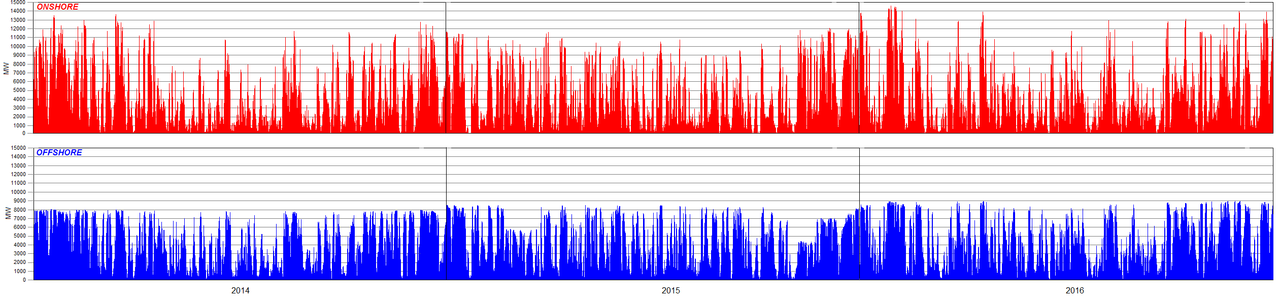
To establish whether offshore wind is a strong or weak complimentary source, we can once again look at the data from Denmark, which has about 8GW of offshore wind capacity installed. In 2017, Euan Mearns analysed three years worth of data for both offshore and onshore wind, and found that the two are well-correlated (R squared = 0.71 for hourly data, 1 is a perfect correlation). This means that offshore wind is a relatively weak complimentary source. When the wind is blowing on land, chances are it's also blowing out at sea (and vice versa). 

Hourly onshore (red) and offshore (blue) wind generation with total generation scaled up to meet total demand, Denmark, 2014-2016 (from Euan Mearns).
So this means that power stations will still need to be ramped up and down as before. Offshore wind, like onshore,  will be incapable of replacing power stations, meaning its usefulness will be limited.

References: http://euanmearns.com/can-offshore-wind-be-integrated-with-the-grid/

Saturday, 28 July 2018

Ireland Moves Towards Auction Based Support System for Renewables

The Minister for Energy and Climate has announced that Ireland will move to an auction system for renewables in 2019.


RESS been approved by Government and I will now seek EU State Aid approval. This Scheme will mark a shift from guaranteed fixed prices for renewable generators to a more market-oriented mechanism (auctions) where the cost of support will be determined by competitive bidding between renewable generators. The RESS is a critical step in bringing Ireland to a leadership role in relation to renewable energy, climate action, and energy efficiency. Communities are central to the design of the new Scheme and this will have a transformative impact on renewable energy projects right across the country.

 Theoretically, this should lead to lower electricity prices but let's wait to see the finer details of how it will work. The Press Release mentions the importance of not locking in higher costs for consumers - surely the first time an Irish minister has acknowledged that the existing REFIT scheme led to higher electricity prices. 


RESS auctions will be held at frequent intervals throughout the lifetime of the scheme. This will allow Ireland to take advantage of falling technology costs and by not auctioning all the required capacity at once, we will not be 'locking in' higher costs for consumers for the entirety of the scheme.

In the submission made by Irish Energy Blog to the consultation on the scheme (which can be read here), I outlined a scheme that would allow a low cost alternative to the fixed price REFIT scheme, which of course wasn't adopted, but I did warn about locking society into high energy costs : 


This would ensure that our society is not locked into high energy costs for many years to come.

The proposed auction scheme still requires EU State Aid approval.

Tuesday, 17 July 2018

Fossil Fuel Divestment Bill a Token Gesture and Commerically Reckless

The Irish Government is set to divest over €300 million of it's investments in mostly US fossil fuel companies. This paves the way for more investments in renewables, including the Irish wind sector which as this blog has shown has been making losses in recent years. 

BP data shows that oil, natural gas and coal will still be the dominant energy sources in the future even with rapid growth in renewables. 


BP Data

In transport, oil will comprise over 80% of the energy sources used by 2040. 


The mission statement of the NTMA (National Treasury Management Agency) is to manage public assets and liabilities commercially and prudently.  The fossil fuel divestment bill is at odds with this mission statement as it's purpose is to divest from the most profitable energy markets and from energy sources that will be in high demand for many more years to come. The NTMA do not seem to have carried out a commercial assessment of renewable sources like wind energy. Is it commercially viable or not ? The fact that many Irish wind energy companies are selling up and divesting from the wind energy business altogether might give you a clue. 

The farcical nature of the discussion that took place around the Bill was on full display in the Dail (Irish parliament) with contributions made like this one by Michael D'Arcy of Fine Gael :

I am concerned about something that is happening now, which I see in my own county, whereby people are objecting to everything. It is everywhere. Wind farms are objected to. We brought in new controls to keep turbines back from property boundaries, which is appropriate. There are objections to solar farms. People are creating fear and doubt and saying the craziest things about renewable energies that are clean and tested and have been for decades. It has to stop or we will never meet these targets.  Events like what happened with the Apple data centre in Athenry cannot continue. People who object to a project because it is close to them are wrong in so doing.

It doesn't take too much research to learn that data centres will consume more fossil fuels and make it harder to meet our targets. But here we have somebody in government who believes the opposite. I was waiting for him to say the sun revolves around the earth next.

The fossil fuel divestment bill is a token gesture, will have zero impact on global emissions and will result in losses for the taxpayer.