Thursday, 29 January 2015

More on the Energy Bubble


Figure 1: How generating capacity has increased since 2006. East West Interconnector included in 2013 and 2014, also Great Island CCGT included in 2014 and retired oil plant on same site taken out


The above graph, Figure 1, shows the levels of electricity generation capacity for the Republic of Ireland at the end of 2014. We are now approaching the 10 GW mark, the highest ever in the State. If you really want to know why your electricity bills are so high then you only need to look no further than the above graph. All the above power stations and wind farms have to be financed through our bills, even though we only use on average less than a third, and at peak times less than half, of this capacity in electricity. The key to understanding this graph is looking at the gap between the blue (average demand) and black line (total capacity including wind) and the red (peak demand) and black line in 2006 and then comparing this gap with the current gap in 2014 (See Figure 2). As you can see, it has gone out of control. Consider that back in 2006, when the economy was booming, there were no blackouts . The level of back up capacity was sufficient but now that we have over 2GW of wind, it appears that more back up capacity is required to maintain a stable and reliable system.


2006
2014
Total Capacity
/ Average Demand
2.0 times
3.2 times
Total Capacity
/ Peak Demand
1.3 times
2.0 times
Figure 2: Total Capacity is now over 3 times that of average demand and double that of peak demand

There is an argument put forward by the Greens that this excess capacity will be required when everyone switches over to electric cars and electric heating systems as this will lead to a surge in average and peak demand. But there is a major flaw in this argument. You would still need enough dispatchable plant (i.e. plant that can be switched on and off at the touch of a button rather than when the wind blows) at least equal to the peak demand under this scenario, no matter how many wind farms there are. Otherwise, what would everyone do on a calm day like the 11th October 2014 ? Cycle the 10 or 20 miles or more to work ? Or perhaps wear extra woolly jumpers ? So you would still need to build more power stations to cover the surge in demand under this scenario and wind turbines would still result in excess capacity just like in the above graph.

Fuel Mix 2013 - another historic milestone


Figure 3: Fuel Mix 2013 with UK imports broken down into original fuel sources

Figure 3 shows that in 2013, Ireland used nuclear power for the first time. 2% of the electrons going into your electric socket in 2013 came from nuclear stations in the UK. I have broken down the power consumed here through UK imports into their energy sources and added that to the fuel mix provided by SEAI to arrive at the above chart. UK coal power accounted for 40% of our imports with gas at 25% and nuclear at 21%. The 10GW or so of UK wind provided just 6% of imports. So we are still very reliant on gas and coal power - almost 70% of the electrons entering your home in 2013 came from gas and coal power. (not including spinning reserves or back up generation)

But when we look at SEAI's original chart it tells an interesting story :

Figure 4: SEAI Fuel Mix 2013


While on the face of it, wind power did well, one has to put the output of a generator in the context of its generating capacity. The following table (Figure 5) shows the share of generating capacity each energy source had in 2013, so for example, gas plants made up 44% of the entire power plant and wind farm fleet in 2013.


Ireland's Power Generation Mix
2013
Gas
44%
Wind
20%
Coal
9.5%
Peat
4%
Interconnection
5.5%
Oil
12%
Hydro
2%
Pumped
3%
Figure 5: Generating mix 2013

Definitions used :

Grid Acceptance Rate (GAR): the rate at which when power becomes available from a generating source that it is accepted by the grid. So wind power has a grid acceptance rate of 1:1 because it has priority dispatch, meaning when wind power is available it is automatically taken by the grid. Gas has a GAR of between 1:0.8 - 0.9 because when wind becomes available it pushes gas off the grid. I will assume 1:0.85 for this analysis. Coal and Peat are assumed to have a GAR of 1:0.95 as they are occasionally pushed off by wind

Fuel / Capacity Ratio : the position of a fuel source in the fuel mix relative to its position in the generating capacity mix. So a fuel source that makes up 50% of the capacity and 50% of the fuel mix will have a fuel / capacity ratio of 1:1.

Gas power gave just over 1MW power for 1MW share of capacity so had a fuel / capacity ratio of 1:1. Peat gave over twice as much power as capacity (2:1) while coal gave approx 1.6MW power for 1MW capacity (1.6:1). It is no surprise that the highest emitting power sources produced the most power relative to their size. This is because coal and peat store higher concentrations of energy than other fuel sources having formed over millions of years. Oil power, representing 12% of capacity, had a negative fuel / capacity ratio because these plants were lying idle most of the time. Oil plant are mostly used for "peaking" , i.e. when peak demand goes above normal which doesn't happen very often nowadays. So it had a significantly low Grid Acceptance Rate (somewhere around 1:0.01), whereas gas, peat and coal had GARs very close to 1:1 (between 1:0.85-0.95)


So how did wind do? Well, it had a negative output relative to its share of capacity. It comes out at 0.8MW of power for each share of MW installed. This is despite it having priority dispatch i.e. when the wind blows, the power is taken straight away by the grid. So levels of other power sources - mostly gas, and sometimes coal and peat - are reduced when wind is available. Applying the above definitions, this means that wind had the best Grid Acceptance Rate of all fuel sources i.e 1:1, but had a negative fuel / capacity ratio of 0.8:1. So wind and oil came out the worst, but oil had the lowest Grid Acceptance Rate, whereas wind had the highest. What this shows is that wind is a poor storage of energy when compared to coal, gas, peat and oil and storage solutions cannot solve this problem, rather it simply transfers the storage of this energy from one hour to another. What is required is a renewable source that contains higher concentrations of energy


And herein lies the problem with wind energy - you can't run a reliable grid if you install power plants that almost always give a negative fuel / capacity ratio. If you install 1,000 MW of wind, and demand hits 1,000MW, the power from the wind will almost always be less than 1,000MW so you have a blackout. This problem means that wind energy can never replace conventional plant and so competitiveness goes out the window


Sunday, 25 January 2015

PSO Levy set to soar this year


As pressure mounts on Energy suppliers to cut bills (some cuts have this week been announced), consumers will be expecting to see some extra change in their pocket in the coming months as some of the reductions in gas and oil wholesale prices are passed on. But there will be a sting in the tail come July.  Each July, the Energy Regulator (CER) calculates the PSO Levy required for the coming year, which begins in October. The PSO Levy recovers some of the costs for wind, peat and idle gas plants. Last year saw a rise in the PSO Levy of over € 100 million, mainly due to lower gas prices.


The PSO levy of €335.4 million for 2014/15 compares with €210.9 million allowed for the current 2013/14 PSO period. The biggest drivers for the year-on-year increase are as follows : 

Lower wholesale electricity prices. The estimated average wholesale electricity price in the all-island Single Electricity Market (SEM) for the 2014/15 period is €57.17/MWh. This is down circa 11% on the €64.28/MWh used to determine the levy for the current PSO period. A lower wholesale price for next year results in the PSO plants needing more PSO money to cover their allowed costs, to offset the lower money they are predicted to receive from the market. This applies across-the-board for renewables, peat and security of supply plants supported by the PSO. It is the biggest single driver of the rise in the levy. The lower estimated wholesale price for next year is reflective of a trend in recent months in the SEM of lower spot and forward contracting prices, related to lower gas prices; [extract from CER PSO Decision Paper  2014/2015]

And the trend since July was one of even lower gas and oil prices, that nobody, let alone the CER, could have foreseen. While we dont use much oil in electricity generation, oil is used in the extraction and transportation of gas so it does have a knock on effect on gas prices. So the CER will have no choice but to increase the € 335 million PSO levy even further next winter completely reversing and most likely exceeding the measly price cuts introduced by energy suppliers. The suppliers of course, it goes without saying, will pass the PSO Levy hike on to consumers, while at the same time, their power generating arms will pocket most of the portion of the PSO Levy relating to wind (most wind farms in the State are owned by the big Energy suppliers such as Energia, ESB, Bord Gais, Airtricity etc. Bord na Mona own the peat plants).

The current energy policy really resembles something from the Communist Soviet Union with the final electricity product incapable of reflecting market realities, rather shareholder interests.

Oil - To invest or not to invest ?

Meanwhile, Eddie O'Connor, CEO of Mainstream Renewables, recently stated in a blog

The fall in oil prices over the past few months has brought a huge measure of reality to energy investors. If production costs are higher than USD70 per barrel then their investment is wasted. Assets which can’t be sold for cost reasons are stranded and the companies which made the investments are in deep trouble. The investors who backed the companies could potentially lose everything.

 But back in 2009 he was warning about the impact of "peak oil" :

How much worse will the panic be when the truth is eventually accepted and we stare down the barrel of a gun at prices of US$200 – US$300 per barrel of oil and all other energies follow in price.

It looks like Prophet Eddie's predictions are about as reliable as his wind turbines.......


Friday, 23 January 2015

Wind Energy a wasteful use of resources (EROI)


The Energy Return on Investment (EROI) measures the energy output given by a certain power supply technique over its lifetime relative to the energy required to extract the fuel and build the power station to provide that same power supply. Recent research into the German energy system reveals the EROI for different types of power supply based on the most detailed study yet into the area :


They first of all calculated the unbuffered EROI for each power supply, which does not include storage systems. They then calculated the buffered EROIs, taking into account pumped storage which is required to balance wind power, so that like to like comparisons can be made with other power plants. 

The results show that nuclear and hydro come out best with coal and CCGT (gas) on respectable positions. Renewables in general dont come out too well. Solar CSP, which are built in deserts, comes out the best. As for wind, when you add in all the concrete, steel, water, magnet processing and oil that goes into their manufacture, installation and maintenance, you get a relatively small amount of energy back over the turbine's lifetime :


The lifetime of wind turbines


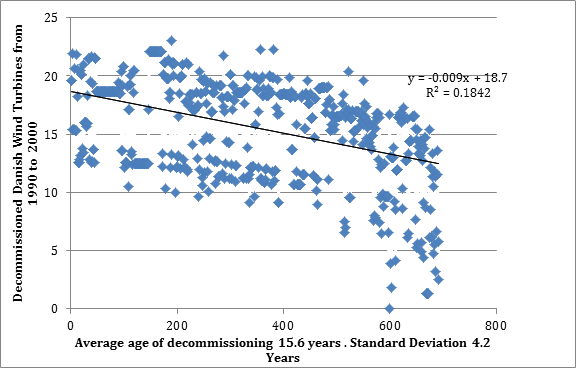
One could argue that the EROI for wind may be slightly higher in Ireland with the slightly higher wind speeds over Germany. However, a lifetime of 20 years was assumed in this study. The lifetime of wind turbines, in particular the larger ones, is now been questioned as the experience in Denmark shows that turbines installed between 1990 and 2000 lasted on average for 15 years [Figure 1].


Figure 2: Decommissioned Danish Wind Turbines from 1990 to 2000. (Graph provided by John Dooley based on data from Danish Energy Agency)


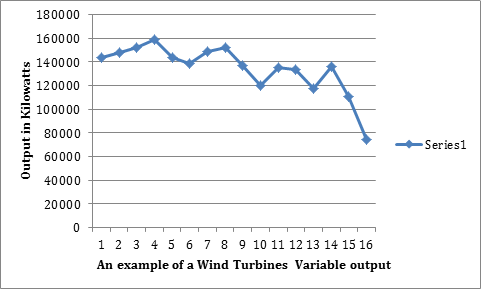
Figure 3: Example of wind turbines variable output (Graph provided by John Dooley based on data from Danish Energy Agency)

And Figure 3 shows how a wind turbines output is not consistent over its lifetime. In fact, the output deteriorates on average at around year 10. So the EROI of wind would be even worse if the above factors had been taken into account in the analysis.

The importance of EROI

So why is the EROI important ? Well, one needs to put it into context. Our modern society evolved around the use of coal and later oil as sources of energy. Our present society would be unimaginable without them. The fallacy thrown around by wind lobbyists (and that of many other renewables) is that wind energy is comparable with fossil fuels. You can't build a modern grid from the bottom up with wind energy. Just ask our 18th and 19th Century ancestors. But you can build a modern grid around fossil fuels and then integrate other less reliable sources into it, but always at an additional cost to the consumer. The fossil fuel plants still have to kept running and open for business.

As Charles A.S. Hall explains :
The importance of EROI is far more than simply whether it is positive or negative. Several of the participants in the current debate about corn-derived ethanol believe that corn-based ethanol has an EROI of less than 1:1, while others argue that ethanol from corn shows a clear energy surplus, with from 1.2 to 1.6 units of energy delivered for each unit invested. But this argument misses a very important issue. Think of a society dependent upon one resource: oil. If the EROI for this oil was 1.1:1 then one could pump the oil out of the ground and look at it and that’s it. It would be an energy loss to do anything else with it. If it were 1.2:1 you could refine it into diesel fuel, and at 1.3:1you could distribute it to where you want to use it. If you actually want to run a truck with it, you must have an EROI ratio of at least 3:1 (at the wellhead) to build and maintain the truck, as well as the necessary roads and bridges (including depreciation). If additionally you wanted to put something in the truck and deliver it, that would require an EROI of, say, 5:1.


Now say you wanted to include depreciation on the oil field worker, the refinery worker, the truck driver, and the farmer; you would need an EROI of 7:1 or 8:1. If their children were to be educated you would need perhaps 9:1 or 10:1, to have health care 12:1, to have arts in their lives maybe 14:1, and so on. Obviously to have a modern civilization one needs not just surplus energy, but lots of it—and that requires either a high EROI or a massive source of moderate-EROI fuels. If these are not available, the remaining
low-EROI energy will be prioritized for growing food and supporting families.

And to get to the stage where activist groups like Greenpeace can fly a bunch of unemployed people to Lima on a jet plane to desecrate an ancient structure in a protest against fossil fuels, you probably need something like an EROI of 20:1. And that's the trouble with fuel sources with such high EROI - it leads to large levels of waste. And the plans for large scale wind farms, storage units, pylons and interconnectors (all require significant use of fossil fuels and rare earths) are now becoming just that - wasteful projects.

What the green organisations don't tell you is that if their plans come to fruition, and oil and coal is kept in the ground, some very tough choices will need to be made about division of resources. Of course green (and most of their left wing supporters) groups usually don't concern themselves with "the law of unintended consequences" :
If the energy and hence economic pie is no longer getting larger—indeed, if because of geological constraintsit can no longer get larger—how will we slice it? This may force some ugly debates back into the public vision.If EROI continues to decline then it will cut increasingly into discretionary spending (the engine for economic growth) and we will need to ask some very hard questions about how we should spend our money.
A problem with substitutes to fossil fuels is that, of the alternatives currently available, none appear to have all the desirable traits of fossil fuels, especially liquids.These include sufficient energy density, easy transport-ability, relatively low environmental impact per net unit delivered to society, relatively high EROI, and availability on a scale that society presently demands. Thus it would seem that the United States and the rest of theworld are likely facing a decline in both the quantity and EROI of its principal fuels. How we adjust to this will be a critical determinant of our future.


Google engineers, once very pro-renewables, are only now beginning to realize the folly of investing large amounts of money and resources into renewables (full article here) :

At the start...we had shared the attitude of many stalwart environmentalists: We felt that with steady improvements to today’s renewable energy technologies, our society could stave off catastrophic climate change. We now know that to be a false hope ...Renewable energy technologies simply won’t work; we need a fundamentally different approach.
So the question is how long will it take for governments to realize their mistake or will they carry on spending citizen's money on wasteful projects ? It is estimated that 500 billion dollars has been invested in capital costs alone in European renewable projects - a lot of money that could have been invested in genuine environmental causes, education and health.

Based on this US comparative pricing, the major Nations in Europe have expended of the order of about $0.5trillion on Renewable Energy installations to generate an amount of electrical energy that could have been provided by conventional sources for about 16th of the capital cost. This 16th of the cost also represents an estimate of the approximate cost of the spinning reserve needed to support the Renewable Energy Technologies as they are intermittent and non-dispatchable (link) .


Wednesday, 21 January 2015

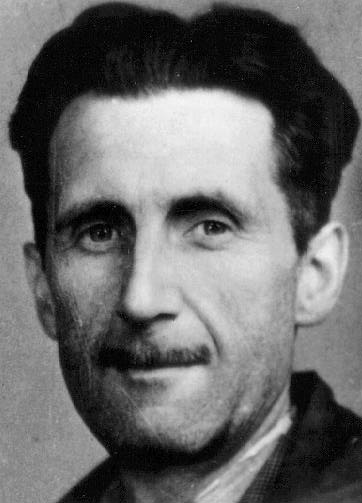
George Orwell, Democracy and The Freedom of the Press


This day, 65 years ago, Eric Arthur Blair, otherwise known as George Orwell, passed away. He was one of the great defenders of freedom of speech and opponents of totalitarianism. His style of writing was always clear and engaging, whether writing about coal mines or toads and he was never afraid of challenging the consensus, a characteristic that many journalists and writers today could benefit from. There are quite a few parallels with Orwell's writings on the Soviet Union and the current energy debate in Ireland and elsewhere. If we look at a recent submission to the Dept of Energy by a wind company for example :

People fundamentally tend to support the consensus view. If a vocal minority succeeds in
dominating local and national media, a consensus can develop, and overall views can shift
radically, regardless of fact. The question is what is the consensus? The extremes views of
energy policy tend to make a disproportionate of column inches.

Why do we need a consensus ? Surely what we need is independent analysis of wind energy and other forms of energy so that people can make an informed view, not abiding by a consensus based on information provided from only one side of the debate  (i.e. the invested interest side). They also seem to have quite a poor view of people's intelligence, implying that people will follow the herd like sheep. People making up their own minds is something not conducive to their interests. One wonders if they would like The Thought Police from Orwell's 1984 to swoop down on dissenters or if they would like to design the perfect human embryo for accepting wind farms as in Huxley's Brave New World

Of course the irony is that it is next to impossible for one of the mainstream papers to say something negative or critical about wind energy (apart from notably The Irish Examiner). Patrick Nyberg found that there was a herd instinct in Ireland and it seems that the wind lobbyists are becoming increasingly frustrated that this herd instinct is not getting behind their project. During the Celtic Tiger, the mainstream media published very little negative articles or comments about the housing bubble and this helped fuel the herd instinct, eventually leading to the large banking collapse.  Orwell once wrote about the sometimes unspoken and unwritten rules with which the Press operate (see here for original). The same remarks can be made about the Press in Ireland today as regards wind (Orwell of course was writing about the British press). I have replaced references Orwell made to "Soviet Union" with "wind energy" -

At this moment what is demanded by the prevailing orthodoxy is an uncritical admiration of Wind energy. Everyone knows this, nearly everyone acts on it. Any serious criticism of the wind industry, any disclosure of facts which the wind industry would prefer to keep hidden, is next door to unprintable. And this nation-wide conspiracy to flatter the wind industry takes place, curiously enough, against a background of genuine intellectual tolerance. For though you are not allowed to criticise the wind industry, at least you are reasonably free to criticise the fossil fuel industry. Hardly anyone will print an attack on wind energy, but it is quite safe to attack fossil fuels, at any rate in books and periodicals.

The issue involved here is quite a simple one: Is every opinion, however unpopular — however foolish, even — entitled to a hearing? Put it in that form and nearly any intellectual will feel that he ought to say ‘Yes’. But give it a concrete shape, and ask, ‘How about an attack on wind energy? Is that entitled to a hearing?’, and the answer more often than not will be ‘No’, In that case the current orthodoxy happens to be challenged, and so the principle of free speech lapses. Now, when one demands liberty of speech and of the press, one is not demanding absolute liberty. There always must be, or at any rate there always will be, some degree of censorship, so long as organised societies endure. But freedom, as Rosa Luxembourg [sic] said, is ‘freedom for the other fellow’. The same principle is contained in the famous words of Voltaire: ‘I detest what you say; I will defend to the death your right to say it.’

Not content with attacking locals who don't accept the propaganda, the wind lobbyists then set their sights on universities, publicly funded bodies and politicians who don't toe the line :

The key to achieving this education and guidance and leadership role is to have credible organisations and authority figures delivering neutral unbiased information, so that people are well informed and can form their own views. Developers’ views unfortunately do not carry much weight, as they are seen tobe biased. Some of this distrust we must attribute to the excesses of the building boom. In ourview, bodies such as the SEAI, DCENR and ESRI should be at the forefront of the public messaging around the fundamental case for wind [This is a strange interpretation of "neutral unbiased information" - admin]. The SEAI’s recent definitive study on the displacement of fossil fuels and CO2 abatement rates per MWh of wind generation is precisely what is required. [see here for an rebuttal of this] There is an unfortunately widening gap between local councillors and national policy and politicians, as seen by local county development plans being changed locally and overturned by the Department of Environment. This tension between national level policies and local interests has always existed, but it should not be so pronounced within the same political parties. Again, an education programme within political parties and at annual conferences could both sides understand the other sides concerns. 


We believe that the economic case for wind has been thoroughly proven, but the message hasbeen lost. A case in point is a headline in the Irish Independent 29th July “Electricity bills to rise as green energy levy soars by 50pc”. In fact the presence of wind reduces electricity prices. The PSO levy is 75% attributed to peat and gas contracts. We understand that the ESRI budget for energy policy research is constrained. With a renewed focus on the affordability of energy policies, we believe an investment in ESRI funding for this area would pay dividends. 


The universities also have a role to play as independent and respected guides of policy. When bad science is trotted out by vested interests, then Irish academics should be not only prepared, but incentivised to step in and set the record straight. Our tax pays their salaries to promote solid science. There is a lot of research and development money channelled through the universities. Some must be spent on blue sky research, but it would seem perfectly reasonable for some of this funding to address more practical issues questions around our energy policy, to help inform the public and policy makers. For example, an Irish specific study on property prices in the vicinity of wind turbines could be persuasive.


This is a totalitarian attempt to control all arms of the State and the media for the benefit of a small number of companies and investors. While they espouse the benefits of an informed debate, its clear the agenda should be restricted to the benefits of wind only. There seems to be a belief that publicly funded bodies whose role is to act in the public good, exist for the benefit of well funded lobby groups. The ESRI, who got things badly wrong during the boom years (remember that stuff about "soft landing") would do well to steer clear of supporting another bubble. 

And it is hard to fathom how anybody could claim that the current energy policies are "affordable". Affordable to whom exactly ? 

In the wake of the Paris attacks, we have heard a lot about freedom of speech. Orwell laid down the benchmark for freedom of speech  "If liberty means anything at all it means the right to tell people what they do not want to hear. The common people still vaguely subscribe to that doctrine and act on it. " So have we moved any further on since the 1940s ? Do our institutions and press listen to that which they do not want to hear ? Well, one can read this article for example and make up their own minds :

http://the-law-is-my-oyster.com/2014/12/08/how-many-pr-consultants-does-it-take-to-change-a-light-bulb/


And what about that great form of government which, when other nations lack in it, we are so quick to criticize them for - democracy. Well, actually, Orwell's classic tale "Animal Farm" is uncanningly like the wind programme initiated in Ireland and the EU. In Animal Farm, the pigs decide and the animals have to toil building windmills. In our case, we may not have to do physical labour, but already a third of our electricity bills (according to the Irish Academy of Engineering) goes to funding this programme. So we in our own way are toiling to build these windmills. 

“No one believes more firmly than Comrade Napoleon that all animals are equal. He would be only too happy to let you make your decisions for yourselves. But sometimes you might make the wrong decisions, comrades, and then where should we be?” - Extract from Animal Farm

Most of the democratic processes, in relation to the renewable energy programmes, have been bypassed at EU level and at an Irish governance level. UNECE Meeting of the Parties ruled, in July 2014, that appropriate levels of public participation were not met when the Irish government adopted their National Renewable Plan :

(a) That the Party concerned [the European Commission], by not having in place a proper regulatory framework and/or clear instructions to implement article 7 of the [Aarhus] Convention with respect to the adoption of National Renewable Energy Action Plans (NREAPs) by its member States on the basis of Directive 2009/28/EC, has failed to comply with article 7 of the Convention;

(b) That the Party concerned, by not having properly monitored the 
implementation by Ireland of article 7 of the Convention in the adoption of Ireland’s 
NREAP, has also failed to comply with article 7 of the Convention;

(c) That the Party concerned, by not having in place a proper regulatory 
framework and/or clear instructions to implement and proper measures to enforce article 7 of the Convention with respect to the adoption of NREAPs by its member States on the 
basis of Directive 2009/28/EC, has failed to comply also with article 3, paragraph 1, of the 
Convention;

http://www.unece.org/fileadmin/DAM/env/pp/mop5/Documents/Post_session_docs/Decision_excerpts_in_English/Decision_V_9g_on_compliance_by_the_European_Union.pdf

The provisions of the Aarhus Convention and EU/Irish Environmental Law are not some box ticking or red tape exercise that gets in the way of progress. They are there to ensure that independent experts and the voice of the public (who are both the financier and host for these projects) get their say. This is even more pertinent for environmental projects as it is enshrined in Irish legislation that the citizen owns the environment, not the State. 

The position taken by EU and Irish officials to those who question the purpose of their projects has been plain anti-democratic. In some cases it has gone to the bizarre. One EU official when questioned about the carbon emissions savings from a renewable project responded:

“If we were to take instead of a 110 m high wind turbine a 110 m high 
metal statue of Mickey Mouse, you would not be expected to do a detailed 
carbon assessment on that, so why do you expect a detailed carbon 
assessment for the wind turbine?" (from UNECE records)


The bottom line is that such information does not exist.

When these compliance issues are taken up with the Irish authorities, the response is often, that this is not the correct forum and that one needs to take a case in the High Court. In otherwords, make it up as you go along. The document below, prepared by Pat Swords, a chemical and environmental engineer, documents some of these failures of the Irish authorities to deal with substantive and compliance issues :

http://www.unece.org/fileadmin/DAM/env/pp/compliance/Pre-admissibility_communications/Ireland_European_Platform/frComm_response_to_Committee_s_questions_01.12.2014.pdf

The pigs have decided whats best for all of us and its no use complaining. So do we have a fully functioning democracy in Ireland or indeed the EU ? Well, there's more chance of Ireland winning the World Cup than Irish citizens getting a fair hearing at EU level. Democracy only exists for those who the EU officials favor, just like in any dictatorship throughout history. But the whole point of democracy is that it exists for everyone and not something to be applied arbitrarily. Indeed, the EU are still fighting UNECE's decision above. So we have a crisis of democracy and the outcome is uncertain. It's not exactly 1984 but it's one step closer.


Friday, 16 January 2015

What's In Your Electricity Bill - Part 3 : Capacity Payments


Source - CER Annual Capacity Payment Sum, Decision Paper, 2015

Capacity Payments are paid to generators to make their capacity available. The generator doesn't have to actually supply electricity, they get paid based on the output they could potentially export to the grid. This may seem strange but it appears that this payment is required to recover some of the capital costs of building plant.  In recent years, capacity payments have been paid to standby diesel generators and wind farms as part of the paradoxical energy policy that has been implemented since the Green Party were in government.

The capacity payments pot has not fluctuated much in the past few years. It has hovered around the €530 million mark, quite a substantial amount, around a quarter of total energy payments. In 2014, the total rose to € 565 million, up €14 million from 2010 and down just €10 million from 2008, at the height of the building boom. It is calculated based on a formula for All Island Capacity Requirement multiplied by the fixed costs per Kw of running a peaking plant in Northern Ireland which runs on oil. So will we be seeing a reduction in Capacity Payments now that oil prices have halved ? Well, unfortunately, the CER have based 2015 rates on 2014 rates and have estimated that oil prices would rise, hence the capacity payment pot for 2015 has gone up to € 574 million.


Capacity payments to wind farms make up around 5% of the total, for providing capacity that is not guaranteed and cannot be relied upon (e.g. 11th / 12th October 2014 when wind power was zero for long periods). But wind farms drive up the final cost of capacity payments. The formula for All Island Capacity Requirement takes account of the capacity credit of wind (now at 369MW out of a total wind capacity of 2,700 MW) which is then added on to the conventional requirement to arrive at the final figure. So the pot was € 29 million higher as a result of wind energy, roughly equal to the amount they receive.

This then raises the question - why, with over 2,000MW of wind in the system, which was designed to reduce dependence on fossil fuels, are we paying well over € 500 million a year to fossil fuel plant just to make them available to provide power when the wind stops ? Have we backed the wrong renewable horse ?

Wednesday, 14 January 2015

What happened to the promises that wind energy would bring down energy prices ?


This week it was revealed that oil prices and wholesale gas prices both fell by 50% and 27% respectively but that electricity suppliers would not be passing on the savings to consumers. But weren't we told that one of the justifications for the large investments in wind energy was that it would bring down energy prices :

 The development of renewables is a way of bringing down electricity and gas prices, as well as tackling climate change   - Eamon Ryan, Minister for Energy, 2009

More wind energy means lower energy bills; it's as simple as that. - Eddie O'Connor, CEO Mainstream Renewables, 2006
The result is that when wind and solar are included in the generation portfolio they have a powerful effect on the economics of electricity, which means a reduction in price - Eddie O'Connor, 2012

          In fact the presence of wind reduces electricity prices - Greenwire, July 2014

Adding significant amounts of wind capacity to a country's generation portfolio leads to lower overall generation costs, and to lower bills, while increasing energy security - Mainstream Renewables - Why Wind Energy ?

 DOUBLING the amount of  wind energy on the national grid is key to preventing  higher electricity bills in the future, Energy Minister Pat Rabbitte has said. Increasing the amount of renewable energy would provide a "hedge"against future oil and gas hikes and ensure Ireland had an indigenous source of secure and cheaper energy - Pat Rabbitte, Minister for Energy, February 2014

When the reduction in wholesale electricity prices is also taken into consideration wind energy will actually deliver savings to the consumer - IWEA

But John Lynch, manager of renewable energy at Bord na Mona, reckons the biggest winner [with wind energy] could be the consumer - February 2014

There's sound economic reasons for having these supports in place. Because wind generation is "free" and does not involve burning oil or gas, it helps reduce the price for all electricity customers  - Paul Melia, Irish Independent 2014

In the meantime, we should be looking at producing as much clean energy as possible, if nothing else than to reduce our bills - Paul Melia, Irish Independent, July 2014 


But we see now, that no matter which direction wholesale prices of fossil fuels goes, our energy bills remain high. The Energy Regulator explained last year what exactly it was that kept our bills high when fossil fuel prices were low:

It (wind) lowers the wholesale price of electricity," a spokesman said. "When fossil fuel prices are high, wind has a particular benefit and tends to reduce costs. When fossil fuel prices are low, wind tends to add to bills CER, February 2014 

 While the price of fossil fuels comes under the spotlight in the media, and quite rightly so, it is important to bear in mind that the cost of fossil fuels only accounts for 22%-25% of your final electricity bill :


In general, supply companies purchase power 12-24 months in advance so there is a timing lag with actual fuel price movement. It’s also worth noting that fuel costs (primarily gas) only account for an average of 25% of a customer’s bill, with other costs, including Government levies, accounting for the vast majority of the bill - Energia

Based on an in-depth analysis by the Academy, the total cost of imported fossil fuels for electricity generation in Ireland in 2013 was approximately €875 million (natural gas - €755 million; coal - €100 million and €18 million for fuel oil and gasoil). The total value of electricity sales in Ireland in 2013 – household and business/industrial – was approximately €4 billion. This means that imported fossil fuels accounted for only 22% of electricity price. A critical analysis of the other components of electricity price is essential - Irish Academy of Engineering

 So, the spotlight now needs to come upon the other elements that make up electricity bills. I have already dealt with two - Energy and Constraint Payments, and hope to have a look at more in the future.