Tuesday, 3 March 2015

Energy Regulator confirms that wind energy will result in additional costs


This blog has consistently made the point that wind has and will result in more costs in the generation of electricity, because when you mix large amounts of non-dispatch with dispatch generation, the dispatch no longer runs as smoothly as before, meaning that the costs of running your dispatch goes up.

The Energy Regulator confirmed this in an Oireachtas Committee a couple of weeks ago :

Wind has been least-cost in the past, but that does not necessarily mean it will be least-cost in the future. More and more wind on the system adds extra costs. It is a question of the law of diminishing returns. To bring in more and more wind, we have extra network costs. We need more flexibility from the generators. The wind does not always blow. When the wind is not blowing, we need to have extra capacity there to keep the lights on. The cost of that increases with the levels of wind. Some of the microgeneration technologies, such as solar technology, start to become more competitive in such circumstances. They also have falling capital costs. We constantly need to look at this in a cost framework. While we have security of supply requirements and we need to consider the environment, cost is a major feature of our overall duty.

https://www.kildarestreet.com/committees/?id=2015-02-18a.1291&s=wind+farm#g1411 

It is good to see the Regulator now focusing on cost, because it certainly is going to become an issue into the future.

Lifetime of larger wind turbines called into question


Gearbox being changed at a wind farm in Wexford with 2.5MW Nordex turbines. This wind farm was installed in 2013. (Source:www.windnoise.info)

A new study by Irish engineer, John Dooley, based on information from Denmark, casts doubt on the lifetime of larger wind turbines. It has been assumed in most business plans and by most financiers that the lifetime of these turbines are 20 years, the same as the smaller older models. If this is not the case, there is trouble ahead for newer wind farms and their investors - only time will tell.

The report can be accessed here:

http://docs.wind-watch.org/Danish-Wind-Turbines-from-1977-to-2014.pdf

Saturday, 28 February 2015

Putting the brakes on


Wind turbine braking system
Example of brakes on a wind turbine

As I write on a very windy night in Ireland, we are curtailing 220MW of wind to keep non-synchronous generation under 50% of total demand (at times it reaches 51%).

But the remarkable thing is that we are still importing 150MW from England. Imported electricity is a form of non-synchronous generation, just as with wind. So in effect, it is competing with wind to get in on the grid in the restricted non-sync slot. So surely we should be allowing that additional 150MW wind in and exporting the surplus to the UK. But instead we are importing coal and nuclear power, when we could use up all our wind, and paying wind farms to shut down.

So we need to get the message. UK does not want our wind energy during the day and at peak times. They are generating enough of their own - 5.5GW at the moment and have no intention of ramping down their CCGT gas plants any further to allow Irish wind in. If they ramp them down any further, they will most likely use up more fuel and create more emissions than if they were running at full load (it results in inefficiencies like driving your car in first gear).

We cannot sell our excess wind to England whenever we want, only when they want, which is during the night when demand is low and they can pay us a low price.

The trouble is that Eirgrid and the authorities now know this so why are there still plans for exporting wind energy after 2020 ?

Friday, 27 February 2015

Cadburys job losses - Our government is sleepwalking into another unemployment disaster


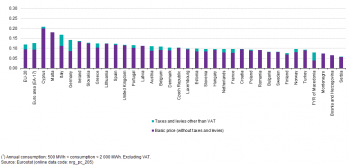
This week saw 100 new jobs in Ireland from Apple but over 200 job losses as Cadburys moved some of its manufacturing plant out of the country.

As can be seen on this chart, Poland is ranked 24th and Ireland the 5th for the highest electricity prices for industrial users in Europe :


There is an interesting discussion here on the Polish energy policy :


Garcia called “illogical” the fact that companies will have to pay more for energy just because it is ecological. He argued that this would limit the investment potential of the sector, pose a threat in terms of competitiveness and lead to moving production outside the EU.  
“To grow, you need energy – in this case the cheapest energy possible. Energy prices in the EU are expected to grow and this is a threat,” he said.

Poland set a renewable target of 19% for electricity compared to Ireland's 40%. As can be seen here Poland is not expected to even meet these targets :

http://www.keepontrack.eu/keeping-track/poland/2014/

Their government did not transpose the EU Renewable Energy Directive into national law. The European Commission were not happy and in March 2013 proposed a daily penalty of €133,000, around €48m a year. By December 2014, this proposed fine was reduced to € 61,000 a day, about €22 million a year. I can find no date for a judgement that will actually impose the fine. There are no subsidies for renewable generation and no multi-billion Euro investment to upgrade its already adequate grid infrastructure.  We are told by Keep On Track that the Polish Prime Minister, Donald Tusk expresses the argument that energy generated from [renewable] sources is the most expensive one and contributes to growing energy prices for end users, deteriorates the landscape and adversely affects the functioning of the electricity system. Contrast this position with that of Irish politicians who tell us idiotically that renewable generation will bring down the price of electricity.

So where are Cadbury planning on moving their manufacturing plant to - well, you guessed it - Poland. England has seen two Cadbury plants close a few years ago and move to Poland so it shouldn't have come as big surprise that Irish plants were next :


But on Tuesday it said earlier plans by Cadbury to close the plant and move production to Poland were too advanced - Cadbury plant, Somerdale,  BBC News 2010 

But days after the takeover was completed the firm controversially announced that it would close the plant and move production to Poland - Cadbury plant, Keynsham, BBC News 2011

The plant in Coolock, Dublin opened in 1964, the Somerdale plant in England opened in 1935. 

Jobs Minister Richard Bruton said about the Irish closures :
“Unfortunately, due to a cost base which is significantly out of line with competitor countries, it appears likely that the company will proceed,” he said in a statement today.

Of course, the costs of energy is just one cost but it is quite a significant one for a manufacturing firm, whereas it would be less for say a financial services firm.

So we can see a trend here. The EU monster is getting angry and beginning to growl. The Polish government stands up to it, while the Irish government grovels at the monster's feet, while warning its own people about fines for disobeying Big Brother. The net result is that Poland gains 200 jobs, while 200 hard working Irish people are now forced to seek handouts at the Social Welfare office. 

This trend can only continue - 10 closures like the plant in Coolock equates to a minimum of social welfare payments of € 20 million per year, roughly equal to the fines threatened by the EU on Poland for failing to implement the EU's energy policy. Then there is the tax take, council rates and the contribution to local economies to take into account. Who are the smart people here, who are the ones who have the best grasp of maths and economics ?

Meanwhile Richard Bruton is flapping around like a headless chicken blaming a cost base which his government are responsible for. But we know the energy policy will not change, so expect more flapping and unfortunately more job losses to come.

Apple data centre a great boost for Galway but please spare us the Green Propaganda


There is much to be said in favour of modern journalism. By giving us the opinions of the uneducated, it keeps us in touch with the ignorance of the community - Oscar Wilde

Apple's new data centre in Galway will bring 100 long term jobs, according to Minister Richard Bruton, jobs that are very much welcome to this region of the country. Much was made by the usual suspects about how the centre was going to be powered by 100% renewables. But the reality was far less romantic :

Apple has promised that it will use renewable energy, but local residents have been told that this does not involve construction of a wind farm – rather the company will purchase power from a renewable energy provider. 


Of course, there is no such thing as a renewable energy provider, all electricity providers provide electricity from the same grid with the same fuel mix and a frequency set by synchronous fossil fuel power. So that was took some amount of PR, Spin and double-speak to get from the data centre will use the same grid power as everyone else to the data centre will be powered from 100% renewables. 


As the local councillor said “This is a very significant investment, and the only by-product will be a lot of hot air.” - Well, quite.


Data centres consume quite a bit of power but we are told that Ireland’s high electricity costs – 30 per cent more now than in 2010, which is well above the European average – will be offset by the temperate location, which presumably will assist in the cooling of the servers and units. I cant find any data but I would imagine that a conventional manufacturing plant would use more electricity, but I would be interested in opinions on this.


Both Apple and the Green movement / Wind industry are very much dependent on China for the mining of rare earths. There is not a whole pile of information available on this as one would expect from a Communist regime, but I would suggest a couple of articles which reveal some of the hypocrisy involved in Western movements :


In China, the true cost of Britain's clean, green wind power experiment: Pollution on a disastrous scale - The Daily Mail

Rare-earth mining in China comes at a heavy cost for local villages - The Guardian

Of course, most manufacturing and high tech industries involve some degree of environmental impact and it would be unfair to single out one or two but the reason I bring this subject up here is because the movements and industries which espouse green principles and credentials in reality share just the same reliance on raw materials and fossilfuel energy as any other.  

For example, most people in Ireland believe that nuclear power is bad because of the waste by-products but likewise, most believe that wind power is clean because there are no by-products. The facts are that both sources of power result in waste by-products - the only difference is with wind, the by-product lies in a lake thousands of miles away on another continent, out of sight and out of mind. 

As someone long ago once said, ignorance is bliss.

Tuesday, 24 February 2015

Meeting with Department of Energy


Today I had a meeting with the Department of Energy on the energy policy. Many of the arguments made on this blog were put forward including the Energy Bubble graph and the warnings from industry and Representative Bodies.  Some points that came up was that a Cost Benefit Analysis of a plan or programme was not actually required by law, which is not my understanding of the environmental legislation. The other thing I gathered is that the focus will be mainly on CO2 and fuel savings in the electricity sector rather than in other sectors such as airlines, transport, heating etc.

A new plan is been drawn up for 2030 targets and will be open to submissions from the public. So it looks like the current policy will be with us for many years to come....

High Court Case to halt NREAP


In other news, Pat Sword's legal challenge to halt Ireland's Renewable Energy Action Plan (NREAP) re-commences next Tuesday at the Four Courts. The case centers on the lack of compliance with the Aarhus Convention and SEA Directives. The State will be arguing that this is mostly historic at this stage.