Showing posts with label Peat generation. Show all posts

Friday, 15 January 2021

Coal and Oil to the Rescue During Cold Weather

Last week was one of the coldest spells of weather here in Ireland of recent years. As usual with very cold periods, wind generation was low. The grid operators struggled to keep the lights on and many amber alerts were issued.

Wind energy contributed about 20% of the power on average. 

Whitegate Gas power station was and still is out of action which is surprising for a modern ten year old power station. Gas power still provided the majority of the power in the grid mix -  around 50%. 

Wind energy last week - only a small portion of the total installed wind capacity of 4,000MW was available at times


Coal provided 12% despite only two out of the three generators at Moneypoint functioning.

An internal ESB memo shows that national grid operator, Eirgrid, asked the company to start up one of its three generators at Moneypoint in Co Clare, which had been shut down, to avoid any possible risk of blackouts [Eirgrid].

Starting up a coal generator takes at least 16 hours to start up from scratch (cold start) so presumably this unit was kept ticking over (warm start). This is what many wind advocates do not understand - you simply cannot switch off a large power station and expect to turn it back on again at short notice. 


Imports were only 1% presumably because UK had no surplus electricity of their own.

This then leaves "Other" at 10%. 

There are only two possibilities for what this comprises now that all but one of the three peat power stations have been discontinued - waste to energy and oil/diesel. Only one waste to energy plant is currently in operation at 62MW. So assuming it was running at max output it was providing about 1.5% of the total fuel mix. Edenderry peat power station now operates at about 60MW also (the other half of it's fuel source is biomass) so likewise about 1.5%. Therefore, unless I'm missing something, about 7% of the fuel mix came from oil and diesel generators. 

Which is roughly the portion of fuel mix from the two peat power stations that were closed down. Oil generation has not contributed this much since the 2000s. This amounts to an indictment of the renewable energy program, in that 4,000MW of new wind energy installed cannot replace 230MW of peat.

Based on that, the expectation that Moneypoint coal power station will close down by 2025 is now looking very unlikely.


Saturday, 12 December 2020

Have A Green Green Christmas !

 Blackouts on the Way ?

Val Martin reports on what we predicted many years ago would happen as unreliable wind energy became a major energy source in the grid:


There are a number of unusual events occurring at the same time this winter :

  • On the 10th December, peak demand exceeded that of 2010:


  • Two peat power stations have been closed down by the Greens, a loss of 228MW
  • Whitegate power station is offline due to a forced outage, a loss of 440MW
  • Indaver waste to energy plant is offline due to a forced outage, a loss of 17MW
  • The forced outage rates has increased every year for the past four years, which tends to support the theory that higher levels of wind energy leads to excessive cycling and ramping of generators which they were not designed for.
  • Increased reliance on UK interconnectors, a country that has trouble itself with keeping the lights on.
  • the all-island winter capacity margin has reduced every year over the past five years mainly due to increasing demand, dispatchable generation exiting the market and increasing generator forced outage rates. The capacity margin is the spare capacity available to meet peak demand. It is now at its lowest in recent times :


Source: Eirgrid Winter Outook


Monday, 4 May 2020

Fuel Consumption 2012 to 2018 - the Good, the Bad, and the Ugly


In the course of the transition we will gradually reduce our dependence on the fossil fuels – coal, peat, oil and gas – that currently dominate our energy mix - Alex White, Energy Minister, White Paper, 2015


Despite massive efforts to reduce carbon emissions and fossil fuel dependence by successive Irish governments, the efforts have largely proven a failure, as fossil fuel consumption rose by 15% between 2012 and 2018. The government placed an overemphasis on wind energy as the solution, which doubled in capacity during that time to 3,600MW. Demand may also have increased, which in of itself is a failure to reduce consumption habits, and an over emphasis on the generating of electricity. Demand could have been tackled through retrofitting, promotion campaigns aimed at reducing consumption, moving away from the GDP standard, encouraging saving rather than spending (central bank have been doing the opposite), and preventing population growth by curbing immigration.

The main driver of the increase was petroleum products, including natural gas (used in power stations), which has risen by about 20%.


Natural Gas increased by 20%
In 2012, gas generated half of our electricity, as it did again in 2018, but this time with a significantly higher gas consumption. When your car comes off the motorway and goes into ‘stop start’ urban driving it burns more fuel, just like power plants forced into such operation, as intermittent wind energy pours on and off the grid.   


In their favor, coal and peat decreased by 23% and 8% respectively. The reduction in these, contrary to the common held belief, was due to several factors  - an increase in gas, oil, renewables and electricity imports from the UK (the East West Interconnector began operation in late 2012).  The US achieved a 27% reduction in CO2 emissions during the period 2008 to 2017 by simply switching from coal to gas. So too emissions savings in Ireland arise from switching from coal to gas, a lower emitting fuel,  and importing electricity from the UK, where the resulting emissions are counted, and after that, renewables make up the rest of the savings.  


Peat decreased by 8%


For gasoil and diesel we can see that not only has dependence on transport risen, but  oil used in power generation has also, quite remarkably, increased. Much of this increase is due to an oil powered station in Kerry (Tarbert) which ran more in the grid, presumably because of the closures at Moneypoint. There are also more demand side units, which comprise of diesel generators.


We can also see that we are more addicted to air travel than ever, as jet kerosene consumption doubles. How could a virus pandemic ever be prevented from reaching our shores ?

So we have to ask the question, why are we still consuming high amounts of fossil fuels, after installing so many wind turbines ?  Media reports that show that a high percentage of our electricity came from wind fail to mention what we actually saved as a result. If I cycle from Dublin to Galway, but a car follows me all the way, what have I actually saved ? It is obvious now that they are not a long term solution to reducing dependence on fossil fuels. 

In 2020, there is still, regrettably, peat being used in electricity production, although there is an issue about the impact on employment in the midlands region that has still not being resolved. The renewables industry, as we now know, is not a big employer. 

The Energy Bubble


Generating Capacity for the Republic of Ireland, we have over twice as much as we need

The above graph shows how an energy bubble has been created in the past decade. Whereas in 2006, at the height of the building boom, we only needed enough generating capacity to cover 1.3 times the peak demand, we now have 2.4 times the capacity required. Peak demand levels in 2019 are the same as 2006 levels. All this capacity has to be paid for either through the market or from subsidies that are added on to energy bills. New fossil fuel plant are also in the pipeline.

The Cost 


The EU publishes an energy price report every two years. The last year available of full data is 2016; which shows a circa €490 billion bill for energy sources, €212 billion being imported fossil fuels, plus an additional tax squeeze of €280 billion, of which €76 billion in subsidies is for the renewable sector equating to €208 million per day or €150 from each citizen.

€48 billion was paid directly to wind and solar generators on top of the market price for generating 13% of EU’s electricity mix. 

The market price plus tax paid to gas and solid fuel generators, for generating 41% of the EU's electricity mix, were also €48 billion. 

Turkeys would not vote for Christmas if they were able to educate themselves.


Sunday, 10 December 2017

PSO Paradoxes

Recently, this blog reported the not very widely known or reported fact that the contribution of wind decreased last year by 6% despite building 20% more wind farms. This was because the capacity factor (actual output / maximum output) dropped to 27% in 2016. Or another way of saying this is that there was less wind blowing last year. 

At the same time, the PSO Levy, which pays wind farms the difference between the subsidized price and wholesale price, increased last year by 20% (some of that going to peat).  This is a bit of a paradox - wind farm installations increased by 20% but total wind output dropped by 6%, yet the subsidy for wind increased by 20%. 

If a farmer cut his herd or crop by 6%, would he receive more subsidies ? 

The answer is that the Energy Regulator estimates the PSO Levy a year in advance. For 2016, the wholesale price dropped much more than was estimated and so the PSO Levy had to increase to compensate for this large drop in market prices (called the R-factor). 

Another paradox is that the PSO is also paid to higher emitting peat generation at the same time as wind generation. So some, if not all, the CO2 savings from wind have been cancelled out by the use of peat generation instead of gas. PSO payments to peat are due to be phased out by 2019.  

Sunday, 30 July 2017

PSO Levy for Renewables Doubles in Two Years


The PSO Levy is paid to Renewables and Peat generation every year to make up the shortfall between the market price and fixed price set for certain indigenous sources. The Energy Regulator has announced a 20% increase in the PSO Levy for the 2017/18 year. Renewables now makes up 80% of the levy and wind  energy makes up 94% of renewables. So 75% of the PSO Levy now goes to wind generation.


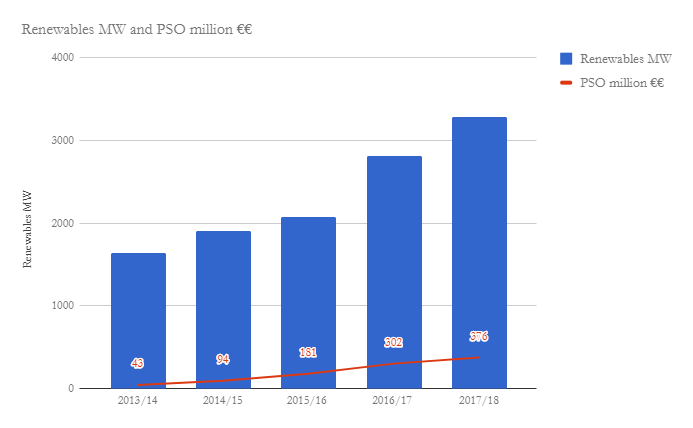
The amount of PSO Levy paid to renewables has doubled in two years from €181 million to € 376 million as renewable generation capacity increased by over 50% from 2,000 MW in 2015 to nearly 3,300 MW in 2017 .  


Renewables generation capacity in blue and PSO Levy in millions in red

Back in 2013, energy costs were a big issue for multinationals in Ireland. Following this recent announcement on the PSO Levy by the energy regulator, it will surely be an even bigger issue.


For domestic / household consumers, they will see a massive 30% increase in the levy.  How long can this go on until there is a backlash ? The Regulator tries to reassure consumers :


Increasing levels of wind generation on the system decrease the wholesale price of electricity, which feeds  through to retail prices.

This claim was debunked on my blog a few years ago :

http://irishenergyblog.blogspot.ie/2015/05/does-wind-energy-reduce-wholesale-prices.html 

The reason for recent falls in wholesale prices was because of the fall in the price of gas. Which was more than offset by the PSO Levy and increases in network and other system costs to pay for all this new renewable infrastructure.