Friday, 6 November 2015

Irish Energy Blog was right ! - Eirgrid revise down demand forecasts


Back in May of this year, Irish Energy Blog published an article questioning Eirgrid's demand forecasts. It was the only media outlet, as far as I can tell, in the country to do so :

In Eirgrid's recent capacity statement, given a recovery scenario, demand for electricity by 2019 is forecast to equal demand at the height of the boom and after this it is forecast to exceed these levels. Ireland, like the UK, has a low energy to GDP ratio. We barely manufacture anything here, most of it is outsourced to China and India, so what exactly are Eirgrid expecting ? Perhaps there will be another industrial revolution, this time in Ireland. But in any event, I will put my blogger reputation on the line, and predict that these demand levels will not materialize. The rising cost of electricity for industry will surely drive any heavy industry out that might consider re-locating here - Irish Energy Blog, May 2015.


Many, if not all, reputable Irish newspapers published the view that new grid infrastructure was essential for increased demand without any question:

Others have identified “hidden” network costs they argue are necessary to facilitate wind. It is true that Ireland is currently modernising an electricity network that for many years suffered from chronic underinvestment. Current investments also support traditional generation, increased demand in the regions, and indeed a more responsive, intelligent and modern grid generally - Joseph Curtain, Irish Times March 2015.

Launched in October 2008, Grid25 is based on energy demand growing in the coming years - Paul Melia, Irish Independent, November 2014. 

The CEO of Eirgrid has now confirmed that Irish Energy Blog was in fact right :

Before the crash, construction made up a significant proportion of the GDP growth in the economy. I think we are all acutely aware that before the crash it accounted for more than 20% but now it is below 10%. What is driving economic growth today is very different. That in part is a reason the relationship between GDP growth and energy growth has changed. One no longer gets the close correlation we had in the years between 2000 and 2007 between GDP growth and energy growth. The make-up of the economy is different and cost competitiveness has become a significant focus for industry. Energy has become one of the areas where businesses have become acutely conscious of the need to manage their costs to ensure competitiveness. We only have to look at yesterday's announcement of the unfortunate closure of the Michelin plant in Ballymena to understand the impact of cost competitiveness on the sustainability of businesses. Businesses are much more conscious of managing energy costs. We are seeing the new standards in housing coming through in the new housing stock, so the use of energy per unit of residential housing is not as good. For all those reasons growth rates in energy are now not as correlated with growth rates in GDP - Fintan Slye, November 2015.


The reference to GDP is very interesting, this blog made that exact same point last May - Ireland, like the UK, has a low energy to GDP ratio.

The draft strategy reflects the change in economic circumstances and where we as a country, an economy and a society are now. When first developed in 2008, Grid 25, as it was then named, which included plans for the Grid Link project, was designed to ensure the electricity grid would continue to support the Celtic tiger economy with its high economic and energy growth rates. The past five years have changed that reality. There has been demand reduction to the point where estimated demand levels for 2010 will not materialise until 2025 - a 15-year delay - and, even then, growth rates will be less than a third of the rates previously forecast - Fintan Slye, November 2015.
This blog also pointed out this very fact - Grid 25 was based on the below graph - it didn't take a genius to figure out that things had changed since :


However, I still wonder whether the pylons will be required for wind farms in this region should they get planning. I would imagine the answer to that question is Yes. Do Eirgrid envisage that these wind farms will not receive planning permission ? The original document from which the above graph was taken is now unavailable and so one can't check but for certain I can remember reading in it that connection of renewables was another justification for the project.

Eirgrid's current statement on Grid Link seems to confirm that they are still accounting for more wind farms :

The Irish government committed to the EU that 40% of electricity generation would come from renewable sources by 2020. To achieve this target, EirGrid needs to connect significant levels of renewable energy in the south and east. As a result, we must improve the transmission grid in this area. We can then bring this new power from renewable sources and supply it to the entire country.

Finally, it's important to note EirGrid's legal obligation to connect electricity generators. As the national electricity transmission system operator for Ireland, we have a statutory function. Subject to direction from the regulator, this statute requires us to offer a connection to the grid for those who request it. When an electricity generator accepts our connection offer, we have to meet their needs. This means we are legally required to develop the grid in response to plans for new electricity generation, such as wind farms.



Wednesday, 4 November 2015

Interconnector to UK providing just 4% of peak demand due to capacity shortage in the UK


With the UK Grid operators today resorting to emergency measures to keep the lights on, Ireland imported much less than usual from the UK during peak demand at 5.45pm. The interconnector has a capacity of 500MW which would normally be running at full load, or near full load, during periods of high demand.

But today, during the peak demand period, the interconnector ran at just 176MW or 35% of capacity.

This amounted to just 4% of our energy demand needs.


Last year, Irish Energy Blog warned this may become a problem if the existing capacity shortage in the UK remained :

But it is interesting that Eirgrid have taken no account of the situation in the UK where National Grid recently stated that Britain's spare capacity has fallen to a seven year low, prompting emergency contingency plans to be put in place such as shutting down large factories during peak periods.
Surely in this climate, where the UK National Grid are considering restricting demand in their own country, they will also be reviewing exported power to Ireland via the two interconnectors ? 
And it's not just the interconnector that is running at low output - our windmills were running at 1% for most of the day :


Same situation in UK and France:

UK wind output (blue line)

French Wind Output - providing just 2% of demand


So we are back to the "Do Nothing" Scenario - relying on our old power plants like we used to before the Green Blob raised its ugly head.

While we will have to pay a bit more for electricity generated here than we would have to pay if we imported it from the UK, it will still be cheaper than if it was generated by wind power.

But still our leaders insist that wind power and interconnectors are "the future". 


Tuesday, 3 November 2015

IWEA told us two years ago that fossil fuel prices were rising


More wind on the system will provide a hedge against rising fossil fuel prices, resulting in lower and more stable energy prices for consumers while helping us achieve our energy and emissions targets - IWEA, 2013, Submission to Tipperary County Council.

In 2013, the Irish Wind Energy Association told us that wind would provide a hedge against rising fossil fuel prices.

But last time I went to the petrol pumps, fuel was so cheap, I was able to fill up my tank for the first
time in many years.

However, when my last electricity bill came through the door, I was barely able to pay it.

Why do our Government continually listen to people backing the wrong horse ?

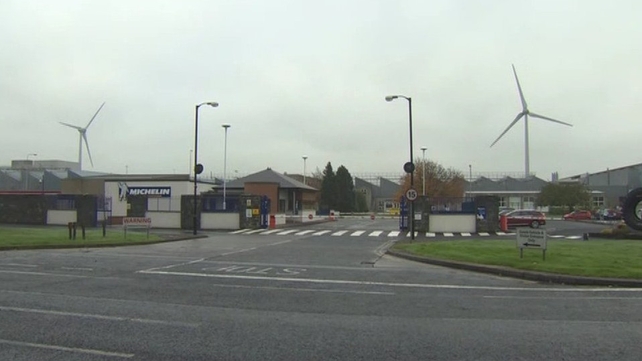
Michelin Factory closes due to high energy costs

The Michelin factory in Ballymena  will close by mid-2018


News today from RTE, as predicted on this blog, more job closures due to high energy prices :

Michelin has announced plans to close its tyre factory in Ballymena, Co Antrim, with the loss of 860 jobs.

The company said it will "run down" the manufacturing plant by mid-2018 as part of a restructuring plan that will see investment in its facilities in Dundee and Stoke on Trent.The announcement comes a year after another major employer in Ballymena - the JTI Gallaher tobacco factory - announced plans to close its operation in the town by 2017, with the loss of around 870 jobs.

The factory in Ballymena opened in 1969.

Managers have been warning for a number of years that high-energy costs were making production increasingly unsustainable.
"Despite great efforts and progress being made in previous years, other European plants are still more competitive than Ballymena.

Back in 2013, the company installed a 4.6MW wind farm on site to try to cut energy costs :

Dale Vince, Ecotricity founder, said: “Building wind power on-site and supplying it directly to a factory not only cuts carbon emissions, but because you don’t need to transport the electricity via the grid – it cuts energy costs too.

“This is a way to make businesses more competitive and more environmentally sustainable at the same time.”

Onsite Wind Energy – pioneered by Ecotricity and known as ‘Merchant Wind’ – ensures that electricity is channelled direct to the end user, while any excess energy not used on site goes into the local Grid.

Wilton Crawford, Factory Manager at Michelin Ballymena, said: “The wind turbines are a welcome asset for Michelin in Ballymena, and will help alleviate the challenge of increased energy costs, particularly as energy prices in Northern Ireland far surpass those in Europe.”

Ecotricity’s two turbines at Michelin’s Dundee site have already produced well over 43 million units (kWh) of energy since being commissioned in 2006: that’s enough electricity to power over ten and a half thousand average homes, keep an iPad going for over 3 and a half million years, or drive an electric car (Nissan LEAF) around the equator over six thousand times.

 However, as they have now learned, wind power is too intermittent to provide reliable power to a factory.

Monday, 2 November 2015

South Australia - What A Future With Wind Energy Looks Like

Interconnectors and Wind Energy go hand in hand. Like South Australia, Ireland has had bad experiences with interconnectors. The Moyle Interconnector linking Scotland and Northern Ireland went out of action in 2011 and since then only half of its capacity is working. Wind energy, as we all know, is intermittent and cant be relied on to produce power when needed. Hence, why it is given a very low capacity credit. So if you combine the two you are asking for trouble. S.Australia experienced a blackout yesterday - here is what a "Green" future looks like :


“We’ve always relied to some degree on the Victorian interconnector — that’s why it’s there, it’s been there for 25 years.
“Many times other supply will kick in and there’s always stuff on standby, but in this case it may well have been the size of the load.”
When the Victorian system shut down, 160 megawatts of energy was lost and wind power did not supply energy because it often does not start until 3am.
Mr Roberts said when outages were planned, people on life support were notified.
But last night’s blackout “caught everyone by surprise”, despite the fact Victoria had issued a low level risk notice for a power outage for the past seven weeks.
Mr Roberts said a review would be conducted into the widespread outage.

Sunday, 1 November 2015

Is the writing on the wall for the NREAP?


An update on the precarious legal position of Ireland's Renewable Plans from The Law is My Oyster Blog is available here (Thanks Neil ! ) :

http://the-law-is-my-oyster.com/2015/10/30/is-the-writing-on-the-wall-for-the-nreap/

Emlagh Wind Farm - Capacity Credit too low to make it worthwhile project


Kells - an important Irish town both culturally and historically


Emlagh Wind Farm is a 120MW wind farm, consisting of 47 turbines, planned for North County Meath. It is sited near the historic town of Kells, an area of unique cultural and historic heritage, that attracts many tourists each year. Kells is most famous of course for the Book of Kells which dates back to the 6th Century.

The benefits from the proposed wind farm would have to be very significant to justify it's imposition in such an area. A decision on the wind farm was due in late September but An Bord Pleanala have delayed this until November 26th.

Capacity Credit 


The best way to measure the value of a wind farm is by calculating it's capacity credit. This is the equivalent amount of conventional power plant that can be shutdown as a result of the new wind farm. It is used by Eirgrid to measure the contribution from a new generator to generation adequacy.


In Eirgrid's Generation Adequacy Report for 2009 – 2015 they noted :

“Although the expected large growth of installed renewable capacity will increase portfolio diversity, it will only offer a limited contribution to generation adequacy.”


The intermittent nature of wind means that the contribution of wind power to generation adequacy is significantly less than its installed capacity. When considering the generation adequacy of wind as an energy source, wind is given a lower “capacity credit” than conventional thermal generation, primarily because of its intermittent nature. 


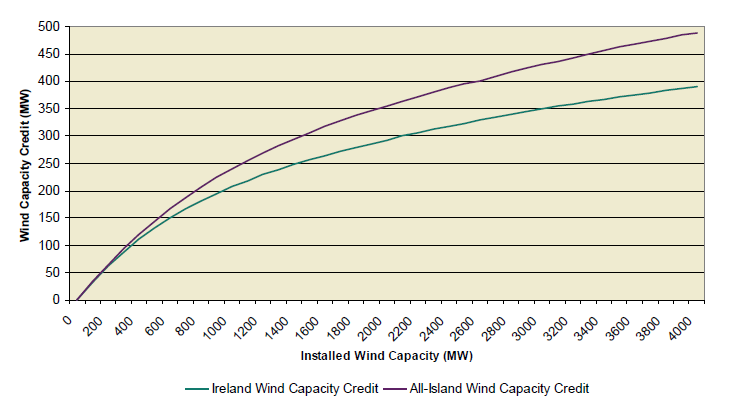
The capacity credit curve for wind used by EirGrid in the Generation Adequacy Report 2009 – 2015 is presented in the below Figure:

 Credit.png


Figure 1, the capacity credit attributable to wind declines with increasing installed wind capacity. The capacity credit for Wind Power Generation (WPG) was predicted by EirGrid to decrease from 19% in 2009 to 12% by 2015 as illustrated in Table below:


Table 1: Wind Capacity Forecast and Associated Capacity Credit


2009
2010
2011
2012
2013
2014
2015
Installed Wind Capacity (MW)
1248
1429
1723
2017
2231
2606
2900
Capacity Credit (MW)
234
250
274
294
313
329
344
Capacity Credit as
% of Installed
Capacity
19%
17.5%
16%
14.5%
13.5%
12.5%
12%


From Table 1 above, it can be seen that Emlagh Wind Farm will have a capacity credit of 12.5% in 2015 (total capacity has not reached predicted 2015 levels). At an installed capacity of 120MW, this then represents a contribution to generation adequacy of just 15MW (equivalent to just 3-4% of a conventional gas plant). This means that should there be a security of supply issue in Meath or the surrounding region, then new conventional plant will need to be built to keep the lights on, despite the large investment and environmental impact of this wind farm.


The following statement made by the Emlagh Wind Farm developer in their Environmental Impact Statement then, is completely at odds with the accepted method of accounting for wind farms in the energy industry:


“Should the wind farm not be developed, fossil fuel power stations will be the primary alternative to provide the required quantities of electricity. This will further contribute to greenhouse gas and other emissions, and hinder Ireland in its commitment to meet its target to increase electricity production from renewable sources and to reduce greenhouse gas emissions. Ireland currently imports up to 85% of our energy. Emlagh Wind Farm offers Ireland an indigenous form of electricity, and provides for security of supply against our dependence on imports.”


But when measured scientifically, the wind farm will not be an alternative to fossil fuel power stations. Instead, a duplicate system will be required, with a need for new transmission infrastructure running alongside existing lines to be built - one powered by fossil fuel, the other by wind (when available). 

A contribution of 15MW for 47 turbines is a very poor benefit given such significant environmental (and indeed economic) costs.