And no, its not climate change :
Showing posts with label EU. Show all posts
Showing posts with label EU. Show all posts
Thursday, 14 January 2021

Sunday, 3 January 2021
The Null Hypothesis by Pat Swords
“Making predictions is difficult, particularly about the future”, but we can learn an awful lot from the past, but regretfully generally choose not to do so. The EU attaches considerable importance to its renewable programme, and indeed, in early 2020 the ‘European Green Deal’ of striving to be the first climate-neutral continent, is the most important objective of the new EU presidency. Before analysing the EU’s methods for assigning its priorities, it is worthwhile reflecting on how some other ‘walks of life’ follow due process in their designations of value and substance.
In comparison to the EU, which has only existed for a few decades, the Catholic Church spans two millennia through times of considerable upheaval. So how does the Catholic Church decide on its most important honours, i.e. that of sainthood? In reality the position of advocatus diaboli, or devil's advocate, has existed at the Vatican for centuries, and as explained by the ‘The Catholic Encyclopedia’:
• The duty of the Promotor Fidei was to oversee every aspect of the beatification and canonization process, ensuring that no person received the honors of sainthood rashly, that proper juridical form was observed, and that every potential weakness or objection to the saints canonization was raised and evaluated in order that only those who were truly worthy would be raised to the dignity of the altars. Because the Promotor Fidei took a juridical position against the canonization of any given saint, it was joked that he was taking the devil's part in the proceedings, hence the common appellation "Devils' Advocate" (advocatus diaboli).
Science has also existed for a long period, and while the application of new scientific knowledge in the last century has transformed the quality of life enjoyed by humankind, science has had a few failures on the way, such as eugenics. So how does science decide that a hypothesis is of value, where a hypothesis is a proposed explanation for a phenomenon?
The widely accepted, traditional ‘scientific method’ is based on formulating and testing hypotheses, in which from the results of subsequent experimentations, a deduction is made as to whether the hypothesis is presumably true or false. In its essence, it is a form of critical thinking and deductive reasoning, but at its core is the principle that the hypothesis and the resulting testing of the hypothesis must be inherently falsifiable. In simple terms, to be acceptable as a scientific theory, there must be a possible negative answer.
The null hypothesis is therefore the hypothesis, which the researcher tries to disprove, reject or nullify. For example, if people take Aspirin and their headache regularly goes away, then a valid hypothesis is that Aspirin is an effective pain medication. However, the null hypothesis would point out that headaches have always come and gone. This is why in pharmaceutical research blind placebo trials are used. If the group taking the Aspirin demonstrate an improved response with respects to headaches, then it is appropriate to adopt Aspirin, as an accepted proven medication for these purposes.
As far back as 1660, with the founding of the Royal Society in England, which is the oldest national scientific institution, they adopted as their motto: Nullius in verba (Latin for "on the word of no one" or "take nobody's word for it"). Equally, the portrayal of Einstein is often that of an older wise man, but he was young and essentially unknown in 1905, when he published his theory of relativity. A theory challenging the Newtonian physics established for more than 200 years. Some considered him an upstart and a scientific book was even published "Hundert Autoren Gegen Einstein (One Hundred Authors against Einstein)". Einstein alleged reply was that to refute relativity one would not need the word of a hundred scientists, just one fact, which no one had produced.
Consensus may therefore be at the core of politics, but it is not science. Richard Feynman was another famous physicist, who worked on the Manhattan Project to develop the atomic bomb and was a Nobel Prize winner. As he stated with respect to scientific consensus: “It does not matter who you are, or how smart you are, or what title you have, or how many of you there are, and certainly not how many papers your side has published, if your prediction is wrong then your hypothesis is wrong. Period.” Science therefore moves forward in incremental steps by attrition, at its heart is an inherently sceptical approach, while the Catholic Church by formalising the role of the advocatus diabolic also demonstrates, as to how it values such scepticism.
It is of course appropriate that the scientific literature represents various hypotheses, but a more recent development is how the drive for researchers to obtain publication in the more prominent journals, has led to more exaggerated attention grabbing claims to be made. Even the mainstream media has noticed that there is now a reproducibility crisis in science, such that when researchers try to reproduce published experimental work, they frequently get significantly different results. Yet replication of experimental research is at the heart of the scientific process.
The previous reference to scientific academics publishing papers on their favourite hypothesis, peer reviewed by like-minded academics, might initially appear somewhat harsh, but it does not seem to bother them much when they get it wrong. For example, the ‘ex-post’ analysis of the original assessment for the 20% renewable energy programme does not make pretty reading. Despite this, the PRIMES model and its academic developers are a key component of the economic analysis of the next phase of the EU’s climate strategies and targets.
The difference with engineering is that as previously highlighted, it is the practical application of science. For example, the fundamentals of bridge design are not scientific hypotheses, but the output of previously validated research and testing. The consequences of getting it wrong are simply too high, which is why there is such criticism coming from experienced engineers, with respect to the manner in which this whole renewable energy programme has been progressed.
How to Assign a Value to this Renewable Programme
This leads to the final claim in Section 5 ‘Conclusion’ of the 2006 Renewable Energy
Road Map namely: “The value of this significant reduction in greenhouse gas
emissions would nearly cover the total additional cost under high energy prices”.
As Section 4.1 demonstrates, the Road Map is concluding with a completely circular
form of reasoning to justify the value of the greenhouse gas savings made. In that the
carbon price per tonne is effectively, a tax placed on fossil fuels. While the use of
renewables is exempt from this tax, so increasing the use of renewables leads to a
tax saving, which in turn helps cover the additional costs spent on renewables. This may well be adequate political reasoning for some, but there are a number of equally
valid questions others require answering:
• Firstly, the “additional cost associated with reaching the proposed share of
renewable energy” were grossly underestimated, such that a complete
bonanza occurred for those supplying wind turbines, solar panels and wood
chips, which the ‘hard pressed’ citizen had to fund in addition to the €25 per
tonne carbon tax added to the use of fossil fuels. Why did this happen, when
under Article 3(3) of the Lisbon Treaty (TEU) the Union shall work for “a
highly competitive social market economy?”
• Why is the ‘hard pressed’ citizen having to pay this carbon tax and if its
justification is the ‘polluter pays principle’, on what basis was €25 per tonne
evaluated?
• When scientific logic and reasoning is applied, what valuation is appropriate
to these greenhouse gas savings?
As regards the first question above, citizens should seek an explanation of this
nature from those allegedly elected to represent you.
As regards the second question, carbon prices are in 2020 currently trading at circa
€25 per tonne, where the allocation of free ‘allowances’ largely determines the price
on the EU ETS. As explained in Section 4.1, the allocations of free allowances is
solely a political decision, hence the EU ETS is a tax applied to fossil fuels and as to
why it is applied, where it is applied and as to how much is applied is solely a political
decision. There is no connection to the environmental damage cost, i.e. external
cost, of CO2. So again, citizens should seek an explanation from those allegedly
elected to represent you.
What is also glaringly obvious with the ‘Renewable Energy Road Map’ and the
subsequent renewable programme, is that the carbon reductions were sole decision
criterion. There was no connection to any other externalities; such as if you force one
type of energy delivery system off the market to promote another, other significant
externalities may arise. For example, as reported in the European Environment
Agency’s Air quality in Europe - 2016 report. “The use of wood and other biomass
combustion for household heating is growing in some countries, owing to government
incentives/subsidies, rising costs of other energy sources, and an increased public
perception that it is a 'green' option”. This Report has a specific section on
“Residential biomass combustion: an important source of air pollution”, as levels of
fine particulates, which have the highest health impact of the common air pollutants,
are increasing due to this biomass use.
Regretfully, this renewable programme is having a serious impact on the prior
successes achieved under the CAFÉ programme, as particulate levels in urban
areas, where these fine particulates are the most damaging of the common air
pollutants in terms of health, are rising again. Equally, the German wild animal
foundation points out with respect to the unacceptable impacts of any further
installations of wind turbines in forested areas, some 250,000 bats and 12,000
raptors (birds of prey) being killed by wind turbines each year in Germany. After
several years of intensive conservation measures in the 1980s and 1990s, the
number of successful raptor breeding pairs, which was increasing, is now once again
in decline. While, Section 4.4 has already highlight the serious concerns associated with low frequency noise from wind turbines and the WHO’s position on this
externality.
To derive a value based on externalities, one has to weight up both the positive and
negative externalities and do so in a competent and transparent manner. However, to
complete the former, one should logically first assign an estimate to the actual carbon
savings being realised? Section 6.3 shows how the majority of the predicted
emission savings were to occur in electricity generation. While as previously
evaluated, there are significant questions in relation to the validity of emission
savings reported for this sector, not least due to the negative impact of intermittent
renewable sources on conventional generation and the actual life cycle of emissions
associated with bioenergy. However, let us assign an annual emission saving
attributed to the implementation of the whole programme of 300 Mt, on the basis that
the data does not really support a value either double that or half that.
Section 3 already articulated as to how ExternE in 2000 finally recommended the use
of a ‘central estimate’ of the external cost of CO2 of €2.4 per tonne, with a ‘minimum’
value of €0.1 per tonne and a ‘maximum’ value of €16.4 per tonne. Simple sums to
convert these to a price basis in 2020 and multiplying by 300 Mt, results in the
annual valuation of external costs avoided as documented below:

No matter how one looks at it, the ratio of financial costs to benefits is pretty awful,
which also indicates, that for this programme to make sense from a cost benefit
perspective, the ExternE assessment of the external cost of CO2 would need to be an
underestimate by several multiples. However in this regard, as documented already
in Section 3 in relation to the work of Professor Richard Tol, a Dutch economist, who
in a later 2009 publication on the “Economic Effects of Climate Change” stated:
• “Projections of future emissions and future climate change have become less
severe over time - even though the public discourse has become shriller”.
Ultimately, we all have to sit down to a banquet of consequences; the statement
above is accurate, while assumptions as to the value of these CO2 savings are just
assumptions. Another metric for expressing the value of 300 Mt of CO2 savings is a
comparison with annual global emissions as shown in Figure 8.1 overleaf. These
have now reached and slightly exceeded 35 billion tonnes of CO2 equivalent per
annum. Therefore, annual savings from the EU’s renewable energy programme
amount to 0.9% of the global total.

- Extract from Pat's book :
Sunday, 27 December 2020
The Financial Wonderland of Covid-19
According to economic experts, Ireland does not have to worry about paying back the massive borrowings that were needed to fund the endless lockdowns :
“Government debt does not have to be paid back, particularly the kind that sits minding its own business in the vaults of the ECB” - Chris Johns, Irish Times
The problem with that is Article 123(1) of the Treaty on the Functioning of the EU :

This means that it is illegal for any Member State to use the ECB as a bank overdraft facility. The only reason why we can afford the luxury of endless lockdowns is our access to lots of free money. The Irish government have already borrowed €20 billion interest free this year and they plan to borrow another € 20 billion next year. This is in addition to around €35 billion borrowed at very low interest rates since 2015 from the ECB's PSPP programme, prior to the covid "pandemic". So the free money bonanza that has enveloped the EU is not a new thing as some commentators have argued.
All this free money being created by the ECB has resulted in the ECB becoming the largest single creditor of the member states in recent years. The German Council of Economic Experts have warned that this could present a threat to monetary policy independence in the long term.
In 2008, after the banking crash, the debt laden on to the backs of the Irish was paid back through taxation. This makes the situation at present different as there is no pressure to increase taxes.
The natural effect of all this free money is massive inflation but we have not seen any sign of that yet (it may help to reduce government debt by de-valuing the euro). What is the most likely outcome - my guess is that we will see some inflation next year but more importantly negative interest rates will skyrocket so that most of the extra cash lying around on deposit will be recouped.
There is already a similar precedent for this in the EU banking system, when deposits were confiscated in Cyprus in 2013 in what became known as a bail in.
So as Mr Johns maintains, the ECB may well continue to play ball by printing infinite quantities of free money but the price will be an eradication of savings, either through inflation or negative interest rates or a combination of both. It will also mean that the EU will once again bend and mold its own laws laid down in it's treaties. This further erosion of the rule of law will sow yet more discontent within the union.
Wednesday, 9 December 2020
Some Christmas Reading
Electricity in the USA is already half the price it is in the EU. Therefore, by 2050 in the EU, it is highly probable we just won’t have any viable jobs and disposable income left to spend, as it will have all gone to the energy bill to eliminate the fossil fuels currently forming 72% of the energy mix.
Charles MacKay in his 1841 book ‘Extraordinary Popular Delusions and the Madness of Crowds’ pointed out: “Men, it has been well said, think in herds; it will be seen that they go mad in herds, while they only recover their senses slowly, one by one”. How on earth did we get to this situation, in a so called intelligent modern society? Were laws broken? Is there something wrong with the weather or do we just have a political crisis with respect to incompetent management? If for example you are paying serious amount of hard earned money for pollution, which is not occurring, can you get your money back or is there going to be even more of the same? [Pat Swords - 2020]
Pat Swords has written a new book on energy and other related matters which can be downloaded for free here :
The Polluter Pays, but to Whom, How Much and On What Basis – Science or the Cult of Witchcraft ?
It takes a look at the EU's mad panic to reduce carbon emissions and the negative consequences of doing so without conducting a proper assessment.
I have also written a book but not energy related, about motion and perception, which includes a collection of articles on Einstein, Descartes, Newton, Empiricism, Mathematics, Ancient Greeks and Galileo and attempts to solve some of the paradoxes of motion and perception that they presented. It will also be free and if you want a copy send me an email.
Friday, 29 May 2020
EU Green Deal Consultation
Pat Swords responds to the EU on their Green Deal Consultation:
Link to Consultation - https://ec.europa.eu/info/law/better-regulation/have-your-say/initiatives/12382-Revision-of-the-guidelines-for-trans-European-Energy-infrastructure
The Commission is already aware of recent drafting findings and recommendations against it at the UNECE Aarhus Convention Compliance Committee, see attached in relation to Projects of Common Interest and Communication C96, in that it discriminated against non-native English speakers by not conducting such public participation exercises falling under Article 7 of the Convention in all the official languages of the EU. This TEN-E Regulation is a programme related to the environment and is the subject mater of Communication C96. The Irish grid, on an isolated island, is a small microcosm of those in the EU. Of its nineteen power stations, the oldest and largest is coal fired and to meet EU renewable targets in the period 2012 to 2018, half its output was ‘replaced’ by the output from 1,100 new wind turbines, each costing €4 million to install. Electricity generation, in modern Irish gas turbine power plants, emits 40% the CO2 arising from generation with more difficult to combust carbonaceous coal. In 2012, gas generated half of Irish electricity, as it did again in 2018, but this time with a significantly higher gas consumption. When your car comes off the motorway and goes into ‘stop start’ urban driving it burns more fuel, just like power plants forced into such operation, as more and more intermittent wind energy pours on and off the grid. The extra gas combusted was well capable of supplying Ireland with 4% of our electricity. Simply switching this coal generation to natural gas and running Irish plants efficiently could have realised over 70% of the emissions savings claimed for renewables. In fact, this is what the USA did in the period 2008 to 2017 and obtained a 27% reduction in CO2 emissions from their power generation sector. If instead of spending a trillion Euros on wind turbines and PV solar panels, a budget of €10 million was provided each day to sprinkle around the EU like ‘pixie dust’ for the ‘common good’, the trillion would run out in 274 years. Equally, it would have paid the majority of the EU’s total food and drink bill in 2018 of €1.1 trillion. Instead, we got EU power sector emissions to decrease 28% in the period 2008 to 2018. The EU publishes an energy price report every two years. Last year of ‘full data’ is 2016; circa €400 billion bill for energy sources, €212 billion being imported fossil fuels, plus an additional tax squeeze of €280 billion. €76 billion in subsidies for renewable sector equating to €208 million per day or €150 from each citizen. €48 billion paid direct to wind and solar generators on top of market price for 13% of EU’s electricity. Market price plus tax paid to gas and solid fuel generators for 41% of electricity, whose fuel costs were same €48 billion. Furthermore, the WTO is totally agnostic about whether countries (parties) want to allegedly save the planet or not. Such considerations can only be brought into WTO trade disputes, if both parties have in fact ratified specific environmental agreements, such as with UNECE and its Aarhus Convention. Hence, compliance with international law, e.g. UNECE Aarhus Convention, is important. For example, the EU could have put tariffs on goods coming from other countries, which have ratified the Aarhus Convention, as a tax to fund renewables, e.g. takes an awful lot of electricity to smelt aluminium, hence a tariff on cheaper aluminium coming from Norway or Azerbaijan. Except there are legal rulings that the EU didn't comply with the Convention in the manner in which it implemented its renewable programme, which it is refusing to comply with since 2012. So it would be unlawful for the EU to do this. EU chemical firms have invested many billions in new manufacturing capacity in the USA, these more modern and efficient plants with lower energy costs will flood the EU with products undercutting EU facilities and putting them out of business, under WTO rules the EU cannot lawfully apply tarrifs against the USA.
Sunday, 10 May 2020
ECB Policy Keeps Afloat Economically Unviable Companies and Creates Market Bubbles - German Court Rules
The Supreme Court in Germany this week ruled that the European Central Bank's monetary policy, called the PSPP (Public Sector Asset Purchase Program) led to "the keeping afloat of economically unviable companies" due to the effect it had on maintaining low interest rates.
Since 2015, the ECB have been buying up large quantities of government bonds, including high risk ones, distorting the EU market and propping up unsustainable debt and spending in the process. Contrary to what you may have read on some media outlets, this ruling has nothing to do with the emergency stimulus program initiated in response to the coronavirus crisis which I would argue was justified. The PSPP program has been going on for five years.
This blog was the first to reveal the shaky financial situation of many wind farms in Ireland. The ECB bond buying program we now learn was required to keep companies like these, aswell as banks, afloat.
ECB bond buying is the sticky plaster of the EU. And it promotes unsustainable economic practices in direct contradiction with the EU's pledges to sustainability.
The German court said this about the effects of the ECB program on banks :
Artificial low interest rates was one of the main factors that led to the catastrophic building boom in Ireland. The EU and the European central banks clearly have not learned from these mistakes as history is repeating itself once again :
The legal conclusions from all this are set out below, namely that the ECB never considered any negative effects from their policy and therefore acted disproportionately and ultra vires :
As the PSPP lowers general interest rates, it allows economically unviable companies to stay on the market since they gain access to cheap credit.
Since 2015, the ECB have been buying up large quantities of government bonds, including high risk ones, distorting the EU market and propping up unsustainable debt and spending in the process. Contrary to what you may have read on some media outlets, this ruling has nothing to do with the emergency stimulus program initiated in response to the coronavirus crisis which I would argue was justified. The PSPP program has been going on for five years.
This blog was the first to reveal the shaky financial situation of many wind farms in Ireland. The ECB bond buying program we now learn was required to keep companies like these, aswell as banks, afloat.
ECB bond buying is the sticky plaster of the EU. And it promotes unsustainable economic practices in direct contradiction with the EU's pledges to sustainability.
The German court said this about the effects of the ECB program on banks :
Moreover, the effects of the PSPP on the banking sector must be taken into account. The programme affects balance sheets in the commercial banking sector by transferring large quantities of government bonds, including high-risk ones, to the balance sheets of the Eurosystem, which significantly improves the economic situation of the relevant banks and increases their credit rating. At the same time, it creates an incentive for banks to increase lending despite the low level of interest ratesThe German Court also warned about the effects of the program on real estate and stock market bubbles :
Relevant economic policy effects of the PSPP furthermore include the risk of creating real estate and stock market bubbles as well as the economic and social impact on virtually all citizens, who are at least indirectly affected inter alia as shareholders, tenants, real estate owners, savers or insurance policy holders. For instance, there is a considerable risk of losses for private savings. This has direct consequences for (private) pension schemes and the returns they generate [...]. Both factors lead to, in part excessive, portfolio shifts [...], while risk premiums are in decline.
Artificial low interest rates was one of the main factors that led to the catastrophic building boom in Ireland. The EU and the European central banks clearly have not learned from these mistakes as history is repeating itself once again :
Real estate prices are on the rise with trends of sometimes particularly sharp increases – especially regarding residential property in major cities – [...], which possibly already come close to creating a “market bubble”, as the oral hearing confirmed. It is not for the Federal Constitutional Court to decide in the current proceedings how such concerns are to be weighed exactly in the context of a monetary policy decision; rather, the point is that such effects, which are created or at least amplified by the PSPP, must not be completely ignored.
It then warns about the risky juggling act that the ECB is trying to keep up :
In addition, the longer the programme continues and the more its total volume increases, the greater the risk that the ESCB becomes dependent on Member State politics as it can no longer simply terminate and undo the programme without jeopardising the stability of the monetary union.
The legal conclusions from all this are set out below, namely that the ECB never considered any negative effects from their policy and therefore acted disproportionately and ultra vires :
(2) In view of the considerable economic policy effects resulting from the PSPP – not all of which are discussed here –, it would have been incumbent upon the ECB to weigh these effects and balance them, based on proportionality considerations, against the expected positive contributions to achieving the monetary policy objective the ECB itself has set. It is not ascertainable that any such balancing was conducted, neither when the programme was first launched nor at a any point during its implementation; it is therefore not possible to review whether it was still proportionate to tolerate the economic and social policy effects of the PSPP, problematic as they may be in respect of the order of competences, or, possibly, at what point they have become disproportionate.
Neither the ECB’s press releases nor other public statements by ECB officials hint at any such balancing having taken place. For this lack of balancing and lack of stating the reasons informing such balancing, the ECB decisions at issue violate Art. 5(1) second sentence and Art. 5(4) TEU and, in consequence, exceed the monetary policy mandate of the ECB deriving from Art. 127(1) first sentence TFEU. cc)
The violation of the principle of proportionality is structurally significant. In this regard, the considerations set out above in relation to the Judgment of the CJEU in Weiss apply accordingly (cf. para. 124 et seq.). Therefore, the ECB’s actions amount to an ultra vires act.
Sunday, 19 April 2020
EU Fossil Fuel Imports have Increased
Surprise, Surprise - The Renewables Program has Failed
One might expect that after installing all this renewable energy, that European Union countries would be importing less fuel. But the failure of their ideologically driven energy policies can now be understood by this simple graph. Gas imports are well up, and even oil and coal are slightly higher as compared to 2007. If the ultimate goal is to "divest" from fossil fuels , then we have got no further on. Perhaps it's time to do a proper cost benefit analysis before we go any further?
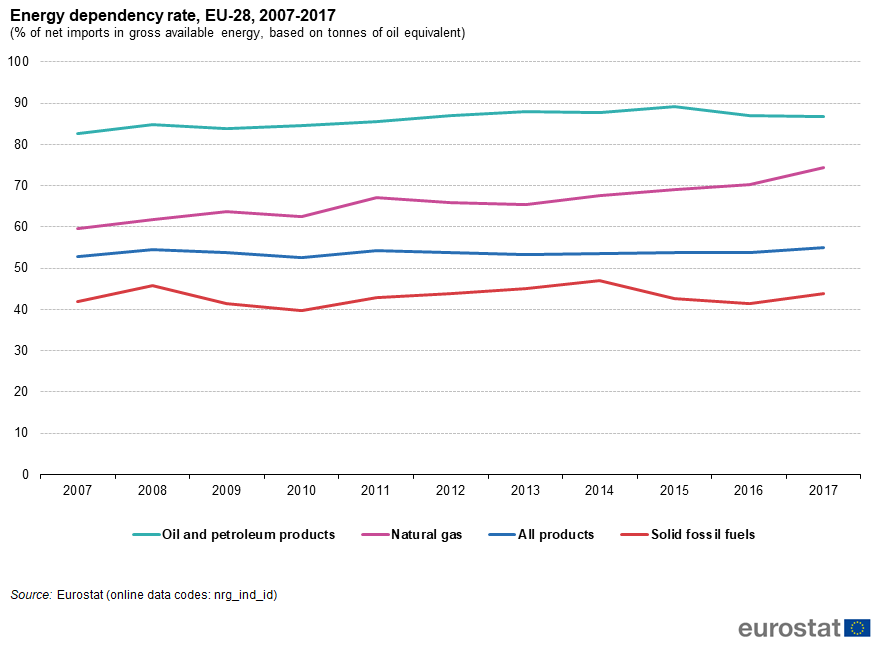
One might expect that after installing all this renewable energy, that European Union countries would be importing less fuel. But the failure of their ideologically driven energy policies can now be understood by this simple graph. Gas imports are well up, and even oil and coal are slightly higher as compared to 2007. If the ultimate goal is to "divest" from fossil fuels , then we have got no further on. Perhaps it's time to do a proper cost benefit analysis before we go any further?
Monday, 2 March 2020
How the EU repeatedly bypassed its Legal Framework and the Rights of its Citizens to implement its Renewable Programme
by Pat Swords
The EU makes repeated claims about the importance of the rule of law, but in reality, it fails to comply with its own legal framework and the rights of its citizens are not considered relevant, when it comes to implementing the New Green Deal. The ideological driven planned economies behind the Iron Curtain, with little regard for either environmental impacts or citizen’s rights, left behind a bitter legacy. In response emerged the United Nations Economic Convention for Europe’s (UNECE) Aarhus Convention on “Access to Information, Public Participation in Decision-Making and Access to Justice in Environmental Matters”, which has been part of EU legal framework since 2005. As the EU Commission has clarified:
The EU makes repeated claims about the importance of the rule of law, but in reality, it fails to comply with its own legal framework and the rights of its citizens are not considered relevant, when it comes to implementing the New Green Deal. The ideological driven planned economies behind the Iron Curtain, with little regard for either environmental impacts or citizen’s rights, left behind a bitter legacy. In response emerged the United Nations Economic Convention for Europe’s (UNECE) Aarhus Convention on “Access to Information, Public Participation in Decision-Making and Access to Justice in Environmental Matters”, which has been part of EU legal framework since 2005. As the EU Commission has clarified:
“Such agreements take precedence over legal acts adopted under the EC Treaty (secondary Community law). So if there was a conflict between a Directive and a Convention, such as the Aarhus Convention, all Community or Member State administrative or judicial bodies would have to apply the provision of the Convention and derogate from the secondary law provision.”As part of this Convention on environmental democracy, obligation placed on contracting parties include "fully integrating environmental considerations in governmental decision making and the consequent need for public authorities to be in possession of accurate, comprehensive and up to date environmental information". That there should, in a transparent and fair framework, be a weighing up of environmental considerations is no different than a key element of EU jurisprudence, the principle of proportionality, which requires that :
“Measures adopted by EU institutions do not exceed the limits of what is appropriate and necessary in order to attain the objectives legitimately pursued by the legislation in question; when there is a choice between several appropriate measures, recourse must be had to the least onerous, and the disadvantages caused must not be disproportionate to the aims pursued”.
As Recital 15 of Directive 2009/28/EC demonstrates, the EU’s 20% by 2020 renewable target was shared out among the Member States based on the existing percentage of renewables and a ‘fudge factor’ based on GDP. No environmental information existed on what was to be built, where it was to be built, what were the impacts and mitigation measures, etc. Having zero information to quantify the negative impact of carbon emissions, the alleged benefit of the 20% renewable target was related to the expected future price of carbon on the EU emissions trading scheme. A price, which is driven by political decisions related to allocations of carbon credits, with zero relationship to environmental impacts. Hence, what resulted was a circular logic of political target setting in the absence of reasoned decision making, with a complete absence of environmental information to justify the enormous impacts on the European environment and energy markets.
This glaring democratic deficit was compounded by the supranational dynamics of the EU, where Directives before adoption should first be scrutinised by public participation at the Member State level, such as in Ireland by detailed Regulatory Impact Analysis with public engagement. However, in practice this was by-passed.
After adoption of Directive 2009/28/EC there was only a year for Member States to prepare National Renewable Energy Action Plans (NREAPs) to implement these renewable targets. The Member States essentially left the section on the environmental impacts of these NREAPs blank, as it was an optional requirement in the EU template. Such plans are also subject before adoption to the detailed requirements of the EU’s Directive on Strategic Environmental Assessment (2001/42/EC), in order to establish the justification, alternatives, impacts, mitigation measures and monitoring for unforeseen adverse impacts. This was also bypassed.
Such legal failures led to a compliance case against the EU at the UNECE (ACCC/C/2010/54) and in 2014 a subsequent declaration of legal non-compliance in International law: Decision V/9g of the Meeting of the Parties on compliance by the European Union with its obligations under the Aarhus Convention. The UNECE recommendations require the EU to:
“…. adopt a proper regulatory framework and/or clear instructions for implementing article 7 of the Convention with respect to the adoption of NREAPs. This would entail that the Party concerned ensure that the arrangements for public participation in its member States are transparent and fair and that within those arrangements the necessary information is provided to the public. In addition, such a regulatory framework and/or clear instructions must ensure that the requirements of article 6, paragraphs 3, 4 and 8, of the Convention are met, including reasonable time frames, allowing sufficient time for informing the public and for the public to prepare and participate effectively, allowing for early public participation when all options are open, and ensuring that due account is taken of the outcome of the public participation. Moreover, the Party concerned must adapt the manner in which it evaluates NREAPs accordingly”.
As the UNECE documentation records, the EU has since 2014 failed to make any progress to comply with the recommendations above, repeatedly failing to reply to specific questions and advice. Furthermore, at the subsequent 2017 UNECE Meeting of the Parties, it blocked with its 28 votes, a further decision of non-compliance against it. Namely its refusal to provide its citizens with effective access to justice, in order to bring such challenges of non-compliance of EU environmental law directly into the Court of Justice of the European Union. Ongoing UNECE compliance proceedings have further expanded to include Regulation 2018/1999 on the Energy Union and Climate Action and the manner in which the National Energy and Climate Plans (NECPs) were adopted. Yet again, the legal requirements of Strategic Environmental Assessment were bypassed and the public had no opportunity to participate in the decision-making, when all options were open and effective public participation could take place.
If we consider the 2018 World Health Organisation’s Environmental Noise Guidelines for the European Region, while these adopted conditional recommendations for wind turbine noise, they make it very clear: “There are serious issues with noise exposure assessment related to wind turbines”.
“Balance of benefits versus harms and burdens: Further work is required to assess fully the benefits and harms of exposure to environmental noise from wind turbines and to clarify whether the potential benefits associated with reducing exposure to environmental noise for individuals living in the vicinity of wind turbines outweigh the impact on the development of renewable energy policies in the WHO European Region”.
Significant negative impacts are occurring on rural populations from the impacts of high-energy sources of low frequency sound (infrasound). There are legal liabilities, as the required Strategic Environmental Assessments and associated monitoring for unforeseen adverse environmental effects never occurred.
Saturday, 29 February 2020
The EU once again fails to comply with International Law
The European Union have once again stonewalled attempts by the UN Aarhus Convention Committee (UNECE) to comply with the Aarhus Convention which protects citizens rights to protect their environment, and is a part of International Law, just like the Geneva Convention on Torture or the 1951 Refugee Convention. The Convention enshrines in law the rights of citizens to public participation, public access to information and access to justice in environmental matters. In 2017, it was found that the EU denied these rights to citizens when Member States such as Ireland prepared their Renewable Action Plans in 2010 (NREAPs), plans which had a serious impact on the environment. Since Member States are now preparing new Renewable Action Plans (NECPs), the Committee has switched it's focus on to them to ensure compliance. Essentially, the UN Committee is acting as a watchdog for the EU, something which the EU is not used to having around.
Regarding the evaluation by the Party concerned of member States’ 2010 NREAPs,
the Committee already made clear in its report on decision V/9g to the sixth session of the
Meeting of the Parties that the information provided by the Party concerned in that
intersessional period did not satisfy the requirements of the last sentence of paragraph 3 of
decision V/9g.
The Committee stressed the need for the Party concerned to address these points. The Party concerned has to date failed to do so. The Committee reiterates its serious concern that, despite having been explicitly invited to do so in the Committee’s first progress review, the Party concerned in its second progress report has still not yet replied to the questions put to it in the Committee’s second progress review on decision V/9g in the last intersessional period.
The Committee regrets the lack of engagement by the Party concerned on this issue.
However, since a proper regulatory framework or clear instructions for implementing
article 7 with respect to the NREAPs was never, and upon the NECPs’ supersession of the
NECPs, now never will be, put in place by the Party concerned, there will remain no proper
framework or clear instructions for any public participation on the NREAPs to be evaluated
against. The Committee thus considers it would be futile for the Committee to spend further
time on reviewing the manner in the Party concerned evaluates NREAPs and more expedient
to instead focus its review on the evaluation of the Party concerned of the member States’
post-2020 NECPs. The Committee underlines that it expects considerably better engagement
from the Party concerned moving forward than that it has provided with respect to the
evaluation of member States’ 2010 NREAPs.
The Committee reiterates its serious concern that, despite having been explicitly invited to do so in the Committee’s first progress review, the Party concerned in its second progress report has still not yet replied to the questions put to it in the Committee’s second progress review on decision V/9g in the last intersessional period. The Committee regrets the lack of engagement by the Party concerned on this issue.
However, since a proper regulatory framework or clear instructions for implementing article 7 with respect to the NREAPs was never, and upon the NECPs’ supersession of the NECPs, now never will be, put in place by the Party concerned, there will remain no proper framework or clear instructions for any public participation on the NREAPs to be evaluated against. The Committee thus considers it would be futile for the Committee to spend further time on reviewing the manner in the Party concerned evaluates NREAPs and more expedient to instead focus its review on the evaluation of the Party concerned of the member States’ post-2020 NECPs. The Committee underlines that it expects considerably better engagement from the Party concerned moving forward that it has provided with respect to the evaluation of member States’ 2010 NREAPs
Essentially when the European Union wants to implement it's plan, it will do it even when its in defiance of International Law. And still we in Ireland wonder why the UK would ever want to leave such an institution.
Thanks to Pat Swords for the update and all his hard work in this case.
Saturday, 29 June 2019
Double Standards in new Trade Deal
Climate Change was the number one issue in the recent European Elections here in Ireland. Within a few weeks of the results however, the EU and South America signed a new trade deal that will increase global emissions and put more pressure on Brazil's rainforests.
The deal will allow 100,000 tonnes of beef to be exported across 4,000 miles to the EU increasing shipping emissions. More rainforests will need to be cleared to meet this demand, putting EU priorities at odds with the environmental significance attached to these forests.
The farming lobby are now starting to see through the duplicitous nature of the EU. Perhaps this is the beginning of a much needed examination of Ireland's relationship with the EU and the climate agenda that drives much of Irish politics.
The deal will allow 100,000 tonnes of beef to be exported across 4,000 miles to the EU increasing shipping emissions. More rainforests will need to be cleared to meet this demand, putting EU priorities at odds with the environmental significance attached to these forests.
The farming lobby are now starting to see through the duplicitous nature of the EU. Perhaps this is the beginning of a much needed examination of Ireland's relationship with the EU and the climate agenda that drives much of Irish politics.
I do not think they will take the Paris Climate Accord seriously at all. They will do whatever suits themselves. Once this deal is over the line, we will pay the consequences for that beef coming in.
It goes to show you the double standards, the double speak that they would allow that volume of beef come in. There is already almost close to 300,000t coming in already and you hear stories about rainforests cut down week on week to facilitate more agricultural production in Brazil.
If they were serious about climate change, they would have found some other way around it other than bringing in that volume of beef. [Farmers Journal].
Sunday, 2 June 2019
Green Wave or Green Ripple ?
The Irish media were in exuberant mood after an exit poll showed that Greens were dominating the elections. Roll on more carbon taxes urged almost every jet-set loving journalist.
The results are now in. The Green Party garnered only 5.6% of the vote nationally in the local elections and 11% in the European elections. The biggest winners were the Fine Gael and Fianna Fail parties, both of which decided not to impose carbon tax increases in the last budget.
The Green Wave became a Green Ripple. The highest concentration of so called "journalists" in Ireland is in Dublin, where the Greens garnered the most votes, and that may explain the lob sided Green Wave hysteria the rest of us had to endure in the past week.
The fanatically EU devoted media outlets behind the exit polls were in fact in breach of EU law, namely Section 30 of the European Parliamentary Election Regulations 2004, which states :
The results are now in. The Green Party garnered only 5.6% of the vote nationally in the local elections and 11% in the European elections. The biggest winners were the Fine Gael and Fianna Fail parties, both of which decided not to impose carbon tax increases in the last budget.
The Green Wave became a Green Ripple. The highest concentration of so called "journalists" in Ireland is in Dublin, where the Greens garnered the most votes, and that may explain the lob sided Green Wave hysteria the rest of us had to endure in the past week.
The fanatically EU devoted media outlets behind the exit polls were in fact in breach of EU law, namely Section 30 of the European Parliamentary Election Regulations 2004, which states :
Prohibition on publication of exit polls
30.—(1) No person shall in the case of a European Parliamentary election publish before the close of the poll—
(a)any statement relating to the way in which voters have voted at the election where that statement is (or might reasonably be taken to be) based on information given by voters after they have voted, or
(b)any forecast as to the result of the election which is (or might reasonably be taken to be) based on information so given.
(2) If a person acts in contravention of paragraph (1), he shall be liable on summary conviction to a fine not exceeding level 5 on the standard scale or to imprisonment for a term not exceeding 6 months.
Sunday, 22 April 2018
EU's Flawed Position on Climate Change Exposed by Trade Policy

Guy Verhofstadt, the European Parliament's representative on Brexit, uploaded this video made by the Economist, in support of liberal policy in the EU. The video claims that populists favour domestic production over imported goods implying that liberals such as Guy do not favour domestic production. This is not true because the EU have for example banned US beef and have had tariffs on other non EU beef products for many years to protect EU farmers. But there is a bigger issue here. Guy is a strong advocate for a global climate policy :


There are signs that the EU will be lifting more tariffs on non EU trade in response to Trump and the populist movement. Recently, the EU signed a provisional trade deal with Mexico which is 5,000 miles away from Ireland. Countries like Mexico are not expected to meet it's greenhouse emission reductions targets so importing goods from these countries will also increase the carbon footprint there as well as globally (in the seas).
EU liberal policy will have the unintended consequence of driving global emissions up, not down negating the actions they take on climate here in Europe.
Friday, 9 February 2018
Wind Farm that caused huge landslide makes losses for ESB
 |
| Photo : Irish Examiner |
The Commission claims also that the construction of the wind farm required the destruction of large areas of coniferous forest amounting to 263 hectares.
The Commission adds that, after the landslide which occurred on 16 October 2003 and the consequent ecological disaster, when the mass of peat which was dislodged from an area under development for the wind farm polluted the Owendalulleegh river, causing the death of about 50 000 fish and lasting damage to the fish spawning beds, Ireland carried out no fresh environmental impact assessment of this construction before the resumption of work on the site by the developer in 2004 [European Court Ruling 2008].
The construction of Derrybrien wind farm in 2003 caused a huge landslide resulting in the ecological disaster described above by the European Courts of Justice. Ten years later, Ireland still has not complied with their ruling and the EU are now seeking to impose fines on Ireland of €2 million.
The wind farm was the largest in Europe at the time with 70 vestas turbines (of 0.85MW each) giving a total output of 59.5MW. It began operation in 2006. Ten years later in 2016, the accounts show that the wind farm was making a loss of €2.3 million. Turnover dropped by 25% to €5m and operating costs increased by 17% to €6.3m from 2015. The company is owned by ESB and €20m in loans are still outstanding to them. It cost €64m to build.

The above graph compares the load factor (actual output / maximum output) for Derrybrien and the national average as published by Eirgrid since 2010. The load factor has dropped significantly in the past two years to 23% in 2016, which was less than the national average of 28%. Not great for a wind farm located in the windy west of Ireland. It could be that these particular wind turbines lose capacity over time. The first indication of a loss in capacity occurred in 2015 after eight years of operation. The national average was high at 33% whilst Derrybrien had a load factor 20% less at 26%.
A loss of wind turbine capacity means higher maintenance costs and this is reflected in the accounts where operating costs have increased to €6.3m from €5.4m in 2016.
The obvious question that needs to be asked about all this is are the massive environmental impact of wind farms built in such delicate areas worth it ? Whilst ESB will probably absorb these losses who finally pays ? ESB is 95% owned by the Government.
National Load Factors - Page 24 here.
Load factors for Derrybrien wind farm for 2015 and 2016 as per published accounts, other years were estimated based on annual turnovers.
Subscribe to:
Posts (Atom)