Showing posts with label European Union. Show all posts

Saturday, 27 November 2021

Can the VAT rate on Electricity be Reduced?

Sinn Féin suggested recently that the VAT rate on electricity, currently at 13.5%, be temporarily removed to ease the burden on households over the winter. The government have claimed that they can't do that due to EU law. In this post, I will take a quick look at the VAT Directive and try to establish what is actually permitted. 

First of all, there is no doubt that the minimum vat rate allowed is 5%, so that rules out a complete removal of vat :


"The reduced rates shall be fixed as a percentage of the taxable amount, which may not be less than 5 %"


Next, Article 118 states that certain services cannot go below 12% and this was referred to by the government as applicable to electricity. As electricity comes under Annex 1, it would seem that the government is correct (- -but wouldn't 12% be better than no reduction ? ) :

" Article 118

 Member States which, at 1 January 1991, were applying a reduced rate to the supply of goods or services other than those specified in Annex III may apply the reduced rate, or one of the two reduced rates, provided for in Article 98 to the supply of those goods or services, provided that the rate is not lower than 12 %". 

However, something that has been noticed before is that there is often a grey area with EU law. Article 102 deals specifically with the supply of energy, including electricity and allows for either of the two reduced rates to be applied. In the case of Ireland, the two reduced rates are 13.5% and 9% (for hotels) :

"Article 102

After consultation of the VAT Committee, each Member State may apply a reduced rate to the supply of natural gas, electricity or district heating"

It is remarkable that no reference is made here to the minimum rate of 12%, but as article 102 precedes 118, perhaps it is inferred that 102 can be relied upon alone in relation to electricity. In that case, surely, a reference to the exception under 102 should have been made in 118. 

I am no legal expert and perhaps someone can comment below on what they think. 

We can test the legal recipes in the EU VAT directive by the results. And here, it would seem to be the case that when we look at other European countries, the vat on electricity can be reduced to a minimum of 5%.

- - Portugal reduced the vat on electricity to 6% for low usage households in 2019. Initial figures show that the reduced rate applies to about 42% of customers with the rest paying vat at the higher rate of 23%.

- - Spain have introduced a temporary reduction to 10% for low usage customers until December 2021. After that, the vat will revert to the normal 21% rate. It is estimated that the vast majority of households and businesses will qualify for the reduced 10 % rate. 

- - Italy have a fixed vat rate of 10% on electricity. This proves that the minimum rate of 12% does not apply to electricity as per article 102 . Applying the Italian model to Ireland would mean we could reduce our vat rate to 9% on electricity. 

- - Greece have a super reduced vat rate of 6% on electricity since 2019. This also applies to medicine and vaccines as well as children's books. Their normal reduced rate is 13 % which applies to hotels. It is interesting to see that in Ireland we seem to have our priorities completely wrong with hotels regarded as more essential than electricity. 

- - The UK had along with Malta the lowest vat rate on electricity in the EU with a rate of 5%. One of the reasons for brexit is that they were not able to reduce it to zero. 

- - Luxembourg have a vat rate of 8% on electricity. 

It seems clear that the vat rate on electricity can be lowered to at least 9%. But the government have chosen the spending option as usual which means additional handouts to struggling families. Which in turn will lead to a cycle of inflation as bills rise even more. 


Thursday, 25 November 2021

EU Ban Scottish Potato Seeds

 Ireland has been importing potato seeds from Scotland for over 150 years but amazingly the EU has banned them following Brexit because they do not comply with "phytosanitary rules". I thought it truly remarkable that the most virus resistant seed available to Ireland since the Great Famine does not comply with EU rules. And we pay the EU for the privilege. 


1866

1879

1949


Sunday, 10 May 2020

ECB Policy Keeps Afloat Economically Unviable Companies and Creates Market Bubbles - German Court Rules

The Supreme Court in Germany this week ruled that the European Central Bank's monetary policy, called the PSPP (Public Sector Asset Purchase Program) led to "the keeping afloat of economically unviable companies" due to the effect it had on maintaining low interest rates. 


As the PSPP lowers general interest rates, it allows economically unviable companies to stay on the market since they gain access to cheap credit.

Since 2015, the ECB have been buying up large quantities of government bonds, including high risk ones, distorting the EU market and propping up unsustainable debt and spending in the process. Contrary to what you may have read on some media outlets, this ruling has nothing to do with the emergency stimulus program initiated in response to the coronavirus crisis which I would argue was justified.  The PSPP program has been going on for five years. 

This blog was the first to reveal the shaky financial situation of many wind farms in Ireland. The ECB bond buying program we now learn was required to keep companies like these, aswell as banks, afloat. 

ECB bond buying is the sticky plaster of the EU. And it promotes unsustainable economic practices in direct contradiction with the EU's pledges to sustainability. 

The German court said this about the effects of the ECB program on banks :
Moreover, the effects of the PSPP on the banking sector must be taken into account. The programme affects balance sheets in the commercial banking sector by transferring large quantities of government bonds, including high-risk ones, to the balance sheets of the Eurosystem, which significantly improves the economic situation of the relevant banks and increases their credit rating. At the same time, it creates an incentive for banks to increase lending despite the low level of interest rates
The German Court also warned about the effects of the program on real estate and stock market bubbles :
Relevant economic policy effects of the PSPP furthermore include the risk of creating real estate and stock market bubbles as well as the economic and social impact on virtually all citizens, who are at least indirectly affected inter alia as shareholders, tenants, real estate owners, savers or insurance policy holders. For instance, there is a considerable risk of losses for private savings. This has direct consequences for (private) pension schemes and the returns they generate [...]. Both factors lead to, in part excessive, portfolio shifts [...], while risk premiums are in decline.

Artificial low interest rates was one of the main factors that led to the catastrophic building boom in Ireland. The EU and the European central banks clearly have not learned from these mistakes as history is repeating itself once again :

Real estate prices are on the rise with trends of sometimes particularly sharp increases – especially regarding residential property in major cities – [...], which possibly already come close to creating a “market bubble”, as the oral hearing confirmed. It is not for the Federal Constitutional Court to decide in the current proceedings how such concerns are to be weighed exactly in the context of a monetary policy decision; rather, the point is that such effects, which are created or at least amplified by the PSPP, must not be completely ignored. 

It then warns about the risky juggling act that the ECB is trying to keep up :


In addition, the longer the programme continues and the more its total volume increases, the greater the risk that the ESCB becomes dependent on Member State politics as it can no longer simply terminate and undo the programme without jeopardising the stability of the monetary union. 


The legal conclusions from all this are set out below, namely that the ECB never considered any negative effects from their policy and therefore acted disproportionately and ultra vires :

(2) In view of the considerable economic policy effects resulting from the PSPP – not all of which are discussed here –, it would have been incumbent upon the ECB to weigh these effects and balance them, based on proportionality considerations, against the expected positive contributions to achieving the monetary policy objective the ECB itself has set. It is not ascertainable that any such balancing was conducted, neither when the programme was first launched nor at a any point during its implementation; it is therefore not possible to review whether it was still proportionate to tolerate the economic and social policy effects of the PSPP, problematic as they may be in respect of the order of competences, or, possibly, at what point they have become disproportionate.

Neither the ECB’s press releases nor other public statements by ECB officials hint at any such balancing having taken place. For this lack of balancing and lack of stating the reasons informing such balancing, the ECB decisions at issue violate Art. 5(1) second sentence and Art. 5(4) TEU and, in consequence, exceed the monetary policy mandate of the ECB deriving from Art. 127(1) first sentence TFEU. cc)

The violation of the principle of proportionality is structurally significant. In this regard, the considerations set out above in relation to the Judgment of the CJEU in Weiss apply accordingly (cf. para. 124 et seq.). Therefore, the ECB’s actions amount to an ultra vires act.

Sunday, 19 April 2020

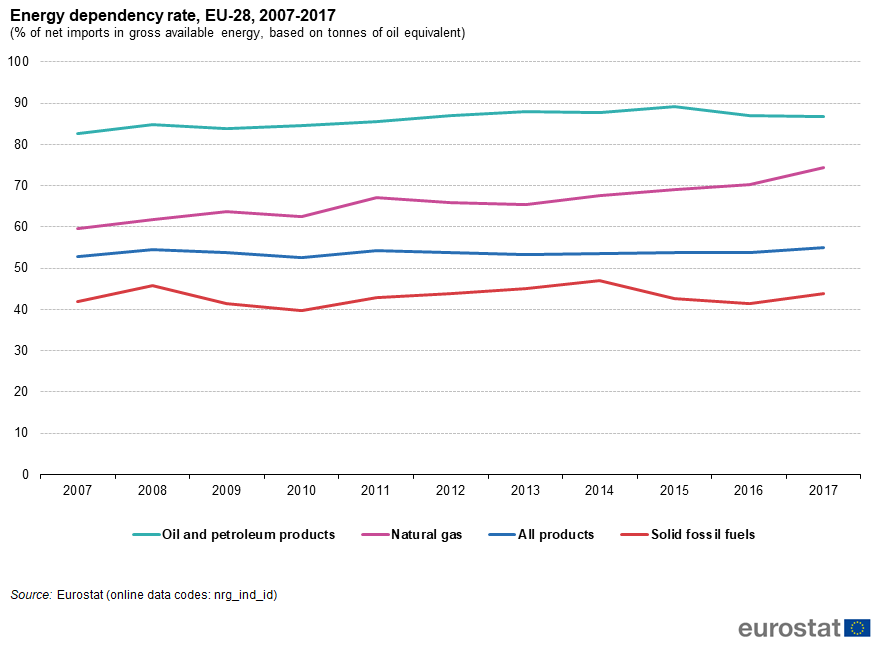
EU Fossil Fuel Imports have Increased

Surprise, Surprise - The Renewables Program has Failed

One might expect that after installing all this renewable energy, that European Union countries would be importing less fuel. But the failure of their ideologically driven energy policies can now be understood by this simple graph. Gas imports are well up, and even oil and coal are slightly higher as compared to 2007. If the ultimate goal is to "divest" from fossil fuels , then we have got no further on. Perhaps it's time to do a proper cost benefit analysis before we go any further?


Monday, 2 March 2020

How the EU repeatedly bypassed its Legal Framework and the Rights of its Citizens to implement its Renewable Programme

by Pat Swords

The EU makes repeated claims about the importance of the rule of law, but in reality, it fails to comply with its own legal framework and the rights of its citizens are not considered relevant, when it comes to implementing the New Green Deal. The ideological driven planned economies behind the Iron Curtain, with little regard for either environmental impacts or citizen’s rights, left behind a bitter legacy. In response emerged the United Nations Economic Convention for Europe’s (UNECE) Aarhus Convention on “Access to Information, Public Participation in Decision-Making and Access to Justice in Environmental Matters”, which has been part of EU legal framework since 2005. As the EU Commission has clarified:


“Such agreements take precedence over legal acts adopted under the EC Treaty (secondary Community law). So if there was a conflict between a Directive and a Convention, such as the Aarhus Convention, all Community or Member State administrative or judicial bodies would have to apply the provision of the Convention and derogate from the secondary law provision.”
As part of this Convention on environmental democracy, obligation placed on contracting parties include "fully integrating environmental considerations in governmental decision making and the consequent need for public authorities to be in possession of accurate, comprehensive and up to date environmental information".  That there should, in a transparent and fair framework, be a weighing up of environmental considerations is  no different than a key element of EU jurisprudence, the principle of proportionality, which requires that :

Measures adopted by EU institutions do not exceed the limits of what is appropriate and necessary in order to attain the objectives legitimately pursued by the legislation in question; when there is a choice between several appropriate measures, recourse must be had to the least onerous, and the disadvantages caused must not be disproportionate to the aims pursued”.


As Recital 15 of Directive 2009/28/EC demonstrates, the EU’s 20% by 2020 renewable target was shared out among the Member States based on the existing percentage of renewables and a ‘fudge factor’ based on GDP. No environmental information existed on what was to be built, where it was to be built, what were the impacts and mitigation measures, etc. Having zero information to quantify the negative impact of carbon emissions, the alleged benefit of the 20% renewable target was related to the expected future price of carbon on the EU emissions trading scheme. A price, which is driven by political decisions related to allocations of carbon credits, with zero relationship to environmental impacts. Hence, what resulted was a circular logic of political target setting in the absence of reasoned decision making, with a complete absence of environmental information to justify the enormous impacts on the European environment and energy markets. 

This glaring democratic deficit was compounded by the supranational dynamics of the EU, where Directives before adoption should first be scrutinised by public participation at the Member State level, such as in Ireland by detailed Regulatory Impact Analysis with public engagement. However, in practice this was by-passed.


After adoption of Directive 2009/28/EC there was only a year for Member States to prepare National Renewable Energy Action Plans (NREAPs) to implement these renewable targets. The Member States essentially left the section on the environmental impacts of these NREAPs blank, as it was an optional requirement in the EU template. Such plans are also subject before adoption to the detailed requirements of the EU’s Directive on Strategic Environmental Assessment (2001/42/EC), in order to establish the justification, alternatives, impacts, mitigation measures and monitoring for unforeseen adverse impacts. This was also bypassed. 

Such legal failures led to a compliance case against the EU at the UNECE (ACCC/C/2010/54) and in 2014 a subsequent declaration of legal non-compliance in International law: Decision V/9g of the Meeting of the Parties on compliance by the European Union with its obligations under the Aarhus Convention. The UNECE recommendations require the EU to:


“…. adopt a proper regulatory framework and/or clear instructions for implementing article 7 of the Convention with respect to the adoption of NREAPs. This would entail that the Party concerned ensure that the arrangements for public participation in its member States are transparent and fair and that within those arrangements the necessary information is provided to the public. In addition, such a regulatory framework and/or clear instructions must ensure that the requirements of article 6, paragraphs 3, 4 and 8, of the Convention are met, including reasonable time frames, allowing sufficient time for informing the public and for the public to prepare and participate effectively, allowing for early public participation when all options are open, and ensuring that due account is taken of the outcome of the public participation. Moreover, the Party concerned must adapt the manner in which it evaluates NREAPs accordingly”. 

As the UNECE documentation records, the EU has since 2014 failed to make any progress to comply with the recommendations above, repeatedly failing to reply to specific questions and advice. Furthermore, at the subsequent 2017 UNECE Meeting of the Parties, it blocked with its 28 votes, a further decision of non-compliance against it. Namely its refusal to provide its citizens with effective access to justice, in order to bring such challenges of non-compliance of EU environmental law directly into the Court of Justice of the European Union. Ongoing UNECE compliance proceedings have further expanded to include Regulation 2018/1999 on the Energy Union and Climate Action and the manner in which the National Energy and Climate Plans (NECPs) were adopted. Yet again, the legal requirements of Strategic Environmental Assessment were bypassed and the public had no opportunity to participate in the decision-making, when all options were open and effective public participation could take place. 

If we consider the 2018 World Health Organisation’s Environmental Noise Guidelines for the European Region, while these adopted conditional recommendations for wind turbine noise, they make it very clear: “There are serious issues with noise exposure assessment related to wind turbines”.


Balance of benefits versus harms and burdens: Further work is required to assess fully the benefits and harms of exposure to environmental noise from wind turbines and to clarify whether the potential benefits associated with reducing exposure to environmental noise for individuals living in the vicinity of wind turbines outweigh the impact on the development of renewable energy policies in the WHO European Region”.

Significant negative impacts are occurring on rural populations from the impacts of high-energy sources of low frequency sound (infrasound). There are legal liabilities, as the required Strategic Environmental Assessments and associated monitoring for unforeseen adverse environmental effects never occurred. 


Saturday, 29 February 2020

The EU once again fails to comply with International Law


The European Union have once again stonewalled attempts by the UN Aarhus Convention Committee (UNECE) to comply with the Aarhus Convention which protects citizens rights to protect their environment, and is a part of International Law, just like the Geneva Convention on Torture or the 1951 Refugee Convention. The Convention enshrines in law the rights of citizens to public participation, public access to information and access to justice in environmental matters. In 2017, it was found that the EU denied these rights to citizens when Member States such as Ireland prepared their Renewable Action Plans in 2010 (NREAPs), plans which had a serious impact on the environment. Since Member States are now preparing new Renewable Action Plans (NECPs), the Committee has switched it's focus on to them to ensure compliance. Essentially, the UN Committee is acting as a watchdog for the EU, something which the EU is not used to having around.


Regarding the evaluation by the Party concerned of member States’ 2010 NREAPs,
the Committee already made clear in its report on decision V/9g to the sixth session of the
Meeting of the Parties that the information provided by the Party concerned in that
intersessional period did not satisfy the requirements of the last sentence of paragraph 3 of
decision V/9g.

The Committee stressed the need for the Party concerned to address these points. The Party concerned has to date failed to do so. The Committee reiterates its serious concern that, despite having been explicitly invited to do so in the Committee’s first progress review, the Party concerned in its second progress report has still not yet replied to the questions put to it in the Committee’s second progress review on decision V/9g in the last intersessional period.

The Committee regrets the lack of engagement by the Party concerned on this issue.

However, since a proper regulatory framework or clear instructions for implementing
article 7 with respect to the NREAPs was never, and upon the NECPs’ supersession of the
NECPs, now never will be, put in place by the Party concerned, there will remain no proper
framework or clear instructions for any public participation on the NREAPs to be evaluated
against. The Committee thus considers it would be futile for the Committee to spend further
time on reviewing the manner in the Party concerned evaluates NREAPs and more expedient
to instead focus its review on the evaluation of the Party concerned of the member States’
post-2020 NECPs. The Committee underlines that it expects considerably better engagement
from the Party concerned moving forward than that it has provided with respect to the
evaluation of member States’ 2010 NREAPs.

The Committee reiterates its serious concern that, despite having been explicitly invited to do so in the Committee’s first progress review, the Party concerned in its second progress report has still not yet replied to the questions put to it in the Committee’s second progress review on decision V/9g in the last intersessional period. The Committee regrets the lack of engagement by the Party concerned on this issue.

However, since a proper regulatory framework or clear instructions for implementing article 7 with respect to the NREAPs was never, and upon the NECPs’ supersession of the NECPs, now never will be, put in place by the Party concerned, there will remain no proper framework or clear instructions for any public participation on the NREAPs to be evaluated against. The Committee thus considers it would be futile for the Committee to spend further time on reviewing the manner in the Party concerned evaluates NREAPs and more expedient to instead focus its review on the evaluation of the Party concerned of the member States’ post-2020 NECPs. The Committee underlines that it expects considerably better engagement from the Party concerned moving forward that it has provided with respect to the evaluation of member States’ 2010 NREAPs

Essentially when the European Union wants to implement it's plan, it will do it even when its in defiance of International Law. And still we in Ireland wonder why the UK would ever want to leave such an institution. 

Thanks to Pat Swords for the update and all his hard work in this case.

Saturday, 29 June 2019

Double Standards in new Trade Deal

Climate Change was the number one issue in the recent European Elections here in Ireland. Within a few weeks of the results however, the EU and South America signed a new trade deal that will increase global emissions and put more pressure on Brazil's rainforests.

The deal will allow 100,000 tonnes of beef to be exported across 4,000 miles to the EU increasing shipping emissions. More rainforests will need to be cleared to meet this demand, putting EU priorities at odds with the environmental significance attached to these forests.

The farming lobby are now starting to see through the duplicitous nature of the EU. Perhaps this is the beginning of a much needed examination of Ireland's relationship with the EU and the climate agenda that drives much of Irish politics.
I do not think they will take the Paris Climate Accord seriously at all. They will do whatever suits themselves. Once this deal is over the line, we will pay the consequences for that beef coming in.
It goes to show you the double standards, the double speak that they would allow that volume of beef come in. There is already almost close to 300,000t coming in already and you hear stories about rainforests cut down week on week to facilitate more agricultural production in Brazil.
If they were serious about climate change, they would have found some other way around it other than bringing in that volume of beef. [Farmers Journal].   

Monday, 17 June 2019

Spending Overruns Undermine Emissions Targets


The European Court of Auditors expect that many EU countries, including Ireland, will not meet their 2020 targets for the share of total energy from renewables :


  • six Member States are unlikely to meet their 2020 target as they need an increase in the share from renewables by: the Netherlands 7.4 pp, France 6.7 pp, Ireland 5.3 pp, the United Kingdom 4.8 pp, Luxembourg 4.6 pp and Poland 4.1 pp.  

  •   the Netherlands shows the largest gap, with an actual average share of 5.9% for 2015/2016, versus an indicative RED trajectory of 7.6%. The gap to the planned NREAP share of 9.7% renewable energy in 2016 is even larger. 

    •  for 11 Member States (Belgium, Cyprus France, Greece, Ireland, Luxembourg, Malta, the Netherlands, Poland, Portugal and the United Kingdom), currently implemented renewable energy policies and already planned renewable energy policy initiatives appear today to be insufficient to trigger the required renewable energy volumes purely domestically. 

    • In addition, for 7 Member States (Austria, Germany, Latvia, Romania, Slovenia, Slovakia and Spain) there is some uncertainty related to 2020 renewable energy target achievement. Their capability of meeting their 2020 national binding targets will to a great extend depend on the levels of energy demand in case there would be a large increase in energy demand that brings their energy consumption back in line with the original trend indicated by the latest EU reference scenario.   

This should be seen as a serious indictment of Ireland's wind only policy which has completely failed to reduce emissions at any meaningful level. The idea that the EU will fine every one of these countries, that are also unlikely to meet their targets, now seems increasingly unlikely, as the widespread impracticality of the targets becomes manifest.

Ireland has already spent €86 million in buying carbon credits to offset it's high emissions with the cost potentially running to billions over the next decade. As with health and foreign aid policy (in fact every policy), Ireland's answer is always to spend more (taxpayers) money instead of doing some actual analysis to uncover the root cause of the problem.


Sustainable Economics is a Sustainable Environment


The simple fact, as this blog has pointed out previously, is that the more the government spend, the higher the emissions. Higher welfare spending, for example, results in more resources consumed beyond our means, more imported goods, higher immigration and more waste material like plastics. High government and private debt also encourages more wasteful spending.

A policy that would encourage more savings and less debt would result in lower emissions. Higher savings means more deferred purchasing, which means lower emissions in the short to medium term. 

It is perhaps somewhat ironic that the most climate change obsessed government in Irish history is also the worst offender when it comes to out of control spending. The Irish Fiscal Council last week reported that the government breached post financial crisis spending rules last year, and the increases in spending in recent years were not "conducive to prudent economic and budgetary management".   They warned that the spending had reached a similar magnitude to those prior to the 2008 crisis (funnily enough when the green party were last in government). Cormac Lucey has worked out that the cost of the spending overruns last year was € 3,500 per person living in the state. Instead of putting away the additional tax receipts into a rainy day fund, which would have lowered emissions, every cent has been squandered. 

And the more the government continues to spend recklessly, the more carbon credits they will need to purchase to offset the extra emissions meaning that the spending overruns are set to become a vicious cycle. If Ireland wants to get serious about reducing emissions it  needs a prudent government.


Friday, 9 February 2018

Wind Farm that caused huge landslide makes losses for ESB


Photo : Irish Examiner

The Commission claims also that the construction of the wind farm required the destruction of large areas of coniferous forest amounting to 263 hectares.
 The Commission adds that, after the landslide which occurred on 16 October 2003 and the consequent ecological disaster, when the mass of peat which was dislodged from an area under development for the wind farm polluted the Owendalulleegh river, causing the death of about 50 000 fish and lasting damage to the fish spawning beds, Ireland carried out no fresh environmental impact assessment of this construction before the resumption of work on the site by the developer in 2004 [European Court Ruling 2008].

The construction of Derrybrien wind farm in 2003 caused a huge landslide resulting in the ecological disaster described above by the European Courts of Justice. Ten years later, Ireland still has not complied with their ruling and the EU are now seeking to impose fines on Ireland of €2 million.  

The wind farm was the largest in Europe at the time with 70 vestas turbines (of 0.85MW each) giving a total output of 59.5MW. It began operation in 2006. Ten years later in 2016, the accounts show that the wind farm was making a loss of €2.3 million. Turnover dropped by 25% to €5m and operating costs increased by 17% to €6.3m from 2015.  The company is owned by ESB and €20m in loans are still outstanding to them. It cost €64m to build. 


The above graph compares the load factor (actual output / maximum output) for Derrybrien and the national average as published by Eirgrid since 2010. The load factor has dropped significantly in the past two years to 23% in 2016, which was less than the national average of 28%. Not great for a wind farm located in the windy west of Ireland.  It could be that these particular wind turbines lose capacity over time. The first indication of a loss in capacity occurred in 2015 after eight years of operation. The national average was high at 33% whilst Derrybrien had a load factor 20% less at 26%. 


A loss of wind turbine capacity means higher maintenance costs and this is reflected in the accounts where operating costs have increased to €6.3m from €5.4m in 2016.   

The obvious question that needs to be asked about all this is are the massive environmental impact of wind farms built in such delicate areas worth it ? Whilst ESB will probably absorb  these losses who finally pays ? ESB is 95% owned by the Government

National Load Factors - Page 24 here.

Load factors for Derrybrien wind farm for 2015 and 2016 as per published accounts, other years were estimated based on annual turnovers.